- Plants
- ›Vascular Plants
- ›flowering plants
- ›Dicots
- ›Legumes, Milkworts, and Allies
- ›Legumes
- ›Faboideae
- ›milkvetches, locoweeds, and allies
- ›Astragalus
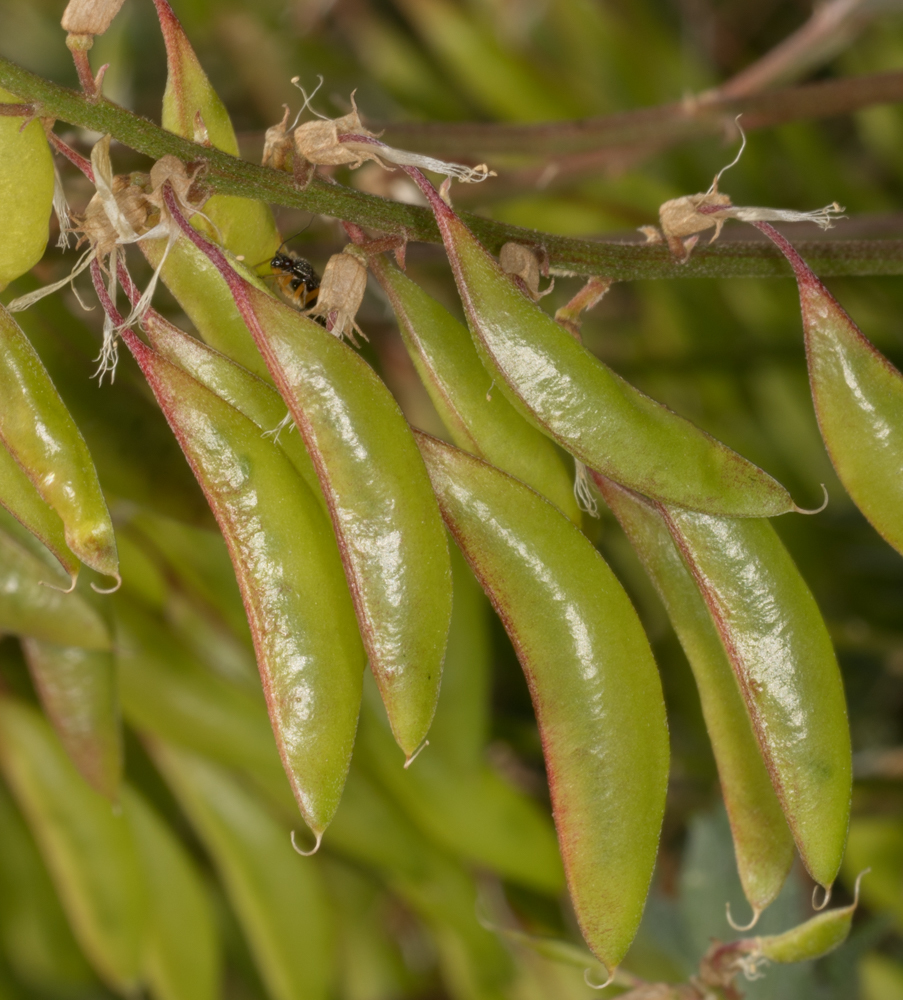
Santa Barbara Milkvetch
Astragalus trichopodus
Astragalus trichopodus is a species of legume known by the common name Santa Barbara milk vetch. It is native to southern California and Baja California, where it grows in several types of open habitat, including in the Transverse Ranges and Mojave Desert.
The species has three subspecies:
From the article Astragalus trichopodus on Wikipedia (CC BY-SA), quoted section by section
Description
This is a robust perennial herb producing a branching stem up to about a meter in maximum height. The hairy stem is lined with many leaves each up to 20 cm (7.9 in) long which are made up of several pairs of widely spaced lance-shaped leaflets each up to 2.5 cm (0.98 in) in length. The inflorescence is a raceme of up to 50 flowers which are cream colored and sometimes tinted with light purple. Each flower is 2 to 3 cm (0.79 to 1.18 in) long including its tubular base of sepals. The species' blooming period is from February to June. The fruit is a laterally compressed, slightly inflated legume pod up to 4 to 5 cm (1.6 to 2.0 in) long which dries to a papery texture. The fruits hang in bunches where they develop from the inflorescence. Each pod contains many seeds.
Range & habitat
The plant is endemic and native to southern California and its range also extends to Baja California. It can be found in coastal sage scrub and grassland communities. It is most commonly found in the months of March, April, and May. Its conservation status is listed as G3, which means it is vulnerable.
Wikipedia: “Distribution and habitat”
What it does
Astragalus trichopodus supports several different species of butterflies and is the host plant for the Reakirt's blue, the arrowhead blue, the marine blue, Queen Alexandra's sulphur, and the critically endangered Palos Verdes blue butterfly. The species was once thought to be the only host plant for Palos Verdes blue butterflies, but larvae have since been found to feed on Acmispon glaber as well.
Wikipedia: “Ecology”
Where it lives
Recorded sightings
—
geo-referenced records in GBIF, from museums, herbaria and field observers.
Drag the globe to turn it. Dots are where records exist, not a range map; darker means more records.
In the stacks
Searching the stacks…
Every page naming Astragalus trichopodus in the Biodiversity Heritage Library →
This page is assembled live from iNaturalist, GBIF, Wikipedia, the Source Library and the Internet Archive. It is not yet part of the hand-edited codex. iNaturalist taxon 75688.