- Plants
- ›Vascular Plants
- ›flowering plants
- ›monocots
- ›Agaves, Orchids, Irises, and Allies
- ›amaryllis, onions, and allies
- ›onion subfamily
- ›Allieae
- ›Allium
- ›Allium
- ›Allium
- ›Oenoprason
- ›Allium vineale
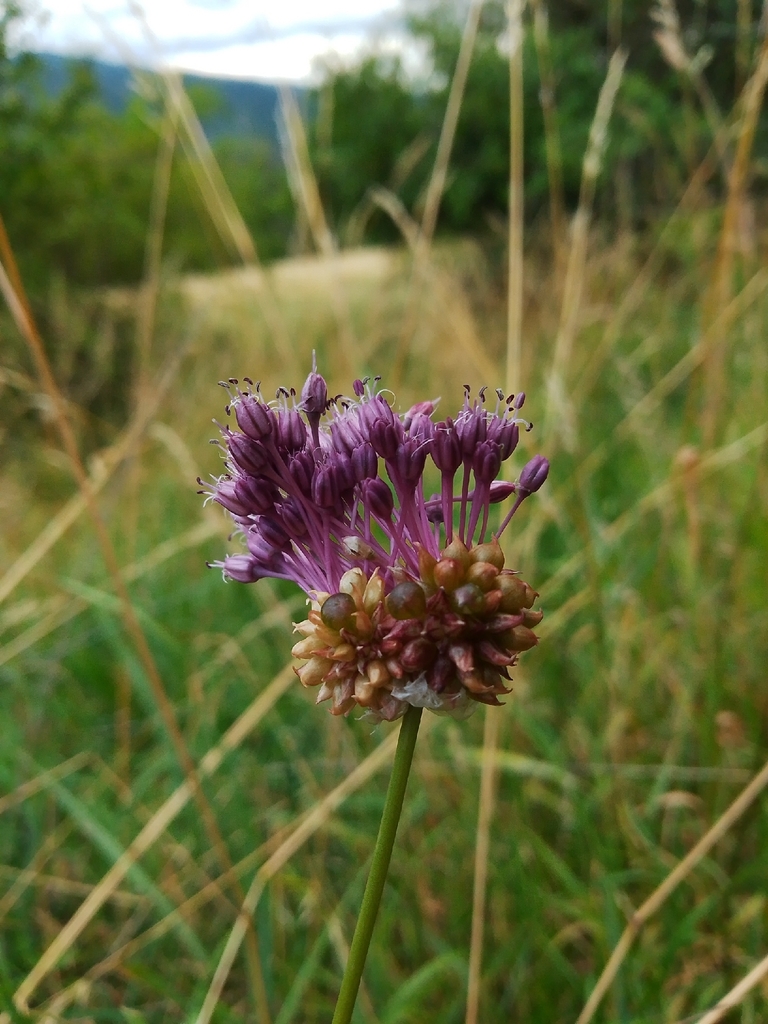
wild garlic
Allium vineale
Allium vineale (wild garlic, onion grass, crow garlic or stag's garlic) is a perennial, bulb-forming species of wild onion, native to Europe, northwestern Africa, and the Middle East. The species was introduced in Australia and North America, where it has become an invasive species.
From the article Allium vineale on Wikipedia (CC BY-SA), quoted section by section
Description
All parts of the plant have a strong garlic smell. The underground bulb is 1–2 cm (0.4–0.8 in) diameter, with a fibrous outer layer. The main (flower) stem grows to 30–120 cm (12–47 in) tall, bearing 2–4 leaves and an apical inflorescence 2–5 cm (0.8–2 in) diameter comprising a number of small bulbils and none to a few flowers, subtended by a basal bract. The leaves are slender hollow tubes, 15–60 cm (6–24 in) long and 2–4 mm thick, with a waxy texture and a groove along the side of the leaf facing the stem. Although similar to the leaves of Allium schoenoprasum (chives), they tend to be more fibrous, have more vertical grooves, and have better defined grooves. The inflorescence is a tight umbel surrounded by a membranous bract in bud which withers when the flowers open. Each individual flower is stalked and has a pinkish-green perianth 2.5 to 4.5 mm (3⁄32 to 3⁄16 in) long. There are six tepals, six stamens and a pistil formed from three fused carpels. Mixed with the flowers are several yellowish-brown bulbils. The fruit is a capsule but the seeds seldom set and propagation usually takes place when the bulbils are knocked off and grow into new plants. Plants with no flowers, only bulbils, are sometimes distinguished as the variety Allium vineale var. …
At the table
The leaves, flowers, and bulbs of Allium vineale are edible. While it has been suggested as a substitute for garlic, there is some difference of opinion as to whether there is an unpleasant aftertaste compared to that of common garlic (Allium sativum). It imparts a garlic-like flavour and odour on dairy and beef products when grazed by livestock. It is considered a pestilential invasive weed in the US, as grain products may become tainted with a garlic odour or flavour in the presence of aerial bulblets at the time of harvest. Wild garlic is tolerant to herbicides, which cannot cling well to the vertical, smooth and waxy structure of its leaves. Allium vineale 'Hair', a cultivated variety, is sold as an ornamental plant in the UK and US. It has unusual flowerheads which have purple centres and green hair-like extensions.
Wikipedia: “Uses and invasiveness”
Where it lives
Recorded sightings
—
geo-referenced records in GBIF, from museums, herbaria and field observers.
Drag the globe to turn it. Dots are where records exist, not a range map; darker means more records.
In the old herbals & bestiaries

De medicinali materia libri sex
Dioscorides · 1552 · p.320

Hortus Eystettensis
Basilius Besler · 1640 · p.70

The Great Herbary with all the figures of the herbs
1532 · p.283

Notable Commentaries on the History of Plants
Leonhart Fuchs · 1542 · p.773

Notable Commentaries on the History of Plants
Leonhart Fuchs · 1542 · p.771

Notable Commentaries on the History of Plants
Leonhart Fuchs · 1542 · p.772

Book of Herbs
Hieronymus Bock (Tragus) · 1546 · p.603

Notable Commentaries on the History of Plants
Leonhart Fuchs · 1549 · p.769

De medicinali materia libri sex
Dioscorides · 1552 · p.321

On the Names of Plants
Hieronymus Bock (Tragus) · 1552 · p.820

Commentaries on the Six Books of Pedanius Dioscorides on Medical Matter
Pietro Andrea Mattioli · 1565 · p.732

History of Rare Plants of Pannonia
Carolus Clusius · 1576 · p.219
In the stacks
Searching the stacks…
Every page naming Allium vineale in the Biodiversity Heritage Library →
This page is assembled live from iNaturalist, GBIF, Wikipedia, the Source Library and the Internet Archive. It is not yet part of the hand-edited codex. iNaturalist taxon 75371.