- Plants
- ›Vascular Plants
- ›flowering plants
- ›Dicots
- ›Sunflowers, Bellflowers, Fanflowers, and Allies
- ›Sunflowers, Daisies, Asters, and Allies
- ›chicories, dandelions, and allies
- ›Lettuce, Chicory, Dandelion and Salsify Tribe
- ›Microseridinae
- ›Agoseris
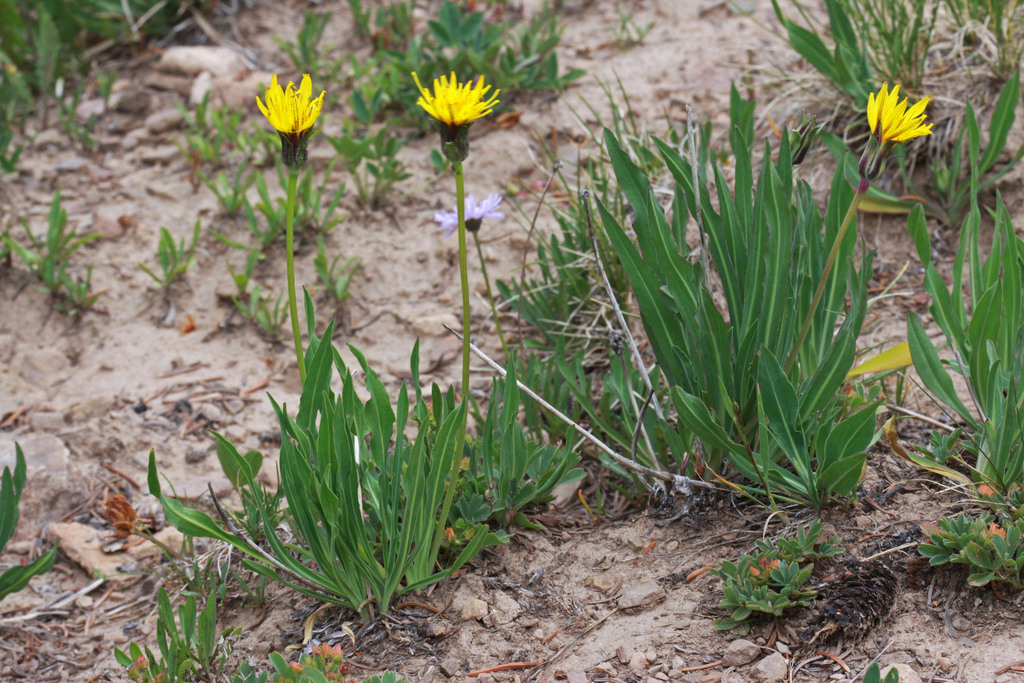
Pale agoseris
Agoseris glauca
Agoseris glauca is a species of flowering plant in the family Asteraceae known by the common names false dandelion, pale agoseris, prairie agoseris, and short-beaked agoseris. It is native to western North America.
From the article Agoseris glauca on Wikipedia (CC BY-SA), quoted section by section
Description
Agoseris glauca is a perennial herb which varies in general appearance. Growing up to 70 centimeters (28 inches), it produces a basal patch of leaves of various shapes which may be as long as the plant is high, but are typically up to 35 cm (14 in). There is no stem, but from May to September the plant flowers in a stemlike inflorescence which is sometimes erect, reaching heights near .5 metres (1+1⁄2 feet) or taller. The flower head is 1–3 cm (1⁄2–1+1⁄4 in) wide with layers of pointed phyllaries. The head is ligulate, bearing many yellow ray florets but no disc florets. The rays may become pinkish with age. The fruit is an achene with a body up to a centimeter long and a pappus, which may be almost 2 cm in length.
Similar species. Other species in the genus known as false dandelion or mountain dandelion, as well as true dandelions, can be distinguished from A. glauca by differences in their fruit.
Range & habitat
The plant is native to western and northwestern North America from Alaska east to the Northwest Territories and Ontario, southeast to California, Arizona, and New Mexico. It grows in many habitat types, usually those which are non-forested.
Wikipedia: “Distribution and habitat”
At the table
The plant contains a bitter milky juice, which solidifies into a substance that can be chewed as gum; this may have been done by some Plains Indians.
Wikipedia: “Uses”
Where it lives
Recorded sightings
—
geo-referenced records in GBIF, from museums, herbaria and field observers.
Drag the globe to turn it. Dots are where records exist, not a range map; darker means more records.
In the stacks
Searching the stacks…
Every page naming Agoseris glauca in the Biodiversity Heritage Library →
This page is assembled live from iNaturalist, GBIF, Wikipedia, the Source Library and the Internet Archive. It is not yet part of the hand-edited codex. iNaturalist taxon 75303.