- Plants
- ›Vascular Plants
- ›flowering plants
- ›Dicots
- ›Legumes, Milkworts, and Allies
- ›Legumes
- ›Acacias, Mimosas, Mesquites, and Allies
- ›Acacia
- ›Phyllodineae
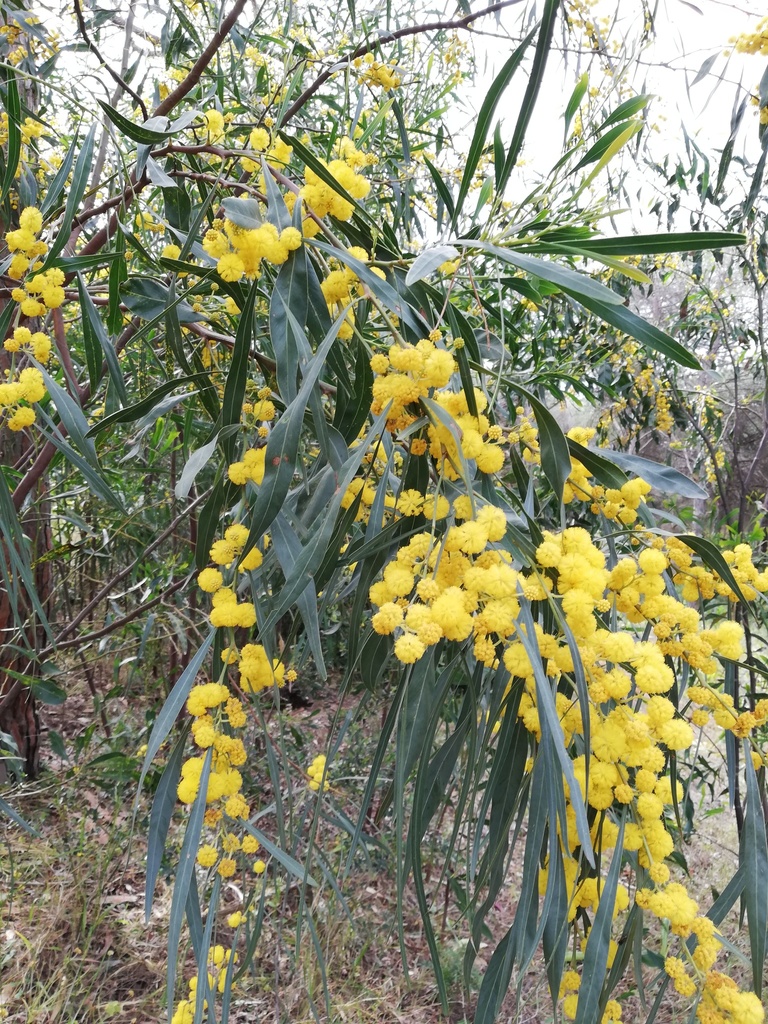
golden wreath wattle
Acacia saligna
Acacia saligna, commonly known by various names including coojong, golden wreath wattle, willow wattle, orange wattle, blue-leafed wattle, Western Australian golden wattle, and, in Africa, Port Jackson willow, is a small tree in the family Fabaceae. Native to Australia, it is widely distributed throughout the south west corner of Western Australia, extending north as far as the Murchison River, and east to Israelite Bay.
The Noongar peoples know the tree as Cujong.
From the article Acacia saligna on Wikipedia (CC BY-SA), quoted section by section
Description
Acacia saligna grows as a small, dense, spreading tree with a short trunk and a weeping habit. It grows up to 8 metres (26 ft) tall. Like many Acacia species, it has phyllodes rather than true leaves; these can be from 8 centimetres (3.1 in) up to 25 centimetres (9.8 in) long. At the base of each phyllode is a nectary gland, which secretes a sugary fluid. This attracts ants, which are believed to reduce the numbers of leaf-eating insects. The yellow flowers appear in late winter and early spring, in groups of up to ten bright yellow spherical flower heads. The fruit is a legume, while the seed is oblong and dark to black in colour. A natural colonizer, Coojong tends to grow wherever soil has been disturbed, such as alongside new roads. Its seeds are distributed by ants, which store them in their nests to eat the seed-stalks. Disturbance of the soil brings them to the surface and allows them to germinate. Seeds germinate readily, and hundreds of seedlings can sometimes be found beneath a single parent tree. It is also extremely vigorous when young, often growing over 1 metre (3 ft 3 in) per year.
At the table
Acacia saligna can be used for multiple purposes, as it grows under a wide range of soil conditions into a woody shrub or tree. It has been used for tanning, revegetation, animal fodder, mine site rehabilitation, firewood, mulch, agroforestry and as a decorative plant. Acacia saligna has been planted extensively in semi-arid areas of Africa, South America and the Middle East as windbreaks and for stabilisation of sand dunes or erosion.
Wikipedia: “Uses”
Where it lives
Recorded sightings
—
geo-referenced records in GBIF, from museums, herbaria and field observers.
Drag the globe to turn it. Dots are where records exist, not a range map; darker means more records.
In the stacks
Searching the stacks…
Every page naming Acacia saligna in the Biodiversity Heritage Library →
This page is assembled live from iNaturalist, GBIF, Wikipedia, the Source Library and the Internet Archive. It is not yet part of the hand-edited codex. iNaturalist taxon 75255.