On eBird ↗
Black-capped Gnatcatcher
Live sightings near you, the range map, bar charts of when it is seen, and Macaulay Library photos and recordings.
Black-capped Gnatcatcher
Polioptila nigriceps
The black-capped gnatcatcher (Polioptila nigriceps) is a small songbird in the family Polioptilidae. It is found in Mexico and the United States.
From the article Black-capped gnatcatcher on Wikipedia (CC BY-SA), quoted section by section
Description
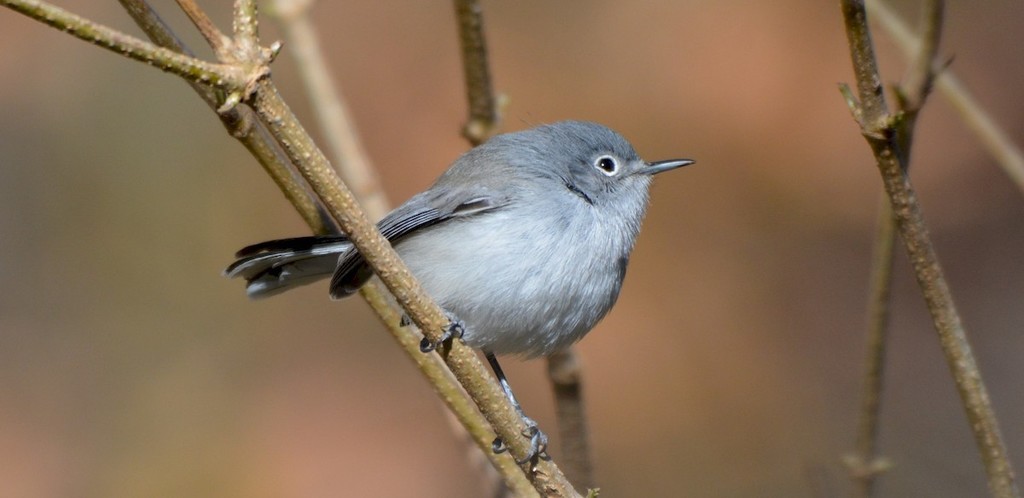
The black-capped gnatcatcher is 10 to 12 cm (3.9 to 4.7 in) long and weighs 5 to 8 g (0.18 to 0.28 oz). Adults are blue-gray on the upperparts with white underparts. They have a long slender bill and a long black tail with mostly white outer feathers. Males in alternate (breeding) plumage have a glossy black cap. The female's gray upperparts have less of a bluish tint but are otherwise similar to the non-breeding male. This species is very similar to the black-tailed gnatcatcher (P. melanura).
Range & habitat
The nominate black-capped gnatcatcher is found in western Mexico from central Sinaloa south to Colima. P. n. restricta is found mostly in western Mexico from eastern Sonora south to northern Sinaloa. It has occasionally nested just across the U.S. border in the Madrean sky islands area of southernmost Arizona. In the northern part of its range it inhabits mesquite thickets near riparian corridors. To the south it inhabits thorn scrub and arid deciduous woodlands. In elevation it occurs mostly below 500 m (1,600 ft). The species is primarily non-migratory, though the northernmost birds might move south after breeding.
Wikipedia: “Distribution and habitat”
What it does
The black-capped gnatcatcher's diet has not been documented. It is assumed to be arthropods like the diets of other gnatcatchers. They forage actively in trees or shrubs, gleaning foliage and sometimes sallying to catch insects.
Wikipedia: “Feeding”
Listen
Looking for field recordings…
Where it lives
Recorded sightings
—
geo-referenced records in GBIF, from museums, herbaria and field observers.
Drag the globe to turn it. Dots are where records exist, not a range map; darker means more records.
In the stacks
Searching the stacks…
Every page naming Polioptila nigriceps in the Biodiversity Heritage Library →
This page is assembled live from iNaturalist, GBIF, Wikipedia, the Source Library and the Internet Archive. It is not yet part of the hand-edited codex. iNaturalist taxon 7491.