On eBird ↗
Fasciated Wren
Live sightings near you, the range map, bar charts of when it is seen, and Macaulay Library photos and recordings.
Fasciated Wren
Campylorhynchus fasciatus
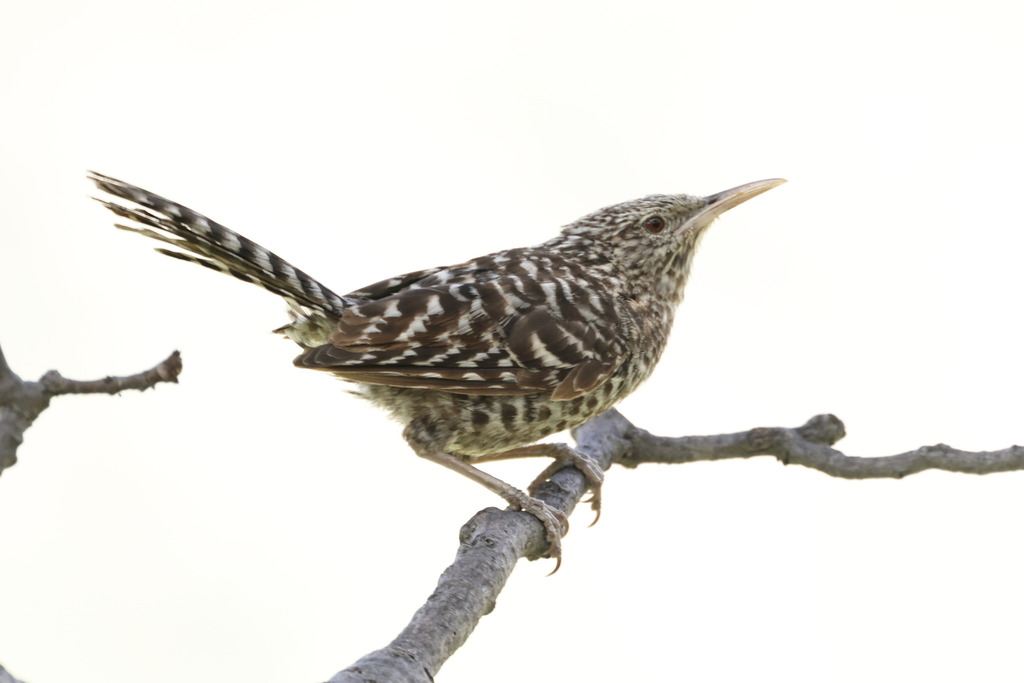
The fasciated wren (Campylorhynchus fasciatus) is a species of bird in the family Troglodytidae. It is found in Ecuador and Peru. Its natural habitats are subtropical or tropical dry forests, subtropical or tropical moist lowland forests, subtropical or tropical dry shrubland, and subtropical or tropical high-altitude shrubland.
From the article Fasciated wren on Wikipedia (CC BY-SA), quoted section by section
Description
The fasciated wren is approximately 19 cm (7.5 in) long; one female weighed 24.9 g (0.88 oz). Both sexes of the nominate have a gray crown, grayish supercilium, and dark gray shoulders, back, and rump. The shoulders have whitish speckles and the rump whitish bars. The tail is barred off-white and blackish brown. The chin is off-white with darker streaks. The whitish chest and belly have heavy dark gray spots and the flanks are barred with dark gray. C. f. pallescens is paler with less distinct markings on the underside. The juvenile also has less well defined markings on its underside.
Range & habitat
The nominate fasciated wren is found in coastal Peru from the Department of Piura south to the Department of Lima and also inland Peru from the departments of Cajamarca and Amazonas south to the Department of Huánuco. C. f. pallescens is found from southwestern and southern Ecuador into Peru's departments of Tumbes and Piura. The fasciated wren primarily inhabits arid and semi-arid landscapes such as thorny scrublands. It also occurs in citrus orchards and other areas that humans have heavily modified. In Ecuador it uses more humid habitat including deciduous forest. In elevation the species is usually found between sea level and 1,500 m (4,920 ft) but can be found as high as 2,500 m (8,200 ft).
Wikipedia: “Distribution and habitat”
What it does
The fasciated wren's diet is principally invertebrates but also includes some vegetable matter. It forages in groups, mostly in bushes and shrubs but sometimes on the ground.
Wikipedia: “Feeding”
Listen
Looking for field recordings…
Where it lives
Recorded sightings
—
geo-referenced records in GBIF, from museums, herbaria and field observers.
Drag the globe to turn it. Dots are where records exist, not a range map; darker means more records.
In the stacks
Searching the stacks…
Every page naming Campylorhynchus fasciatus in the Biodiversity Heritage Library →
This page is assembled live from iNaturalist, GBIF, Wikipedia, the Source Library and the Internet Archive. It is not yet part of the hand-edited codex. iNaturalist taxon 7484.