- Animals
- ›Chordates
- ›Vertebrates
- ›Mammals
- ›Therians
- ›Placental Mammals
- ›Primates, Rodents, and Allies
- ›Primates
- ›Monkeys, Apes, and Tarsiers
- ›Monkeys and Apes
- ›Apes and Old World Monkeys
- ›Old World Monkeys
- ›Cercopithecines
- ›Baboons, Macaques, and Mangabeys
- ›Papio
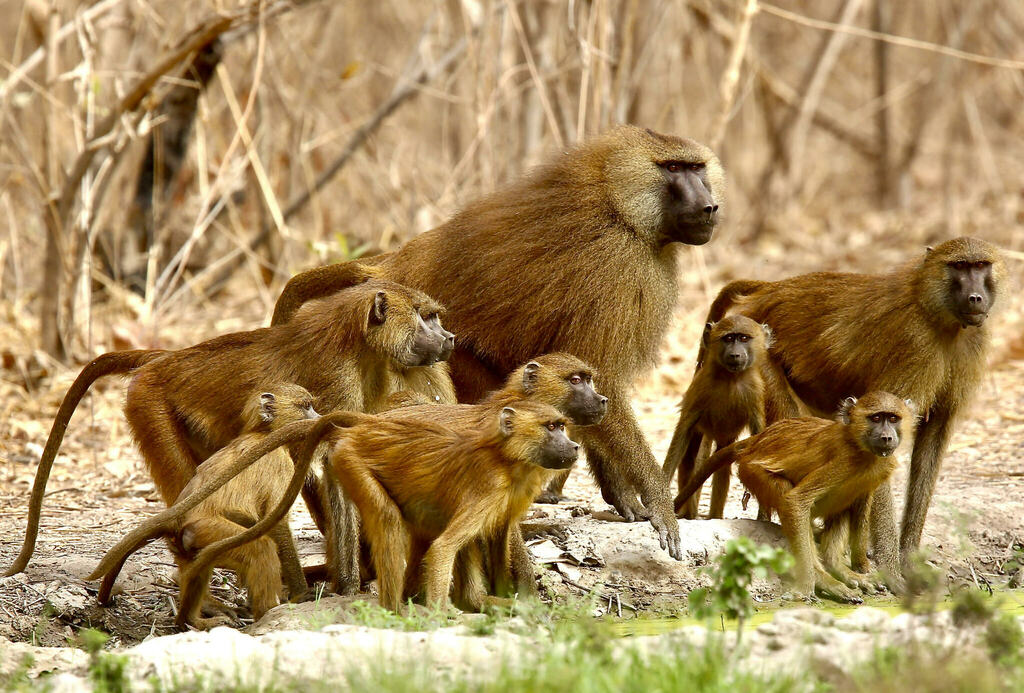
Guinea Baboon
Papio papio
The Guinea baboon (Papio papio) is a baboon from the Old World monkey family. Some (older) classifications list only two species in the genus Papio, this one and the hamadryas baboon. In those classifications, all other Papio species are considered subspecies of P. papio and the species is called the savanna baboon.
The Guinea baboon inhabits a small area in western Africa. Its range includes Guinea, Senegal, Gambia, southern Mauritania and western Mali. Its habitat includes dry forests, gallery forests, and adjoining bush savannas or steppes. It has reddish-brown hair, a hairless, dark-violet or black face with the typical dog-like muzzle, which is surrounded by a small mane, and a tail carried in a round arc. It also has limb modifications that allow it to walk long distances on the ground. The Guinea baboon is one of the smallest baboon species, weighing between 13 and 26 kg (28.6–57 lbs). Their life spans are generally between 20 and 50 years.
From the article Guinea baboon on Wikipedia (CC BY-SA), quoted section by section
Range & habitat
Generally found in woodland savannas, Guinea baboons seasonally congregate near permanent water sources, breaking off in the wet season into smaller groups. Although baboon species are all allopatric, some of their ranges do overlap, and interbreeding does occasionally occur. These baboons are found in a wide range across Africa in savannah habitats including Guinea, Senegal, Gambia, southern Mauritania and western Mali. Most typically they are in the savannah and forests of sub-Saharan Africa. They can also be found in grasslands, rain forests, and other open areas.
Wikipedia: “Habitat and distribution”
What it does
Guinea baboons are diurnal, living on the ground instead of in trees, and typically sleep in trees at the terminal ends of branches. Their group size is widely variable and ranges from 30 to 200. However, the most common troop size is 30–40 individuals. Often, a pronounced male hierarchy and fierce competition for females happens within the group. This competition leads to sexual dimorphism among the species. When it comes to feeding, they are independent foragers, and females are always paired with males when foraging so they can be protected. Females may choose to follow the same males from year to year.
Diet. Like other baboon species, Guinea baboons will eat any available foods, but their main sources are fruits, roots, tubers, grass, seeds and leaves. They also will eat insects, worms, spiders, small mammals, birds and invertebrates.
Wikipedia: “Ecology”
Listen
Looking for field recordings…
Where it lives
Recorded sightings
—
geo-referenced records in GBIF, from museums, herbaria and field observers.
Drag the globe to turn it. Dots are where records exist, not a range map; darker means more records.
In the stacks
Searching the stacks…
Every page naming Papio papio in the Biodiversity Heritage Library →
This page is assembled live from iNaturalist, GBIF, Wikipedia, the Source Library and the Internet Archive. It is not yet part of the hand-edited codex. iNaturalist taxon 74833.