On eBird ↗
Yucatan Wren
Live sightings near you, the range map, bar charts of when it is seen, and Macaulay Library photos and recordings.
Yucatán Wren
Campylorhynchus yucatanicus
The Yucatan wren (Campylorhynchus yucatanicus) is a species of bird in the Troglodytidae family. It is endemic to Mexico. Its natural habitat is subtropical or tropical dry shrubland, and it is only found on the narrow coastal strip of the northern Yucatán Peninsula. One of the key habitats of this species is the Petenes mangroves ecoregion of the Yucatan coast. It is threatened by habitat destruction.
From the article Yucatan wren on Wikipedia (CC BY-SA), quoted section by section
Description
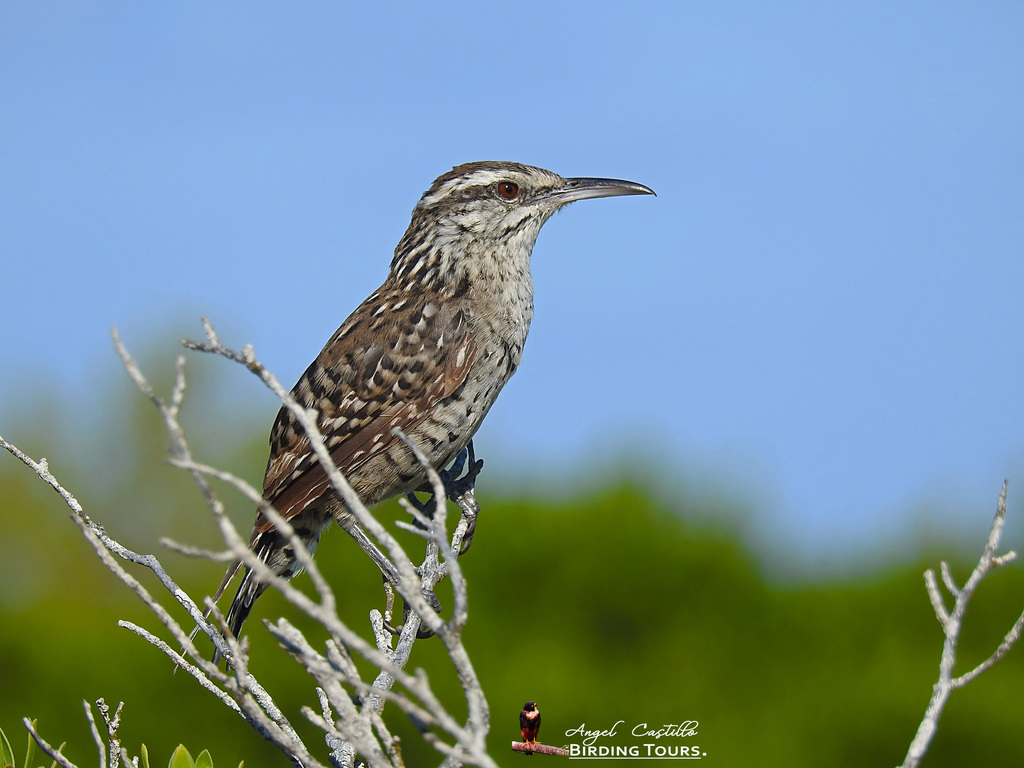
The adult Yucatan wren is a small species about 18 centimetres (7 in) long. The face is whitish with a dark eye-stripe, and the crown is greyish brown. The upper parts are brown streaked with black and white, and the wings are brown and barred with dark brown and white. The tail is black barred with grey, with white tips to some of the outer feathers. The underparts are whitish with a dark cheek stripe and blackish spotting and barring. The juvenile is similar in appearance to the adult but with less contrast between the upper and underparts.
Range & habitat
The Yucatan wren is endemic to a coastal strip of the Yucatan peninsula. It can be found in arid areas with scrub, large cacti, and pastureland edges. Its breeding range is even more restricted to a strip about one kilometre wide, edging the mangrove forests which fringe the coast.
Wikipedia: “Distribution and habitat”
What it does
The Yucatan wren is usually seen in pairs or small family groups and forages among the foliage and on the ground. Its diet is unknown. The Yucatan wren starts nest-building activities in April, but eggs are laid in June. The nests are globular grass structures with side entrances. They are built a few metres off the ground in coastal scrub and the borders of the black mangrove (Avicennia germinans) forest, which thrives along the region's coasts. Clutch size averages three eggs, and both parents help rear the chicks. A third adult has been observed feeding the chicks occasionally, an example of cooperative breeding.
Wikipedia: “Ecology”
Listen
Looking for field recordings…
Where it lives
Recorded sightings
—
geo-referenced records in GBIF, from museums, herbaria and field observers.
Drag the globe to turn it. Dots are where records exist, not a range map; darker means more records.
In the stacks
Searching the stacks…
Every page naming Campylorhynchus yucatanicus in the Biodiversity Heritage Library →
This page is assembled live from iNaturalist, GBIF, Wikipedia, the Source Library and the Internet Archive. It is not yet part of the hand-edited codex. iNaturalist taxon 7481.