- Animals
- ›Chordates
- ›Vertebrates
- ›Mammals
- ›Therians
- ›Placental Mammals
- ›Ungulates, Carnivorans, and Allies
- ›Bats
- ›Yangochiroptera
- ›Vespertilionoid Bats
- ›Funnel-eared Bats
- ›Natalus
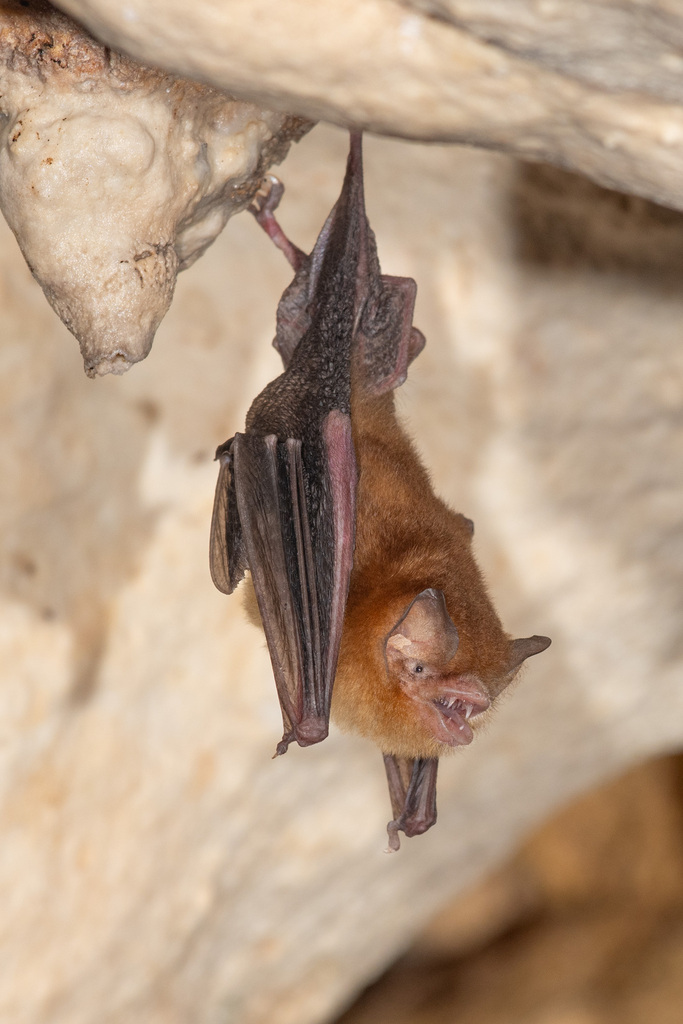
Hispaniolan Greater Funnel-eared Bat
Natalus major
The Hispaniolan greater funnel-eared bat (Natalus major) is a funnel-eared bat species endemic to the island of Hispaniola (in both the Dominican Republic and Haiti) in the Caribbean. First described in 1902, it has a complex taxonomic history, with some authors identifying multiple subspecies, now recognised as the separate species Natalus primus and Natalus jamaicensis, and others considering Natalus major to be itself a subspecies of Natalus stramineus. It lives primarily in caves and feeds on insects.
From the article Hispaniolan greater funnel-eared bat on Wikipedia (CC BY-SA), quoted section by section
Description
The Hispaniolan greater funnel-eared bat is similar in appearance to a larger version of the Mexican funnel-eared bat (Natalus stramineus). The two species have such similar morphology that in his original description of the Hispaniolan greater funnel-eared bat, Miller declined to offer a description of its physical appearance, writing "Except for its greater size, Natalus major so closely resembles specimens of N. stramineus from Dominica as to require no detailed description." The Hispaniolan greater funnel-eared bat has a forearm length of between 40 and 45 millimetres (1.6 and 1.8 in). The fur covering the body of the species is soft and moderately long, with a wool-like texture at the base. The upperparts are tawny-olive, while the underparts, and the base of the hairs, are pink-buff. The membranes on the wing are umber. The large natalid organ (the structure located on the forehead) is bell-shaped. No sexual dimorphism is apparent.
Range & habitat
The species is found widely throughout the island of Hispaniola, in both the Dominican Republic and Haiti. Previous reports of the species from Jamaica and other islands are now recognised as records of separate species. For the most part, the species is found in caves, though a record from a hollow tree is also known. Due to the delicate wing membrane, it is assumed that the species requires relatively humid caves for daytime roosting. The Hispaniolan greater funnel-eared bat is insectivorous, like all members of its genus. Individuals are assumed to forage in dense vegetation over a limited range near their preferred roost. No information on reproduction is known.
Wikipedia: “Distribution, habitat and ecology”
Listen
Looking for field recordings…
Where it lives
Recorded sightings
—
geo-referenced records in GBIF, from museums, herbaria and field observers.
Drag the globe to turn it. Dots are where records exist, not a range map; darker means more records.
In the stacks
Searching the stacks…
Every page naming Natalus major in the Biodiversity Heritage Library →
This page is assembled live from iNaturalist, GBIF, Wikipedia, the Source Library and the Internet Archive. It is not yet part of the hand-edited codex. iNaturalist taxon 74730.