- Animals
- ›Chordates
- ›Vertebrates
- ›Mammals
- ›Therians
- ›Placental Mammals
- ›Ungulates, Carnivorans, and Allies
- ›Bats
- ›Yangochiroptera
- ›Vespertilionoid Bats
- ›Funnel-eared Bats

Natalus
The genus Natalus of funnel-eared bats is found from Mexico to Brazil and the Caribbean islands. They are slender bats with unusually long tails and, as their name suggests, funnel-shaped ears. They are small, at only 3.5 to 5.5 cm in length, with brown, grey, yellow, or reddish fur. Their tail is completely enclosed in the interfemoral membrane. Adult males have a natalid organ, a large glad-like organ, on the muzzle or face. Their skulls are delicate and extended. They have swollen, rounded braincase and narrow, somewhat tubular rostrum. They have nineteen teeth on both sides, with two upper and three lower being incisors, one upper and lower canine, three upper and lower premolars, and three upper and lower molars. Like many other bats, they are insectivorous, and roost in caves. The genus is similar to the Furipteridae and Thyropteridae genera. All three genera have mostly the same geographic ranges.
Eight species belong to this genus, with cranial and external differences:
7 branches of this genus, most-observed first · about 7 known species

Mexican Greater Funnel-eared Bat
speciesNatalus mexicanus

Trinidadian Funnel-eared Bat
speciesNatalus tumidirostris

Brazilian Funnel-eared Bat
speciesNatalus macrourus

Mexican Funnel-eared Bat
speciesNatalus stramineus
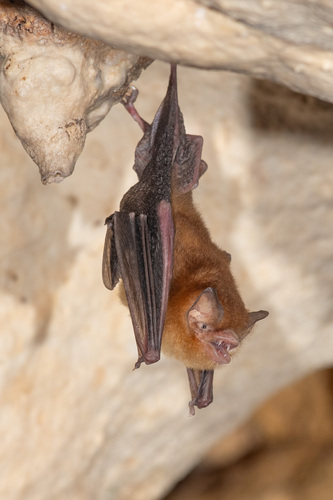
Hispaniolan Greater Funnel-eared Bat
speciesNatalus major
Cuban Greater Funnel-eared Bat
speciesNatalus primus
Jamaican Greater Funnel-eared Bat
speciesNatalus jamaicensis
Where it lives
Recorded sightings
—
geo-referenced records in GBIF, from museums, herbaria and field observers.
Drag the globe to turn it. Dots are where records exist, not a range map; darker means more records.
In the stacks
Searching the stacks…
Every page naming Natalus in the Biodiversity Heritage Library →
This page is assembled live from iNaturalist, GBIF, Wikipedia, the Source Library and the Internet Archive. It is not yet part of the hand-edited codex. iNaturalist taxon 41202.