- Animals
- ›Chordates
- ›Vertebrates
- ›Mammals
- ›Therians
- ›Placental Mammals
- ›Ungulates, Carnivorans, and Allies
- ›Carnivorans
- ›Mustelids
- ›Weasels
- ›Mustela
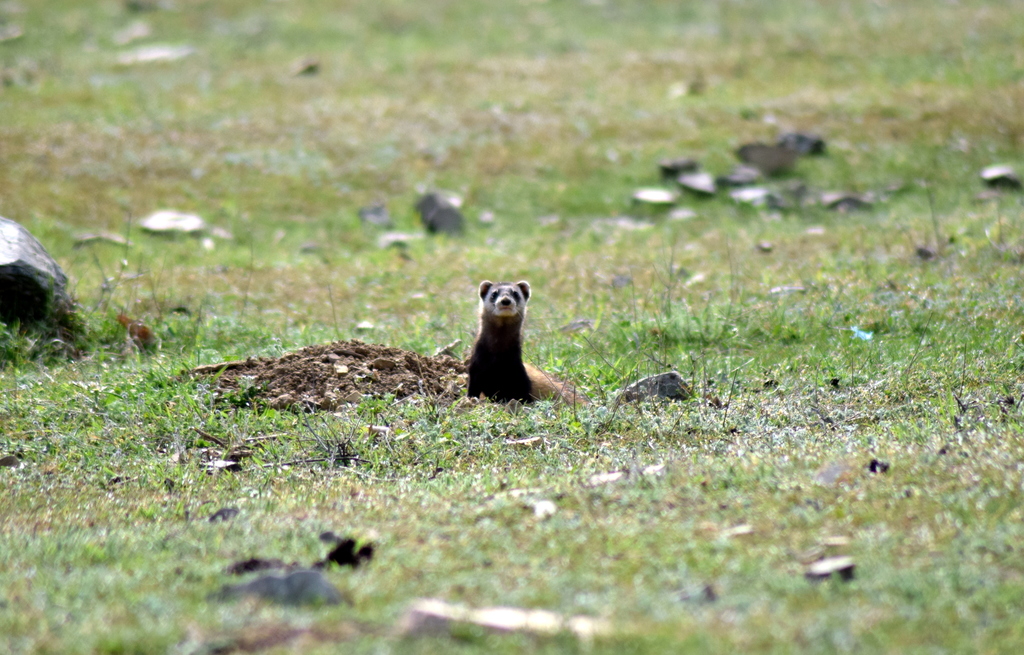
Steppe Polecat
Mustela eversmanii
The steppe polecat (Mustela eversmanii), also known as the white or masked polecat, is a species of mustelid native to Central and Eastern Europe and Central and East Asia. It is listed as Least Concern on the IUCN Red List because of its wide distribution, occurrence in a number of protected areas, and tolerance to some degree of habitat modification.
It is generally of a very light yellowish colour, with dark limbs and a dark mask across the face. Compared to its relative, the European polecat, the steppe polecat is larger in size and has a more powerfully built skull.
From the article Steppe polecat on Wikipedia (CC BY-SA), quoted section by section
Description
The steppe polecat is very close to the European polecat in general appearance, proportions and habits, though its body seems somewhat more elongated, due to its shorter guard hairs. The tail is short, constituting a third of its body length. The skull is heavier and more massive than that of the European polecat, having more widely spaced zygomatic arches and more strongly developed projections, particularly the sagittal crest. It greatly resembles the black-footed ferret of North America, with the only noticeable differences between them being the steppe polecat's much longer and softer fur, shorter ears, and shorter postmolar extension of the palate. It has four pairs of teats and well-developed anal glands, which can produce a sharp-smelling liquid which is sprayed in self-defence. Males measure 320–562 mm (12.6–22.1 in) in body length, while females measure 290–520 mm (11–20 in). Tail length of males is 80–183 mm (3.1–7.2 in) and 70–180 mm (2.8–7.1 in) for females. Males in Siberia may weigh up to 2.0 kg (4.5 lbs.), while females weigh 1.4 kg (3.0 lbs.). One giant polecat from Semirechye had a body length of about 775 mm (30.5 in). …
Range & habitat
The steppe polecat occurs from Central and Eastern Europe in the west through southern Russia, northern Georgia, Kazakhstan, Turkmenistan, Uzbekistan, Tajikistan, and Kyrgyzstan to Mongolia and northern and western China. In 2014, it has been recorded at an elevation of 5,050 m (16,570 ft) in Upper Mustang, Annapurna Conservation Area, Nepal.
Wikipedia: “Distribution and habitat”
What it does
The steppe polecat does not hold sharply defined home ranges. During warm seasons, especially in areas rich in ground squirrels, aged polecats hold relatively stable territories until they have extirpated their prey. Younger polecats are less sedentary, and will sleep overnight in the burrows of ground squirrels they have killed. Females nursing their litters are the most settled, but will begin roaming once the kits are old enough to accompany them. Generally, the steppe polecat only occupies one home range for a few days or up to a few months. In winter, the steppe polecat is more active and moves 12–18 km (7.5–11.2 mi) a day. During heavy snowfall, the steppe polecat migrates to more favourable areas, such as along the slopes of steppe ravines, near settlements and winter encampments. The species does not usually dig its own burrow, instead using those of marmots, ground squirrels, hamsters, moles, voles, jerboas and others, after slightly widening them. Its burrow is often poorly constructed, as it does not inhabit one long enough to warrant restructuring. Nesting burrows are not lined, and have many outlets, ranging from three to 20. Alongside the nest chamber is a food store. Independently dug burrows are typically shallow and simple in construction.
Wikipedia: “Territorial and sheltering behaviours”
Listen
Looking for field recordings…
Where it lives
Recorded sightings
—
geo-referenced records in GBIF, from museums, herbaria and field observers.
Drag the globe to turn it. Dots are where records exist, not a range map; darker means more records.
In the stacks
Searching the stacks…
Every page naming Mustela eversmanii in the Biodiversity Heritage Library →
This page is assembled live from iNaturalist, GBIF, Wikipedia, the Source Library and the Internet Archive. It is not yet part of the hand-edited codex. iNaturalist taxon 74670.