- Animals
- ›Chordates
- ›Vertebrates
- ›Mammals
- ›Therians
- ›Placental Mammals
- ›Ungulates, Carnivorans, and Allies
- ›Even-toed Ungulates and Cetaceans
- ›Ruminants
- ›Deer
- ›Plesiometacarpal Deer
- ›Muntjacs and Tufted Deer
- ›Muntiacus
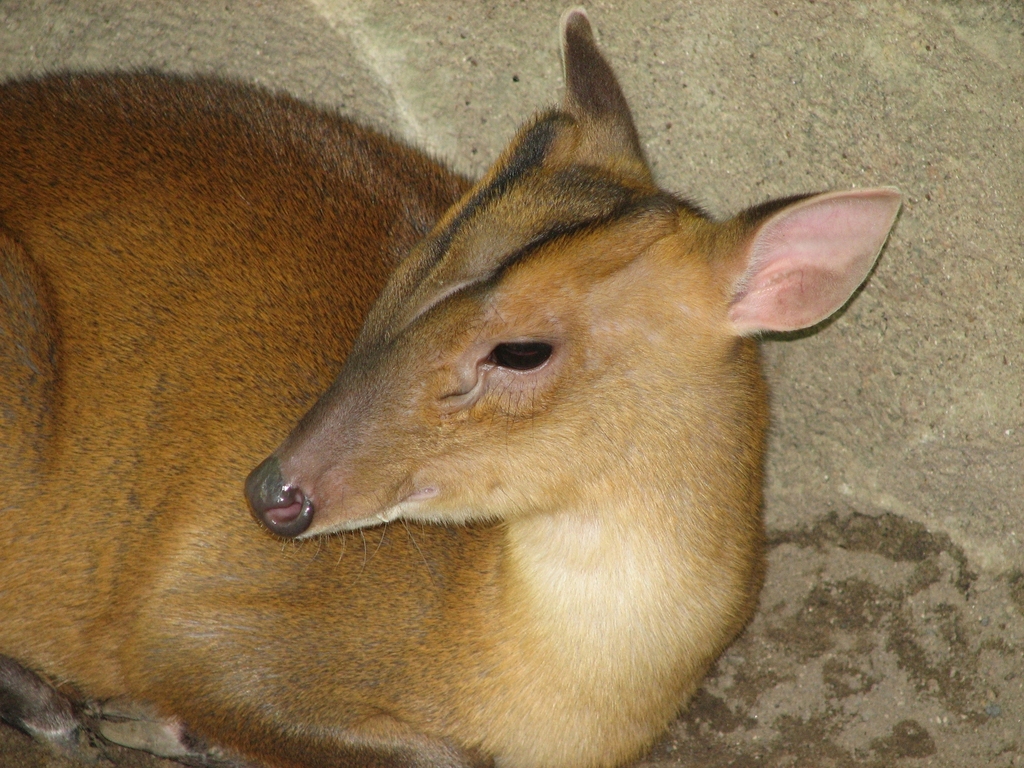
Large-antlered Muntjac
Muntiacus vuquangensis
The giant muntjac (Muntiacus vuquangensis), sometimes referred to as the large-antlered muntjac, is a species of muntjac deer. It is the largest muntjac species and was discovered in 1994 in Vũ Quang, Hà Tĩnh Province of Vietnam and in central Laos. During inundation of the Nakai Reservoir in Khammouane Province of Laos for the Nam Theun 2 Multi-Purpose Project, 38 giant muntjac were captured, studied, and released into the adjacent Nakai-Nam Theun National Protected Area. Subsequent radio-tracking of a sample of these animals showed the relocation was successful. The species is also located in parts of eastern Cambodia, as well as the Annamite Mountains (Trường Sơn Mountains).
The giant muntjac is commonly found in evergreen forests and weighs about 66–110 lb (30–50 kg). It has a red-brown coat and is an even-toed ungulate. Due to slash-and-burn agriculture, combined with hunting, the giant muntjac is considered critically endangered. It is preyed upon by animals such as the tiger and leopard. It is most closely related to Muntiacus muntjak (common muntjac).
Listen
Looking for field recordings…
Where it lives
Recorded sightings
—
geo-referenced records in GBIF, from museums, herbaria and field observers.
Drag the globe to turn it. Dots are where records exist, not a range map; darker means more records.
In the stacks
Searching the stacks…
Every page naming Muntiacus vuquangensis in the Biodiversity Heritage Library →
This page is assembled live from iNaturalist, GBIF, Wikipedia, the Source Library and the Internet Archive. It is not yet part of the hand-edited codex. iNaturalist taxon 74660.