On eBird ↗
Brown Creeper
Live sightings near you, the range map, bar charts of when it is seen, and Macaulay Library photos and recordings.
Brown Creeper
Certhia americana
The brown creeper (Certhia americana), also known as the American treecreeper, is a small songbird, the only North American member of the treecreeper family Certhiidae.
From the article Brown creeper on Wikipedia (CC BY-SA), quoted section by section
Description
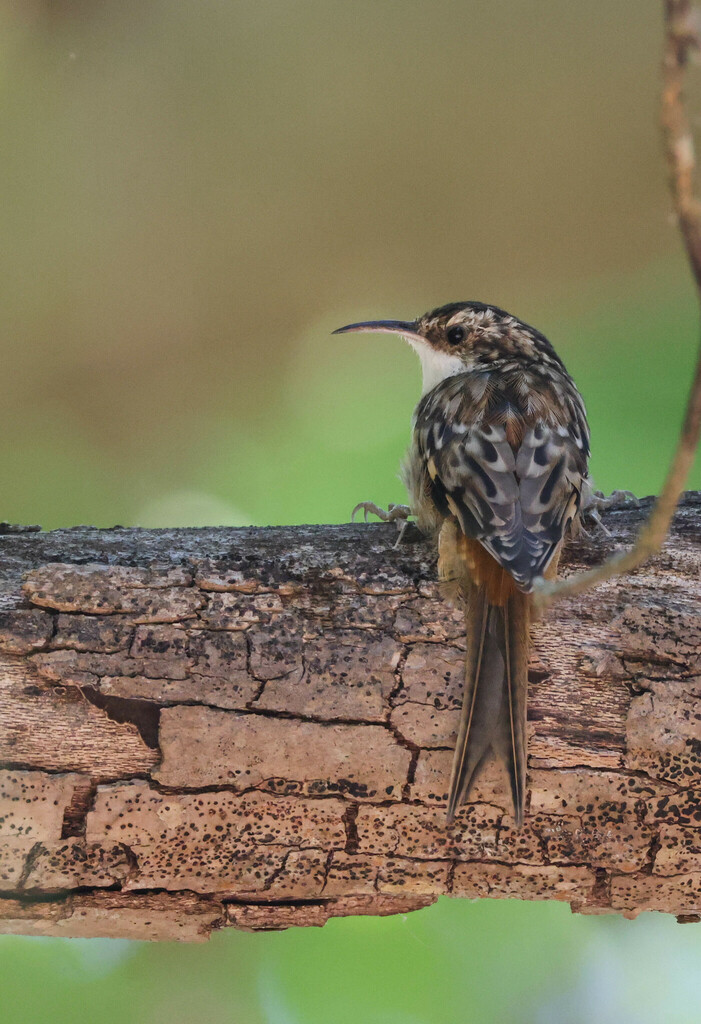
Adults are brown on the upper parts with light spotting, resembling a piece of tree bark, with white underparts. They have a long thin bill with a slight downward curve and a long stiff tail used for support as the bird creeps upwards. The male creeper has a slightly larger bill than the female. Brown creepers are smaller than white-breasted nuthatches but larger than golden-crowned kinglets. Measurements:
Length: 4.7–5.5 in (12–14 cm) Weight: 0.2–0.3 oz (5.7–8.5 g) Wingspan: 6.7–7.9 in (17–20 cm) Its voice includes single very high pitched, short, often insistent, piercing calls; see, or swee. The song often has a cadence like; pee pee willow wee or see tidle swee, with notes similar to the calls. Creepers in California have songs of four to nine syllables, except in the San Bernardino Mountains, where there are as many as nine to thirteen syllables per song, but within the same two second time frame. This species's avoidance of edges, cryptic plumage, and high-pitched vocalizations contribute to a low survey detection rate compared to other species.
Range & habitat
Brown creepers are both migratory and year-round residents in North America. Their breeding habitat is mature forests, especially conifers, in Canada, Alaska and the northeastern and western United States, and they are non-breeding in the southern part of the United States. They are permanent residents through much of their range; many northern birds migrate to the southern half of the United States. Brown creepers have occurred as vagrants to Bermuda and Central America's mountains in Guatemala, Honduras and the northern cordillera of El Salvador. Since 1966 the brown creeper has experienced a yearly 1.5% population increase throughout the northeastern and northwestern (Pacific coast) regions of its range. The first breeding brown creepers in the Northwest Territories were detected in 2008, in the Liard Valley, which may be a result of northern range expansion. As a migratory species with a northern range, this species is a conceivable vagrant to western Europe. However, it is intermediate in its characteristics between common treecreeper and short-toed treecreeper, and has sometimes in the past been considered a subspecies of the former, although its closest relative seems to be the latter (Tietze et al., 2006). …
Wikipedia: “Distribution, habitat and range”
What it does
Brown creepers forage on tree trunks and branches, typically zig-zagging upwards from the bottom of a tree trunk, and then flying down to the bottom of another tree. They creep slowly with their body flattened against the bark, probing with their beak for insects. They will rarely feed on the ground. They mainly eat small arthropods found in the bark, but sometimes they will eat seeds in winter.
Wikipedia: “Behavior”
Listen
Looking for field recordings…
Where it lives
Recorded sightings
—
geo-referenced records in GBIF, from museums, herbaria and field observers.
Drag the globe to turn it. Dots are where records exist, not a range map; darker means more records.
In the stacks
Searching the stacks…
Every page naming Certhia americana in the Biodiversity Heritage Library →
This page is assembled live from iNaturalist, GBIF, Wikipedia, the Source Library and the Internet Archive. It is not yet part of the hand-edited codex. iNaturalist taxon 7458.