On eBird ↗
Eurasian Treecreeper
Live sightings near you, the range map, bar charts of when it is seen, and Macaulay Library photos and recordings.
Eurasian Treecreeper
Certhia familiaris
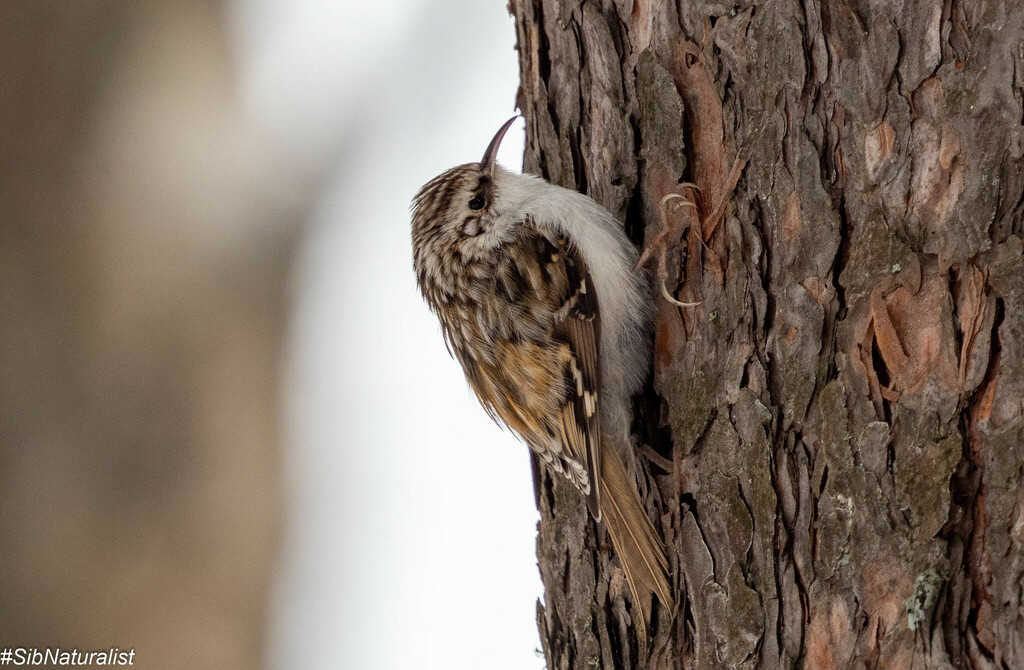
The Eurasian treecreeper or common treecreeper (Certhia familiaris) is a small passerine bird also known in the British Isles, where it is the only living member of its genus, simply as treecreeper. It is similar to other treecreepers, and has a curved bill, patterned brown upperparts, whitish underparts, and long stiff tail feathers which help it creep up tree trunks. It can be most easily distinguished from the similar short-toed treecreeper, which shares much of its European range, by its different song.
The Eurasian treecreeper has nine or more subspecies which breed in different parts of its range in the Palearctic. This species is found in woodlands of all kinds, but where it overlaps with the short-toed treecreeper in western Europe it is more likely to be found in coniferous forests or at higher altitudes. It nests in tree crevices or behind bark flakes, and favours introduced giant sequoia as nest sites where they are available. The female typically lays five or six pink-speckled white eggs in the lined nest, but eggs and chicks are vulnerable to attack by woodpeckers and mammals, including squirrels.
From the article Eurasian treecreeper on Wikipedia (CC BY-SA), quoted section by section
Description
Similar in appearance, all treecreepers are small birds with streaked and spotted brown upperparts, rufous rumps and whitish underparts. They have long decurved bills, and long rigid tail feathers that provide support as they creep up tree trunks looking for insects. The Eurasian treecreeper is 12.5 cm (4.9 in) long and weighs 7.0–12.9 g (0.25–0.46 oz). It has warm brown upperparts intricately patterned with black, buff and white, and a plain brown tail. Its belly, flanks and vent area are tinged with buff. The sexes are similar, but the juvenile has duller upperparts than the adult, and its underparts are dull white with dark fine spotting on the flanks. The contact call is a very quiet, thin and high-pitched sit, but the most distinctive call is a penetrating tsree, with a vibrato quality, sometimes repeated as a series of notes. The male's song begins with srrih, srrih followed in turn by a few twittering notes, a longer descending ripple, and a whistle that falls and then rises. The range of the Eurasian treecreeper overlaps with that of several other treecreepers, which can present local identification problems. In Europe, the Eurasian treecreeper shares much of its range with the short-toed treecreeper. Compared to that species, it is whiter below, warmer and more spotted above, and has a whiter supercilium and slightly shorter bill. …
Range & habitat
The Eurasian treecreeper is the most widespread member of its genus, breeding in temperate woodlands across the Palearctic from Ireland to Japan. It prefers mature trees, and in most of Europe, where it shares its range with short-toed treecreeper, it tends to be found mainly in coniferous forest, especially spruce and fir. However, where it is the only treecreeper, as in European Russia, or the British Isles, it frequents broadleaved or mixed woodland in preference to conifers. It is also found in parks and large gardens. The Eurasian treecreeper breeds down to sea level in the north of its range, but tends to be a highland species further south. In the Pyrenees it breeds above 1,370 metres (4,490 feet), in China from 400–2,100 metres (1,300–6,900 ft) and in southern Japan from 1,065–2,135 metres (3,494–7,005 ft). The breeding areas have July isotherms between 14–16 °C and 23–24 °C (73–75 °F) and 72–73 °F). The Eurasian treecreeper is non-migratory in the milder west and south of its breeding range, but some northern birds move south in winter, and individuals breeding on mountains may descend to a lower altitude in winter. Winter movements and post-breeding dispersal may lead to vagrancy outside the normal range. …
Wikipedia: “Distribution and habitat”
What it does
The Eurasian treecreeper typically seeks invertebrate food on tree trunks, starting near the tree base and working its way up using its stiff tail feathers for support. Unlike a nuthatch, it does not come down trees head first, but flies to the base of another nearby tree. It uses its long thin bill to extract insects and spiders from crevices in the bark. Although normally found on trees, it will occasionally hunt prey items on walls, bare ground, or amongst fallen pine needles, and may add some conifer seeds to its diet in the colder months. The female Eurasian treecreeper forages primarily on the upper parts of the tree trunks, while the male uses the lower parts. A study in Finland found that if a male disappears, the unpaired female will forage at lower heights, spend less time on each tree and have shorter foraging bouts than a paired female. This bird may sometimes join mixed-species feeding flocks in winter, but it does not appear to share the resources found by accompanying tits and goldcrests, and may just be benefiting from the extra vigilance of a flock. Wood ants share the same habitat as the treecreeper, and also feed on invertebrates on tree trunks. The Finnish researchers found that where the ants have been foraging, there are fewer arthropods, and male treecreepers spent a shorter time on spruce trunks visited by ants.
Wikipedia: “Feeding”
Listen
Looking for field recordings…
Where it lives
Recorded sightings
—
geo-referenced records in GBIF, from museums, herbaria and field observers.
Drag the globe to turn it. Dots are where records exist, not a range map; darker means more records.
In the stacks
Searching the stacks…
Every page naming Certhia familiaris in the Biodiversity Heritage Library →
This page is assembled live from iNaturalist, GBIF, Wikipedia, the Source Library and the Internet Archive. It is not yet part of the hand-edited codex. iNaturalist taxon 7450.