- Animals
- ›Chordates
- ›Vertebrates
- ›Mammals
- ›Therians
- ›Placental Mammals
- ›Ungulates, Carnivorans, and Allies
- ›Carnivorans
- ›Civets, Genets, and Oyans
- ›Genets and Oyans
- ›Genetta
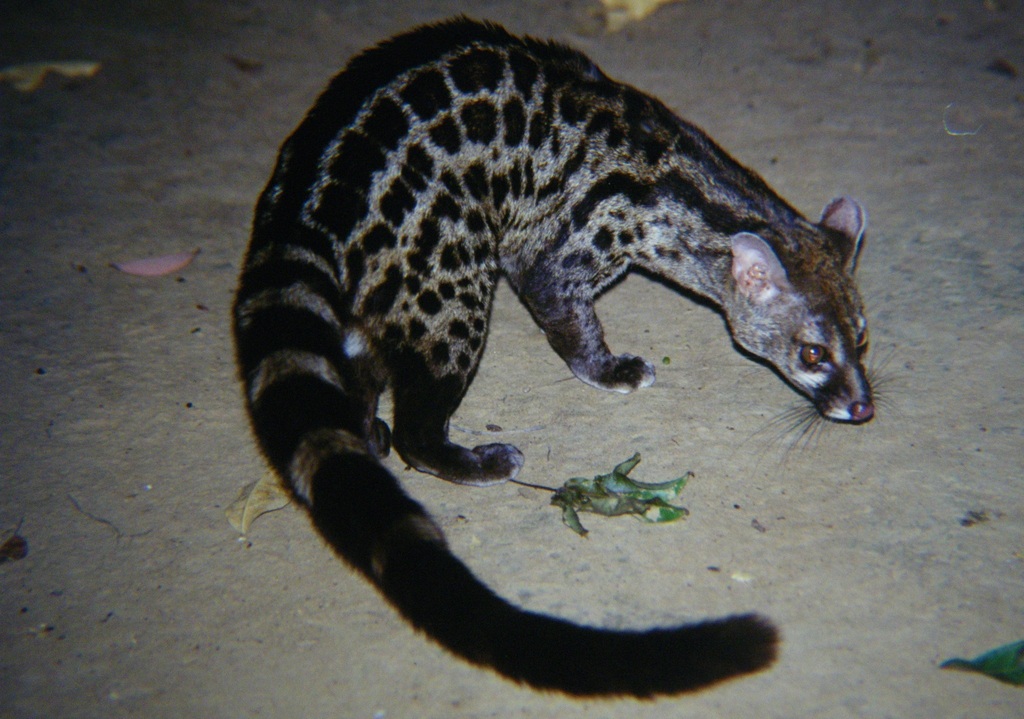
West African Large-spotted Genet
Genetta pardina
The pardine genet (Genetta pardina), also known as the West African large spotted genet, is a genet species living in West Africa. As it is widely distributed and common, it is listed as Least Concern on the IUCN Red List.
From the article Pardine genet on Wikipedia (CC BY-SA), quoted section by section
Description
The pardine genet's fur is yellowish grey with round black spots, which are bigger on the hind legs than on the shoulders. Its head is more reddish, and the muzzle brownish. It has white spots under each eye and below the chin. Its ears are grey. Its tail has six to seven narrow white and six to seven broader black rings. The tip of the tail is black. Measurements of adult males range from 410 to 553 mm (16.1 to 21.8 in) in head and body with a 390 to 490 mm (15 to 19 in) long tail. Adult females range from 410 to 530 mm (16 to 21 in) in head and body with a 420 to 450 mm (17 to 18 in) long tail.
Wikipedia: “Characteristics”
Range & habitat
Pardine genets are distributed from Senegal eastwards to Ghana, where the Volta River is possibly a barrier to dispersal. They live in rainforests, gallery forests, moist woodlands, but also in plantations. They also venture into suburbs.
Wikipedia: “Distribution and habitat”
What it does
Pardine genets are solitary, and active at night. They are very adept at climbing trees.
Wikipedia: “Ecology and behavior”
Listen
Looking for field recordings…
Where it lives
Recorded sightings
—
geo-referenced records in GBIF, from museums, herbaria and field observers.
Drag the globe to turn it. Dots are where records exist, not a range map; darker means more records.
In the stacks
Searching the stacks…
Every page naming Genetta pardina in the Biodiversity Heritage Library →
This page is assembled live from iNaturalist, GBIF, Wikipedia, the Source Library and the Internet Archive. It is not yet part of the hand-edited codex. iNaturalist taxon 74355.