On eBird ↗
Japanese Waxwing
Live sightings near you, the range map, bar charts of when it is seen, and Macaulay Library photos and recordings.
Japanese Waxwing
Bombycilla japonica
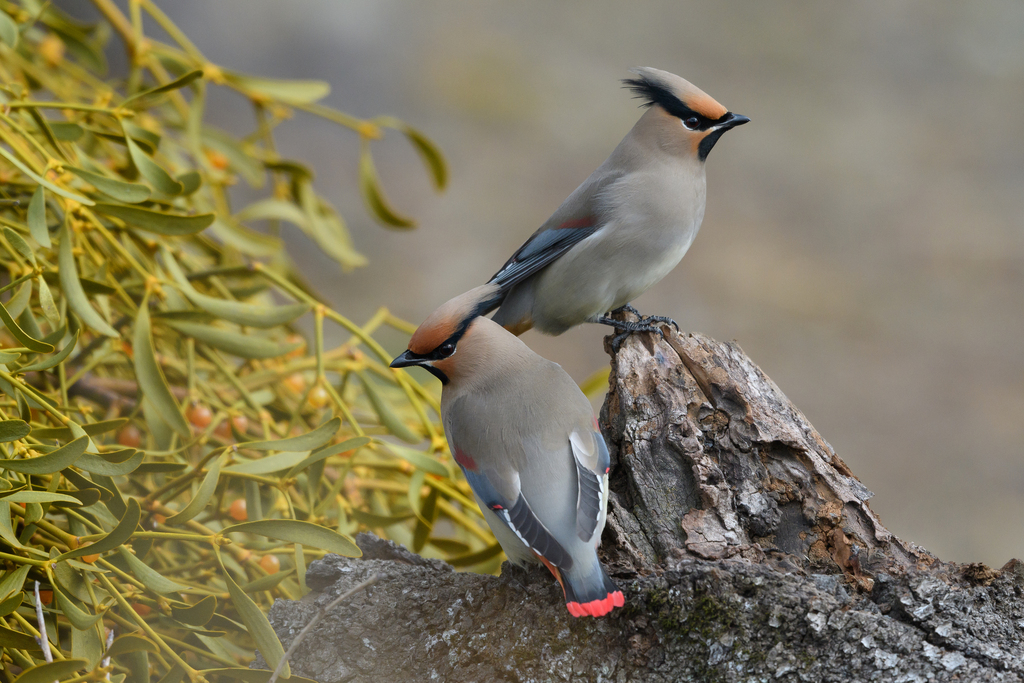
The Japanese waxwing (Bombycilla japonica) is a fairly small passerine bird in the waxwing family found in the eastern Palaearctic, where it breeds south of the breeding range of the related Bohemian waxwing, but overlaps extensively with it in winter. It feeds mainly on fruit and berries but also eats insects during the summer. The nest is a cup of twigs lined with grass and moss which is built in a tree. In males, the secondary wing feathers have red tips, the resemblance of which to sealing wax gives these birds their common name. It is listed by IUCN as Near Threatened, due to loss and degradation of its preferred forest habitat.
From the article Japanese waxwing on Wikipedia (CC BY-SA), quoted section by section
Description
The Japanese waxwing is 15–18 cm in length with a weight of 54–64 g, and its plumage is mostly pinkish-brown. It has a pointed crest, a black throat, a black stripe through the eye, a pale yellow centre to the belly, a grey rump, rusty-red undertail coverts, and a dark grey tail with a black-bordered red tip. The wings have a pattern of black, grey and white with a diffuse reddish-brown bar across the greater covert feathers. Its call is a high-pitched trill but there is no true song. Unlike Bohemian waxwing, the row of red tips on the secondary feathers of the wing (which give the birds their name) are only present in males; they also lack the 'teardrop' shape of that species. Japanese waxwings often occur in mixed flocks with Bohemian waxwings which, as well as usually having more prominent waxy tips, are slightly larger, and with a yellow tail-tip, greyish centre to the belly and no reddish-brown bar on the wing.
Range & habitat
The Japanese waxwing breeds in the dense coniferous forest in the Russian Far East (the Amur basin, northern Primorsky Krai, and Sakhalin) and northeasternmost China (Manchuria, Heilongjiang province). Outside of the breeding season, it migrates south to winter in Japan, the Korean Peninsula, eastern China and Taiwan; the exact distribution is irregular, as birds will travel and move in search of food, mainly seasonal berries, and birds may be common in a certain area during one year but move away the next. In Japan, it is generally present from November to April; few birds winter on Hokkaidō, but in southwestern Japan (Kyūshū, Shikoku, southern Honshu), it outnumbers Bohemian waxwings. In Taiwan, it is an irregular winter visitor, but with large flocks in some winters, such as the 2019-2020 winter when hundreds occurred in March 2020. The winter habitat is open woodland, low-lying farmland, or low mountains, with birds frequently visiting the berry-laden trees in parks and private gardens. Vagrant birds have been known to appear in Hong Kong and Central China; records from further afield, such as in Europe, South Asia or the Middle East, are more than likely to be escapes from captivity (or aviculture) than genuinely wild birds.
Wikipedia: “Distribution and habitat”
Listen
Looking for field recordings…
Where it lives
Recorded sightings
—
geo-referenced records in GBIF, from museums, herbaria and field observers.
Drag the globe to turn it. Dots are where records exist, not a range map; darker means more records.
In the stacks
Searching the stacks…
Every page naming Bombycilla japonica in the Biodiversity Heritage Library →
This page is assembled live from iNaturalist, GBIF, Wikipedia, the Source Library and the Internet Archive. It is not yet part of the hand-edited codex. iNaturalist taxon 7432.