On eBird ↗
Rufous-throated Partridge
Live sightings near you, the range map, bar charts of when it is seen, and Macaulay Library photos and recordings.
Rufous-throated Partridge
Arborophila rufogularis
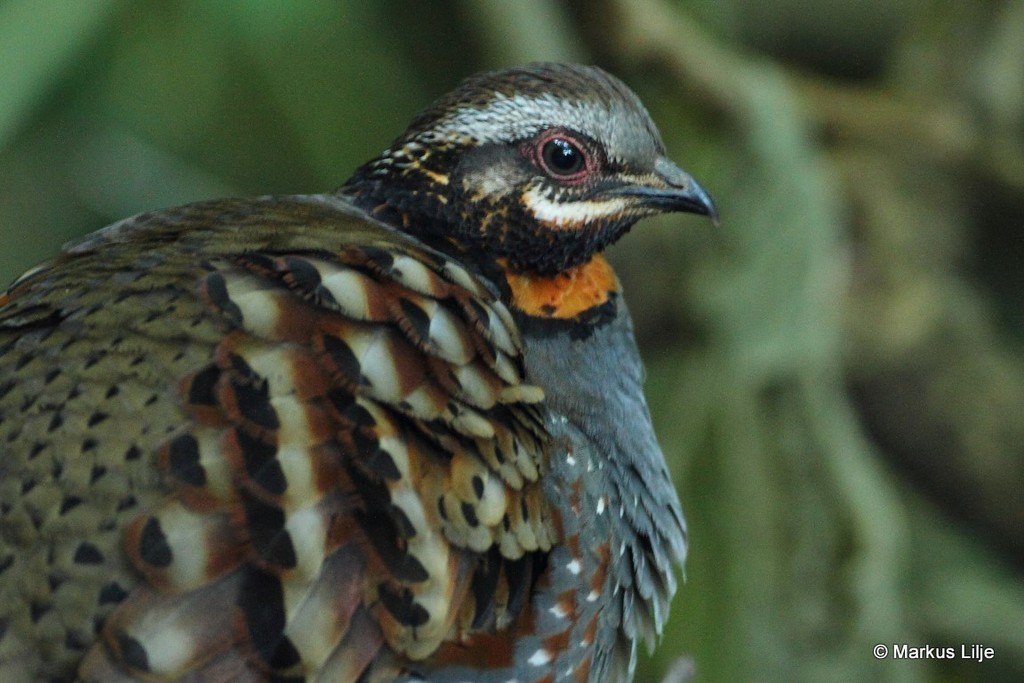
The rufous-throated partridge (Arborophila rufogularis) is a species of bird in the family Phasianidae. It is found in montane forests in India and Southeast Asia. The International Union for Conservation of Nature (IUCN) has assessed it as a least-concern species.
From the article Rufous-throated partridge on Wikipedia (CC BY-SA), quoted section by section
Description
The rufous-throated partridge is 26–29 cm (10–11 in) long. The male weighs 325–430 g (11.5–15.2 oz) and the female weighs 261–386 g (9.2–13.6 oz). The male has a grey forehead. The olive-brown crown and nape have black mottles. There are a whitish supercilium and moustachial curves. The throat and neck-sides are orange-rufous, with black speckles. The breast and flanks are blue-grey. The upper belly is blue-grey and the central belly is whitish. The vent is buffy-brown. The mantle, back and rump are olive-brown. The scapulars and wing coverts have chestnut, black and greyish bands. The beak is dusky-brown or blackish, and the legs are pinkish or crimson. The female is similar to the male. The juvenile bird is duller below, and its crown and flanks have brown and black vermiculations. The subspecies have different patterns on their throats.
Range & habitat
The rufous-throated partridge is found in Bangladesh, Bhutan, China, India, Laos, Myanmar, Nepal, Thailand, and Vietnam. Its natural habitat is montane forests, mainly at elevations of 1,800–3,000 metres (5,900–9,800 ft). Oak forests containing laurels and rhododendrons are preferred.
Wikipedia: “Distribution and habitat”
What it does
This partridge feeds in groups of five to ten birds. It eats seeds, plant shoots, berries, insects and snails. Surprised birds run or fly, sometimes flying to branches like some thrushes. Birds in a covey roost and huddle together in trees, similar to babblers. Breeding has been recorded from April to July in India and from February to May in China. The male builds a scrape in bamboo, forest undergrowth or along water. The nest is lined or padded with grass. Three to five white eggs are laid. The rufous-throated partridge gives a rising series of hu-hu whistles. In a duet, the partner's call is kew-kew-kew.
Wikipedia: “Behaviour”
Listen
Looking for field recordings…
Where it lives
Recorded sightings
—
geo-referenced records in GBIF, from museums, herbaria and field observers.
Drag the globe to turn it. Dots are where records exist, not a range map; darker means more records.
In the stacks
Searching the stacks…
Every page naming Arborophila rufogularis in the Biodiversity Heritage Library →
This page is assembled live from iNaturalist, GBIF, Wikipedia, the Source Library and the Internet Archive. It is not yet part of the hand-edited codex. iNaturalist taxon 743.