On eBird ↗
Dunn's Lark
Live sightings near you, the range map, bar charts of when it is seen, and Macaulay Library photos and recordings.
Dunn's Lark
Eremalauda dunni
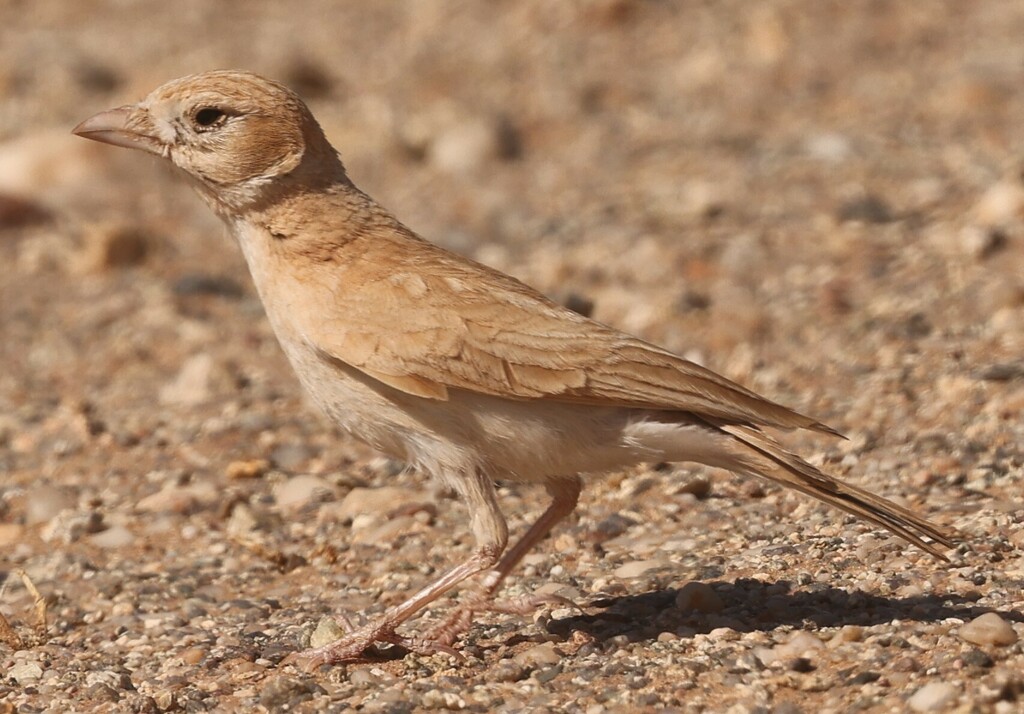
Dunn's lark (Eremalauda dunni) is a small passerine bird of the lark family. It is a desert bird which is found across parts of the Sahara from Mauritania to central Sudan.
From the article Dunn's lark on Wikipedia (CC BY-SA), quoted section by section
Description
Dunn's lark is a stocky bird with a large head and broad wings. It is 14 to 15 cm long with a wingspan of 25 to 30 cm. The upperparts are pale sandy-brown with darker streaks. The underparts are whitish with some dark streaks on the breast. There is a pale stripe over the eye and a pale ring around it. Birds have dark moustachial and malar stripes and a dark mark under the eye. The short, broad tail is black below while the upperside is black with rusty-brown central feathers and pale outer feathers. The bill is large, heavy and pale pinkish or yellowish in colour. After moulting, the birds become gradually duller and the dark markings fainter as the plumage becomes more worn. The song is a scratchy warbling with short whistling phrases. Males sing either from the ground or in flight, hovering 30 metres or more above the ground.
Range & habitat
In Africa, the species has a scattered range from Mauritania through Mali, Niger and Chad to Sudan. Dunn's larks are found in flat, arid areas with light vegetation such as grass and scattered bushes.
Wikipedia: “Distribution and habitat”
What it does
The diet mainly includes seeds and insects. Birds feed on the ground and sometimes dig for food with their bills. They typically feed in flocks outside the breeding season, moving nomadically in response to rainfall.
== References ==
Wikipedia: “Food and feeding”
Listen
Looking for field recordings…
Where it lives
Recorded sightings
—
geo-referenced records in GBIF, from museums, herbaria and field observers.
Drag the globe to turn it. Dots are where records exist, not a range map; darker means more records.
In the stacks
Searching the stacks…
Every page naming Eremalauda dunni in the Biodiversity Heritage Library →
This page is assembled live from iNaturalist, GBIF, Wikipedia, the Source Library and the Internet Archive. It is not yet part of the hand-edited codex. iNaturalist taxon 7411.