On eBird ↗
Botha's Lark
Live sightings near you, the range map, bar charts of when it is seen, and Macaulay Library photos and recordings.
Botha's Lark
Spizocorys fringillaris
Botha's lark (Spizocorys fringillaris) is a species of lark in the family Alaudidae that is endemic to South Africa. It is considered to be South Africa's most endangered bird species with approximately 340 mature individuals left in the wild. Over the last decade, there has been a 90% population decline resulting in the species regionally being uplisted to Critically Endangered in the 2025 Regional Red Data Book of Birds of South Africa, Lesotho and Eswatini.
From the article Botha's lark on Wikipedia (CC BY-SA), quoted section by section
Description
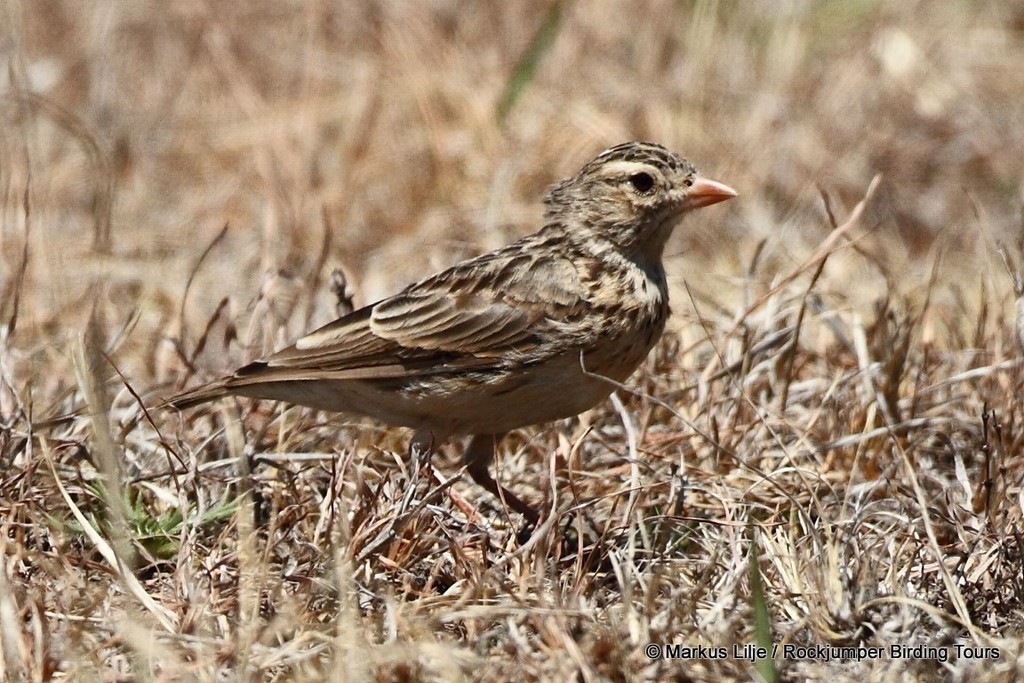
This is a small, compact lark, exhibiting a boldly marked face with a pinkish, conical bill. It has grey-brown upperparts, contrasting with pale underparts and a streaked, buffy chest. This lark also exhibits spread out streaking on its flanks, which helps differentiate it from the similar pink-billed lark (Spizocorys conirostris) which has plain, white flanks. Its call is short and simple and can be given in flight or whilst on the ground.
Range & habitat
Botha's lark is a grassland specialist endemic to the high-altitude grasslands of South Africa, restricted to southern Mpumalanga, eastern Free State and potentially KwaZulu-Natal. The species distribution extends from its southern limit in the Harrismith and Verkykerskop districts of the eastern Free State, through its core stronghold in the southern Mpumalanga, including the Volksrust, Wakkerstroom, and Daggakraal districts, and extending northwards to the Hendrina, Kriel, and Secunda regions of central Mpumalanga. Evidence suggests significant local extinctions across parts of its historical range. Notably, the type specimen was collected near Vredefort in the northern Free State - a locality now well outside the species' known distribution. Likely driven by large-scale habitat loss, transformation, and fragmentation associated with agriculture and infrastructure development.
Population. In 1983, the global population of Botha's lark was estimated to be as many as 20,000 individuals. This was later revised to a more conservative range of 1,500–5,000 individuals in 2000. By 2015, the global population was thought to number fewer than 2,500 individuals. The most recent estimates place the global population at approximately 340 individuals, with a confidence interval of 200–600 birds, highlighting the species' precarious conservation status and steep long-term decline. …
Wikipedia: “Distribution”
What it does
Botha's lark is closely associated with heavily grazed, high-altitude grasslands on dark clay soils, particularly within the Moist Clay Highveld Grassland vegetation type. It typically inhabits short upland grasslands at elevations between 1,500 and 1,900 meters above sea level, preferring flat or gently sloping plateaus and hilltops with short, dense, and well-grazed natural grass. Its range is limited to southeastern Mpumalanga and adjacent areas of the eastern Free State. This restricted distribution is largely due to the species' highly specific habitat requirements for both breeding and foraging, coupled with the widespread transformation and degradation of natural grasslands. These habitats, often maintained through intensive cattle grazing, are essential for the species, which relies on short grass but frequently nests in recently burned areas. The species tends to favour fallow land and heavily grazed, seasonally burned, and trampled patches in low-lying areas. The species is nomadic and makes local movements in response to changing resource availability and habitat conditions.
Wikipedia: “Habitat and ecology”
Listen
Looking for field recordings…
Where it lives
Recorded sightings
—
geo-referenced records in GBIF, from museums, herbaria and field observers.
Drag the globe to turn it. Dots are where records exist, not a range map; darker means more records.
In the stacks
Searching the stacks…
Every page naming Spizocorys fringillaris in the Biodiversity Heritage Library →
This page is assembled live from iNaturalist, GBIF, Wikipedia, the Source Library and the Internet Archive. It is not yet part of the hand-edited codex. iNaturalist taxon 7404.