- Plants
- ›Vascular Plants
- ›flowering plants
- ›Dicots
- ›Sunflowers, Bellflowers, Fanflowers, and Allies
- ›Sunflowers, Daisies, Asters, and Allies
- ›Asteroideae
- ›paper daisies
- ›cudweeds, everlastings, and pussytoes
- ›Antennaria
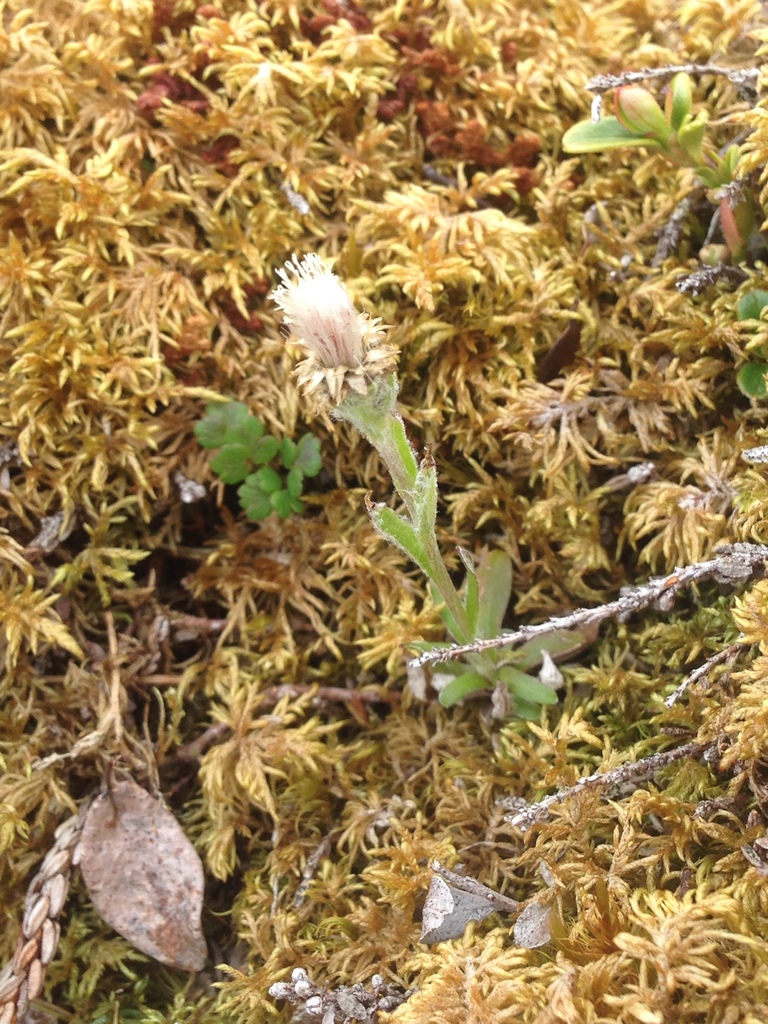
Antennaria porsildii
Antennaria alpina (alpine pussytoes or alpine catsfoot or alpine everlasting) is a European and North American species of plant in the family Asteraceae. Antennaria alpina is native to mountainous and subarctic regions of Scandinavia, Greenland, Alaska, and the Canadian Arctic, extending south at high altitudes in mountains in the Rocky Mountains south to Montana and Wyoming.
From the article Antennaria alpina on Wikipedia (CC BY-SA), quoted section by section
Description
Antennaria alpina is a perennial, herbaceous plant growing 3 to 18 centimeters tall. The plant spreads by means of stolons that reach between 1 and 7 cm in length. It is a cushion plant, a compact, low-growing, mat-forming plant, with a dense taproot that forms annual growth rings. The basal leaves, those attached to the base of the plant, have one prominent vein and are spatulate to oblanceolate in shape, with a length of 6 to 25 millimeters and a width of 2 to 7 mm. The surface of the leaves are green and nearly hairless to gray in color with many hairs, but the undersides are tomentose, white due to a thick covering of woolly hairs. The leaves attached to the stems are even smaller, and narrow like a blade of grass, just 5 to 20 mm long. Each stem is topped with two to seven flowering heads. They have somewhat black bracts. Both the plants in North America and Scandinavia are mostly gynoecious, having almost all seed producing flowers and rarely producing flowers with pollen. It is an apomict, a species that will produce seeds asexually that are genetically identical to the parent. The involucre, the base under a flowering head, is 5–6.5 mm and 4–10 mm for a seed producing flower. They bloom in mid to late summer.
Range & habitat
Alpine pussytoes are limited to alpine and boreal habitats. In Europe it is native to Norway, Sweden, Finland, and northern parts of European Russia. It grows in the mountains of Sweden and Norway in the south and towards the North Sea coast further to the north. In Asia it grows in the botanical area of the Magadan Oblast which also includes the Chukotka Autonomous Okrug at the far eastern tip of Russia. In North America it is found in Alaska and the three northern territories of Canada. Further south it grows in both Alberta and British Columbia in the west and parts of Ontario, Québec, Labrador, and Newfoundland in the east. In the contiguous US it only grows in Montana and Wyoming. The Natural Resources Conservation Service database only records it in six scattered counties in Montana. On Greenland it is a common plant found as far north at 75°23' N in the west and to 74°50' N in the east. It grows at elevations between 100 and 2400 meters. It grows in dry to moist tundra and alpine tundra.
Wikipedia: “Range and habitat”
Where it lives
Recorded sightings
—
geo-referenced records in GBIF, from museums, herbaria and field observers.
Drag the globe to turn it. Dots are where records exist, not a range map; darker means more records.
In the stacks
Searching the stacks…
Every page naming Antennaria porsildii in the Biodiversity Heritage Library →
This page is assembled live from iNaturalist, GBIF, Wikipedia, the Source Library and the Internet Archive. It is not yet part of the hand-edited codex. iNaturalist taxon 739622.