- Animals
- ›Chordates
- ›Vertebrates
- ›Reptiles
- ›Snakes and Lizards
- ›Lizards
- ›Skinks and allies
- ›Skinks
- ›Typical skinks
- ›Plestiodon
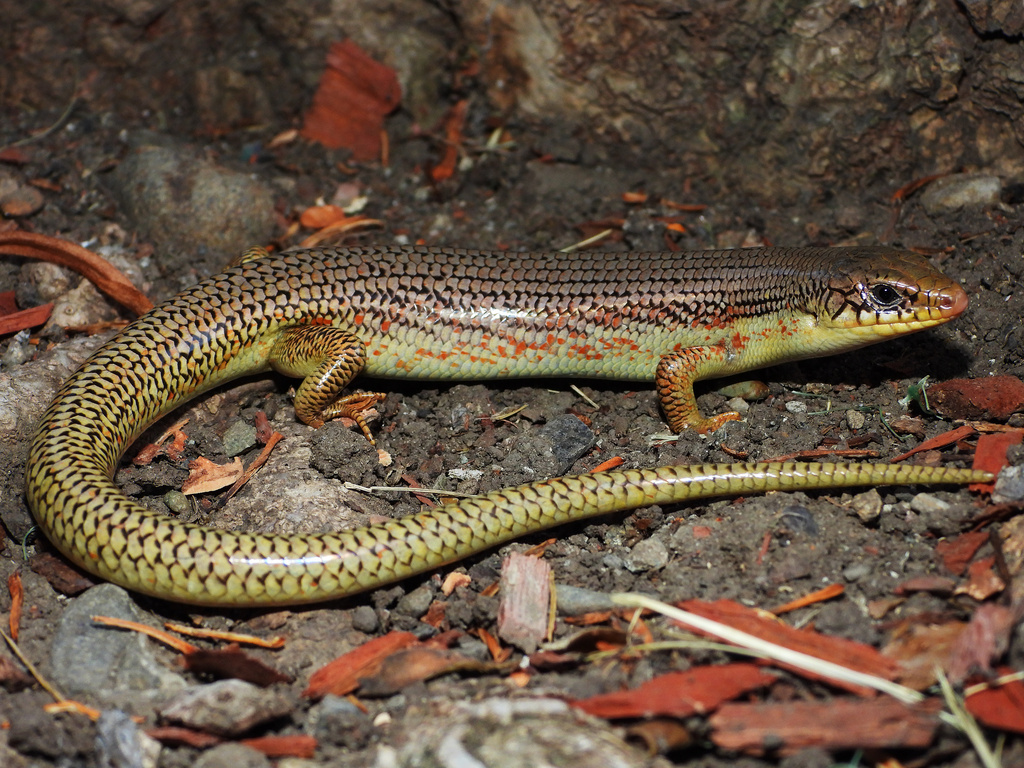
Great Plains Skink
Plestiodon obsoletus
The Great Plains skink (Plestiodon obsoletus) is a species of lizard endemic to North America.
From the article Great Plains skink on Wikipedia (CC BY-SA), quoted section by section
Description
The Great Plains skink, together with the broad-headed skink, is the largest skink of the genus Plestiodon. It reaches a length of 9 to 13 cm from snout to vent (SVL) or up to nearly 34 cm total length (including the tail). This lizard is light gray or beige in color; its dorsal scales have black or dark brown edges. The scales on the sides run diagonally. The belly is yellow. Juveniles are black with white spots on the lips and the head and have a blue or bluish tail.
Range & habitat
The Great Plains skink is very common on the Great Plains, ranging from southeastern Wyoming and Nebraska (and also Fremont County, Iowa) southward to eastern Arizona, New Mexico, Texas, and into Mexico.
Wikipedia: “Geographic range”
What it does
The mating season of the Great Plains skink is in April or May. The female lays between 5 and 32 eggs (on the average about 12) in early summer, which she guards until they hatch in late summer.
Wikipedia: “Reproduction”
Where it lives
Recorded sightings
—
geo-referenced records in GBIF, from museums, herbaria and field observers.
Drag the globe to turn it. Dots are where records exist, not a range map; darker means more records.
In the stacks
Searching the stacks…
Every page naming Plestiodon obsoletus in the Biodiversity Heritage Library →
This page is assembled live from iNaturalist, GBIF, Wikipedia, the Source Library and the Internet Archive. It is not yet part of the hand-edited codex. iNaturalist taxon 73797.