- Animals
- ›Chordates
- ›Vertebrates
- ›Reptiles
- ›Snakes and Lizards
- ›Lizards
- ›Skinks and allies
- ›Skinks
- ›Typical skinks
- ›Plestiodon
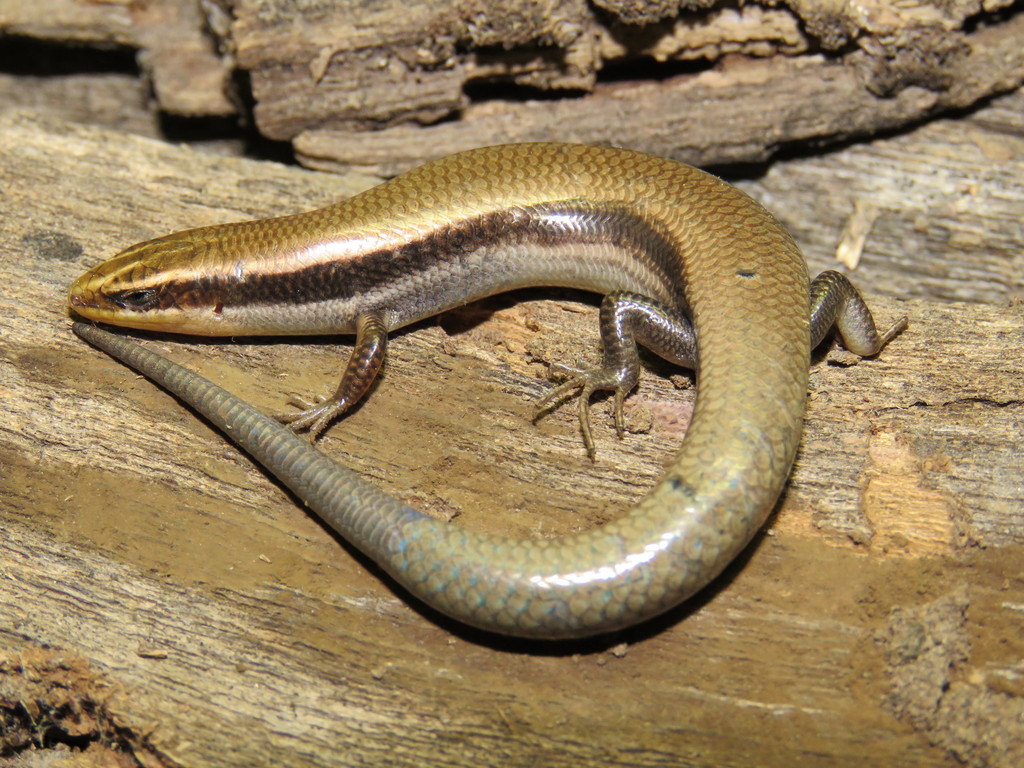
Mountain Skink
Plestiodon callicephalus
Plestiodon callicephalus, commonly known as the mountain skink, is a species of lizard, a medium-sized member of the Plestiodon skinks, endemic to North America.
From the article Plestiodon callicephalus on Wikipedia (CC BY-SA), quoted section by section
Description
The mountain skink is a medium-sized skink reaching a maximum length from snout to vent of about 7.5 cm (3.0 in). Its body is olive to brown in color, with black stripes on the sides. On the head, it features a distinctive, roughly Y-shaped light line pattern, which gave rise to its scientific name: callicephalus is Greek and means "beautiful head". Like many other Plestiodon, juvenile mountain skinks have a bright blue tail. However, contrary to most other species of this genus, adults retain this color, although it does fade a little with age.
Range & habitat
The mountain skink occurs from southeastern Arizona and extreme southwestern New Mexico southward to Nayarit and Jalisco in Mexico. In the U.S., the species is very localized. In New Mexico, mountain skinks are found only in the southern Peloncillo Mountains (Hidalgo County) of southwest Hidalgo County. It is known only from Geronimo Trail and Guadalupe Canyon, where it is uncommon in its limited habitat. In Arizona, the mountain skink occurs in the Coronado National Forest.
Wikipedia: “Geographic range”
What it does
Plestiodon callicephalus is a terrestrial skink, spending most of its time foraging on the ground, hunting for small invertebrates. It is a good burrower, burrowing its own den.
Wikipedia: “Behavior”
Where it lives
Recorded sightings
—
geo-referenced records in GBIF, from museums, herbaria and field observers.
Drag the globe to turn it. Dots are where records exist, not a range map; darker means more records.
In the stacks
Searching the stacks…
Every page naming Plestiodon callicephalus in the Biodiversity Heritage Library →
This page is assembled live from iNaturalist, GBIF, Wikipedia, the Source Library and the Internet Archive. It is not yet part of the hand-edited codex. iNaturalist taxon 73783.