On eBird ↗
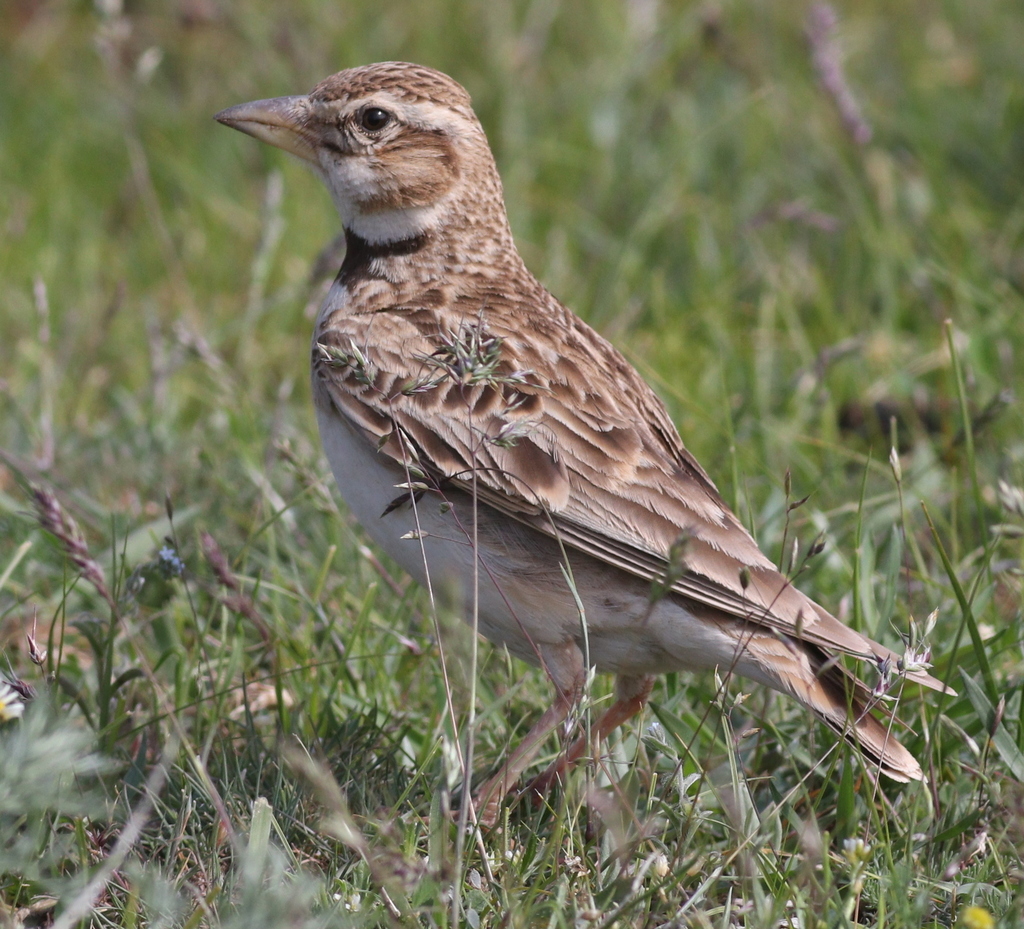
Bimaculated Lark
Live sightings near you, the range map, bar charts of when it is seen, and Macaulay Library photos and recordings.
Bimaculated Lark
Melanocorypha bimaculata
The bimaculated lark (Melanocorypha bimaculata) breeds in warm temperate countries eastwards from Turkey into central Asia. It is the eastern counterpart of its relative, the calandra lark.
From the article Bimaculated lark on Wikipedia (CC BY-SA), quoted section by section
Description
This is a large, robust lark, 16–18 cm in length. It is an undistinguished looking species on the ground, mainly streaked grey above and white below, and with two small black patches on the breast sides, which give this species its name. It has a white supercilium. In flight it shows short broad wings, which are grey-brown below, and a short tail with a white tip, but not white edges. The wing and tail patterns are distinctions from its more westerly relative. The song is like a harder version of that of calandra lark.
Range & habitat
The bimaculated lark is found from west-central Turkey to southern Kazakhstan, Kyrgyzstan, north-eastern Iran and northern Afghanistan. It is also found in northern Israel, Lebanon, western Syria and northern Iraq. It is mainly migratory, wintering in northeast Africa, and ranges widely throughout the greater Middle East to Pakistan, India and Tibet. It is a very rare vagrant to western Europe. This is a bird of stony semi-desert and higher altitude cultivation. Its nest is on the ground, with 3-4 eggs being laid. Food is seeds and insects, the latter especially in the breeding season. It is gregarious in winter.
== References ==
Wikipedia: “Distribution and habitat”
Listen
Looking for field recordings…
Where it lives
Recorded sightings
—
geo-referenced records in GBIF, from museums, herbaria and field observers.
Drag the globe to turn it. Dots are where records exist, not a range map; darker means more records.
In the stacks
Searching the stacks…
Every page naming Melanocorypha bimaculata in the Biodiversity Heritage Library →
This page is assembled live from iNaturalist, GBIF, Wikipedia, the Source Library and the Internet Archive. It is not yet part of the hand-edited codex. iNaturalist taxon 7366.