On eBird ↗
Thekla's Lark
Live sightings near you, the range map, bar charts of when it is seen, and Macaulay Library photos and recordings.
Thekla's Lark
Galerida theklae
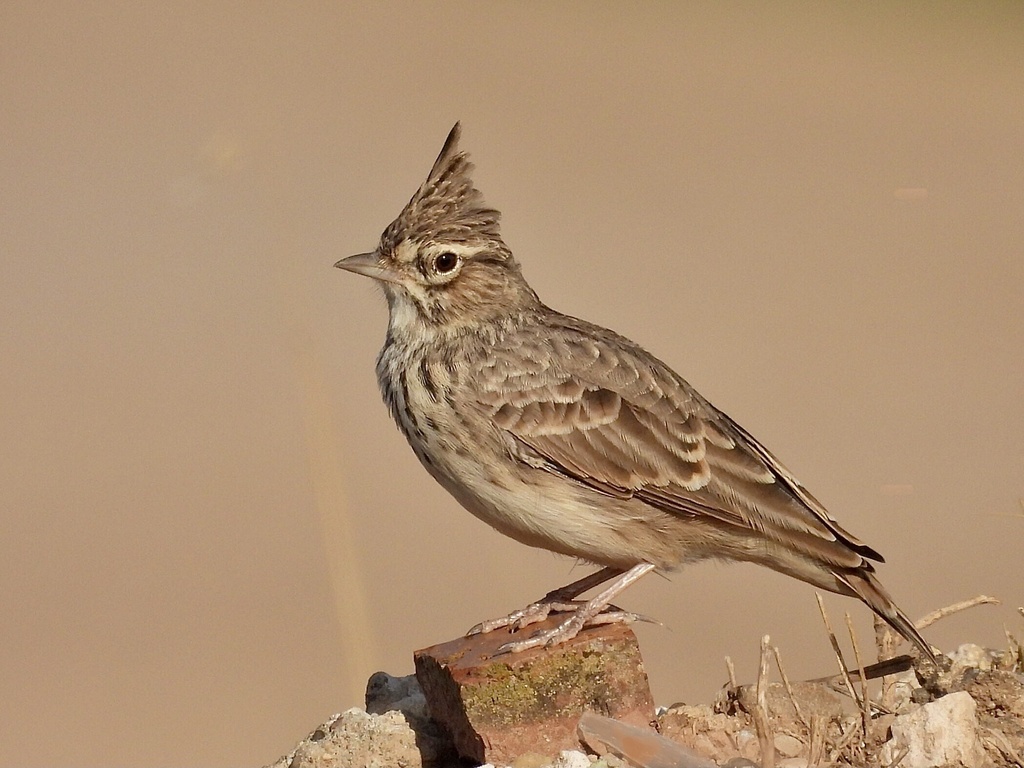
Thekla's lark (Galerida theklae), also known as the Thekla lark, is a species of lark that breeds on the Iberian Peninsula and in North and East Africa south to Kenya. It is a sedentary (non-migratory) species. This is a common bird of dry open country, often at some altitude. Thekla's lark was named by Alfred Edmund Brehm in 1857 for his recently deceased sister Thekla Brehm (1833–1857). The name is a modern Greek one, Θέκλα (Thekla), which comes from ancient Greek Θεόκλεια (Theokleia) derived from θεός (theos, "god") and κλέος (kleos, "glory" or "honour"). The population is declining in parts of Spain, but this is a common bird with a very wide range and the International Union for Conservation of Nature has rated its conservation status as being of "least concern".
From the article Thekla's lark on Wikipedia (CC BY-SA), quoted section by section
Description
This is a smallish lark, slightly smaller than the Eurasian skylark. It has a long, spiky, erectile crest. Its colouring is similar to the widespread crested lark (G. cristata), being predominantly brownish-grey or brown, although its back and rump are greyer than that species. Its breast is streaked with black. It is smaller and somewhat greyer than the crested lark, and has a shorter bill. In flight, it shows grey underwings, whereas the crested lark has reddish underwings. It is also greyer than the Eurasian skylark, and lacks the white wing and tail edge of that species. The body is mainly dark-streaked grey above and whitish below. The sexes are similar.
Range & habitat
Thekla's lark is native and resident in France, Spain, Portugal, Algeria, Egypt, Eritrea, Ethiopia, Kenya, Libya, Morocco, Somalia, Tunisia and Western Sahara. Its typical habitat is rugged areas with scrub, bare patches of ground and semi-arid grassland.
Wikipedia: “Distribution and habitat”
What it does
It nests on the ground, laying two to six eggs. Its food is weed, seeds and insects, the last being especially popular in the breeding season. The song is melodious and varied, with mournful whistles and mimicry included. It is softer and more tuneful than that of the crested lark, and may be sung during flight or from the ground or an exposed perch.
Wikipedia: “Behaviour and ecology”
Listen
Looking for field recordings…
Where it lives
Recorded sightings
—
geo-referenced records in GBIF, from museums, herbaria and field observers.
Drag the globe to turn it. Dots are where records exist, not a range map; darker means more records.
In the stacks
Searching the stacks…
Every page naming Galerida theklae in the Biodiversity Heritage Library →
This page is assembled live from iNaturalist, GBIF, Wikipedia, the Source Library and the Internet Archive. It is not yet part of the hand-edited codex. iNaturalist taxon 7359.