On eBird ↗
Blue-winged Warbler
Live sightings near you, the range map, bar charts of when it is seen, and Macaulay Library photos and recordings.
Blue-winged Warbler
Vermivora cyanoptera
The blue-winged warbler (Vermivora cyanoptera) is a fairly common migratory New World warbler, 11.5 cm (4.5 in) long and weighing 8.5 g (0.30 oz). It breeds in eastern North America in southern Ontario and the eastern United States and winters in southern Central America. Its breeding range is extending northwards, where it is replacing the very closely related golden-winged warbler (Vermivora chrysoptera).
From the article Blue-winged warbler on Wikipedia (CC BY-SA), quoted section by section
Description
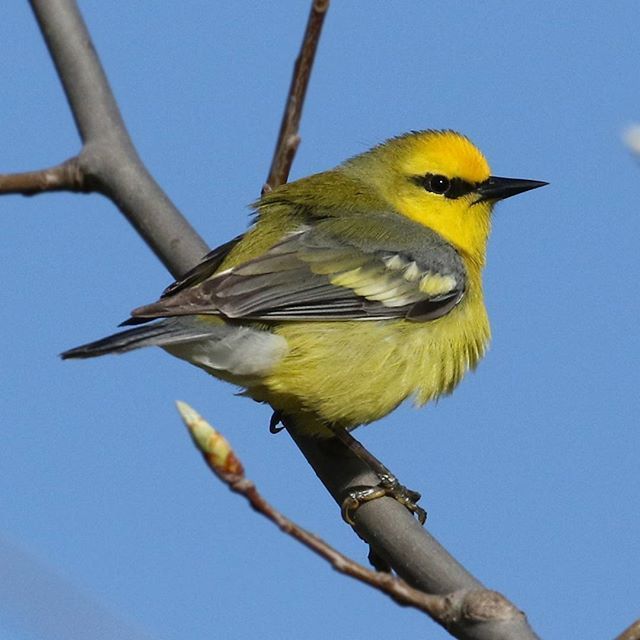
The blue-winged warbler is a small warbler at 11.4–12.7 cm (4.5–5.0 in) long, with a wingspan of 17–19.5 cm (6.7–7.7 in). The breeding plumage of the male consists of a bright yellow head, breast and underparts. There is no streaking of the underparts of the bird. It has a narrow black line though the eyes and light blueish gray with two white wing-bars, which are diagnostic field marks. The blue winged warblers are generally small in size with a well-proportioned body, and heavy pointed bill. They roughly measure 4.3 to 4.7 inches long with a wingspan of around 5.9 inches. An average Blue-Winged Warbler weighs around 0.3 oz. The female is duller overall with less yellow on the crown. Immatures are olive green with wings similar to the adults. The color of their plumage tends to vary depending on the sex of the species. For males, the feathers are of bright yellow and olive green. The males often have bluish-gray wings that come with white wing bars and a distinctive black eye lining, making their heads look pointier compared to other male warbler species. Blue-winged warbler females exhibit a yellow plumage that looks a bit lighter in color. The females also have a much less prominent eye lining which mostly looks grey and light, rather than black as seen in the males. …
Range & habitat
Blue-winged warblers are migratory New World warblers. They winter in southern Central America and breed from east-central Nebraska in the west to southern Minnesota, Wisconsin, Michigan and southern Ontario in the north to central New York, southern Vermont, southern New Hampshire and New England to the east, south to western South Carolina, northern Georgia, northern Alabama, eastern Tennessee and southern Missouri. It is a very rare vagrant to western Europe, with one bird wandering to Ireland. The breeding habitat is open scrubby areas. The species is mostly found in abandoned fields with shrubs and trees and bordered by tall deciduous trees. Blue-winged warblers are generally found in areas located in higher elevation and high percentage of grass and canopy cover.
Wikipedia: “Distribution and habitat”
What it does
Diet consists of insects and spiders. Blue-winged warblers primarily feed on insects found in various plants including apple trees, walnut trees, and water hemlock. Adults sometimes hang upside down to glean and probe leaves and gather insect larvae for their young. Some examples of larvae fed to juvenile blue-winged warblers include Aphis sp., and Corythucha sp. Often, researchers presume that the species's diet and feeding methods tend to differ on each season and habitat, and may also change due to the availability of resources. This could be considered a relatively generalist species.
Wikipedia: “Food and feeding”
Listen
Looking for field recordings…
Where it lives
Recorded sightings
—
geo-referenced records in GBIF, from museums, herbaria and field observers.
Drag the globe to turn it. Dots are where records exist, not a range map; darker means more records.
In the stacks
Searching the stacks…
Every page naming Vermivora cyanoptera in the Biodiversity Heritage Library →
This page is assembled live from iNaturalist, GBIF, Wikipedia, the Source Library and the Internet Archive. It is not yet part of the hand-edited codex. iNaturalist taxon 73553.