On eBird ↗
Pale-eyed Thrush
Live sightings near you, the range map, bar charts of when it is seen, and Macaulay Library photos and recordings.
Pale-eyed Thrush
Turdus leucops
The pale-eyed thrush (Turdus leucops) is a species of bird in the family Turdidae. Its genus is controversial. Some taxonomists place this species in the genus Platycichla based on morphology. The South American Classification Committee of the American Ornithologists' Union places it in the genus Turdus, as does the International Ornithological Committee.
From the article Pale-eyed thrush on Wikipedia (CC BY-SA), quoted section by section
Description
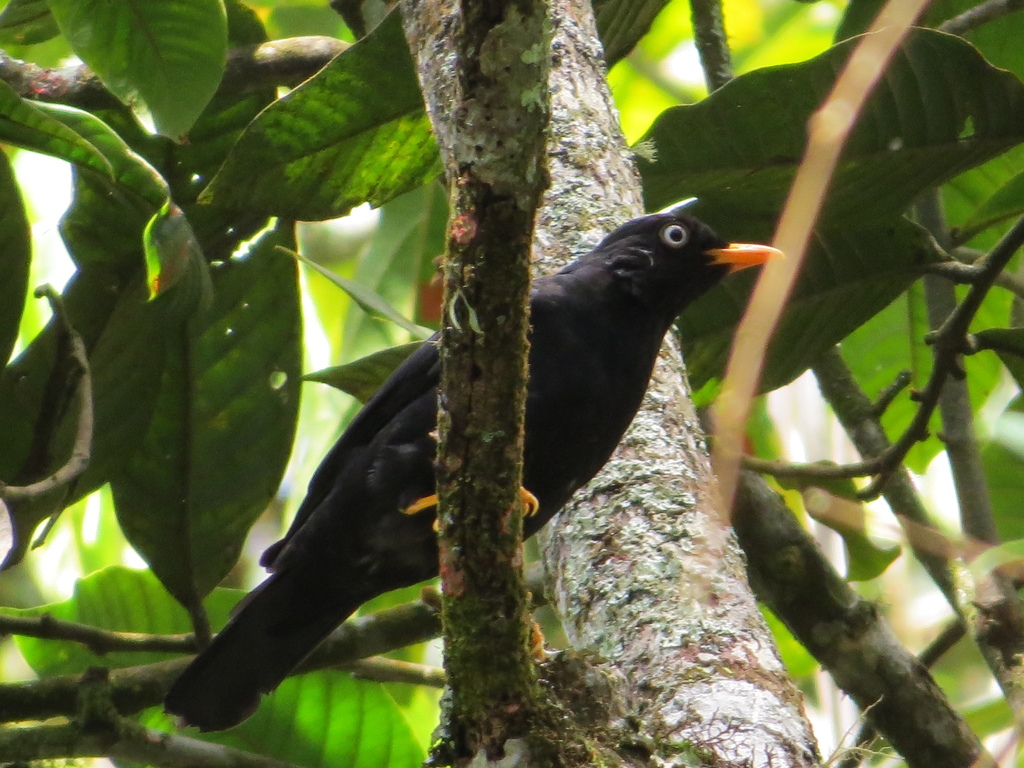
The pale-eyed thrush is 19.5 to 23.5 cm (7.7 to 9.3 in) long and weighs 54 to 80 g (1.9 to 2.8 oz). The species is sexually dimorphic. Adult males are almost entirely glossy bluish black with sometimes some white on the chin. They have a bluish white iris and sometimes a pale yellow-orange eye-ring, a bright yellow to orange bill, and bright yellow to orange legs and feet that match the bill. Adult females have mostly olive-brown upperparts. They have faint buff-yellow streaks on the ear coverts and sometimes yellowish buff edges on the primaries. Their chin and throat are light brown to buff with brown streaks or spots. Their belly is light brown. They have a light brown, gray-brown, or brown iris without an eye-ring, a black or brown bill, and fuscous-washed yellow legs and feet. Juveniles resemble adult females but with less of an olive tinge. They have buff-yellow streaks on their head and upperparts. Their chin and throat are brown with darker "arrowhead" marks. Their breast is brown with small fuscous blotches and their belly and undertail coverts plain brown. They have a light brown iris without an eye-ring, usually a black bill, and fuscous or yellow-fuscous legs and feet.
Range & habitat
The pale-eyed thrush has a highly disjunct distribution. In Venezuela it is found in the Andes from Lara and south into Colombia's Eastern Andes, in the Coastal Range from Carabobo to Miranda, and on tepuis in the states of Amazonas and Bolívar. It is also found on tepuis in Guyana, Suriname, and extreme northern Brazil. In Colombia it is found in the upper valley of the Magdalena River and south along both slopes of the Western Andes. From Colombia its range continues along both slopes of the Andes of Ecuador. In the west it extends to Pichincha Province and on the east slope continues through Peru into Bolivia to western Santa Cruz Department. The pale-eyed thrush inhabits humid to very wet pristine forest, especially cloudforest. It also inhabits wet semi-deciduous and riparian forest, mature secondary forest, and shaded coffee plantations. It shuns built-up areas. In Venezuela it ranges in elevation between 900 and 2,000 m (3,000 and 6,600 ft) north of the Orinoco River and between 1,100 and 1,800 m (3,600 and 5,900 ft) south of it. It ranges between 1,000 and 1,800 m (3,300 and 5,900 ft) in Brazil, between 1,000 and 2,000 m (3,300 and 6,600 ft) in Colombia, mostly between 1,000 and 2,000 m (3,300 and 6,600 ft) in Ecuador, and mostly between 850 and 2,000 m (2,800 and 6,600 ft) but locally to 2,600 m (8,500 ft) in Peru.
Wikipedia: “Distribution and habitat”
What it does
The pale-eyed thrush feeds primarily on seeds and berries. It also includes invertebrates and small vertebrates in its diet. During the breeding season it forages singly or in pairs and outside of it may gather in small to medium-size flocks in fruiting trees. It forages primarily from the forest's mid-level to the lower parts of its canopy and in lesser amounts lower than that including on the ground. It takes fruit while perched and when briefly hovering. It follows army ant swarms to capture small prey fleeing the ants. Animals appear to be taken mostly opportunistically while exploring bromeliads and when following ants.
Wikipedia: “Feeding”
Listen
Looking for field recordings…
Where it lives
Recorded sightings
—
geo-referenced records in GBIF, from museums, herbaria and field observers.
Drag the globe to turn it. Dots are where records exist, not a range map; darker means more records.
In the stacks
Searching the stacks…
Every page naming Turdus leucops in the Biodiversity Heritage Library →
This page is assembled live from iNaturalist, GBIF, Wikipedia, the Source Library and the Internet Archive. It is not yet part of the hand-edited codex. iNaturalist taxon 73543.