On eBird ↗
Amazonian Violaceous Trogon
Live sightings near you, the range map, bar charts of when it is seen, and Macaulay Library photos and recordings.
Amazonian Violaceous Trogon
Trogon ramonianus
The Amazonian trogon (Trogon ramonianus), is a near passerine bird in the trogon family, Trogonidae. It is found in humid forests in the Amazon of South America. Until recently, the Amazonian trogon was considered a subspecies of the violaceous trogon (T. violaceous).
From the article Amazonian trogon on Wikipedia (CC BY-SA), quoted section by section
Description
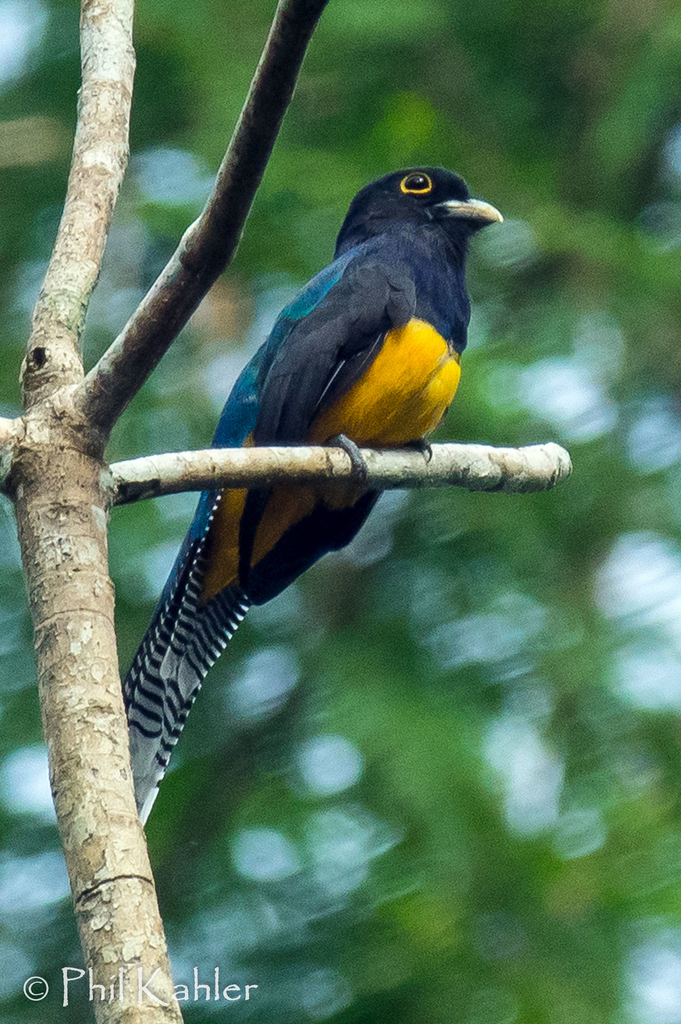
Trogons have distinctive male and female plumages, with soft, often colorful, feathers. The Amazonian trogon is about 23 to 25 cm (9.1 to 9.8 in) long; three males weighed 44 to 46 g (1.6 to 1.6 oz). The male's head, neck, and upper breast are a deep metallic blue-black. The face and throat are black, with little contrast between them and the rest of the head. A narrow white band separates the upper breast from the bright yellow lower breast and belly. The upperparts are metallic green to blue-green. The tail's upperside is deep blue with black feather tips; the underside has fine black and white bars and broad white feather tips. The wings are mostly black with some whitish inclusions. The female's head and face, upper breast, and upperparts are dark gray; the belly is a duller yellow than the male's, and the underside of the tail has a different pattern of black and white. The two subspecies' plumages differ very little, with the differences between them being similar to those among individuals of each.
Range & habitat
The Amazonian trogon is found from the Andean foothills of Colombia, Ecuador, Peru, and Bolivia slightly north into western Venezuela and east across the western and southern Amazon basin of Brazil. The exact delination of the two subspecies' ranges is obscure, but T. r. crissalis is generally considered to be found south of the Amazon River and east of the Tapajós River. The Amazonian trogon inhabits a variety of landscapes including transitional and terra firme forest, palm and bamboo forest, and permanently flooded igapó forest. It is found mostly below 500 m (1,600 ft) of elevation but reaches as high as 1,000 m (3,300 ft) in Ecuador.
Wikipedia: “Distribution and habitat”
What it does
The Amazonian trogon's diet and feeding behavior have not been studied in detail. It is assumed to behave like the other "violaceus" trogons, feeding with sallies from a perch and hovering to pick insects and fruit from vegetation. They also eat small vertebrates such as frogs.
Wikipedia: “Feeding”
Listen
Looking for field recordings…
Where it lives
Recorded sightings
—
geo-referenced records in GBIF, from museums, herbaria and field observers.
Drag the globe to turn it. Dots are where records exist, not a range map; darker means more records.
In the stacks
Searching the stacks…
Every page naming Trogon ramonianus in the Biodiversity Heritage Library →
This page is assembled live from iNaturalist, GBIF, Wikipedia, the Source Library and the Internet Archive. It is not yet part of the hand-edited codex. iNaturalist taxon 73526.