On eBird ↗
Vulturine Parrot
Live sightings near you, the range map, bar charts of when it is seen, and Macaulay Library photos and recordings.
Vulturine Parrot
Pyrilia vulturina
The vulturine parrot (Pyrilia vulturina), not to be confused with Pesquet's parrot (Psittrichas fulgidus), is a Neotropical parrot, which is endemic to humid forest and adjacent habitats in the eastern Amazon of Brazil.
From the article Vulturine parrot on Wikipedia (CC BY-SA), quoted section by section
Description
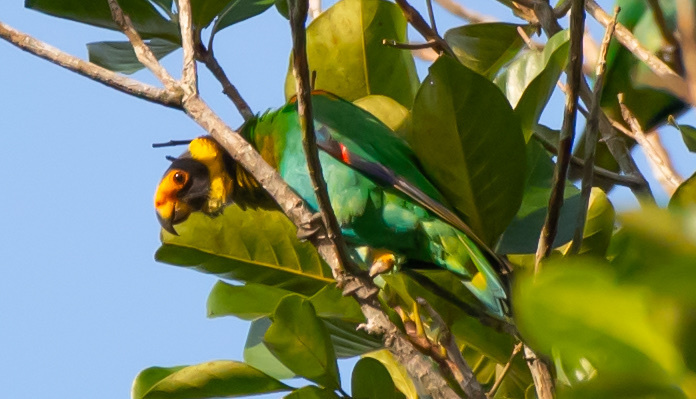
The vulturine parrot is 23 to 25 cm (9.1 to 9.8 in) long and weighs 138 to 165 g (4.9 to 5.8 oz). The adult's face is mostly bare black skin, with yellowish lores and a collar of yellow feathers and a band of black feathers below that. Their upperparts are green with a reddish orange shoulder. Their breast is olive-yellow, their belly green with some blue edges to the feathers, and their lower thighs yellow. Their primaries are black with green edges and their carpal's edges and underwing coverts are red. Their tail's upper surface is green with blue tips and the lower surface green and yellow. Immature birds have green feathered heads with yellowish around the lores and eye and without the adult's yellow collar.
Range & habitat
The vulturine parrot is found in Brazil south of the Amazon River from the Madeira River east to near the Atlantic coast in Maranhão. It inhabits both fairly dry terra firme and seasonally flooded várzea forests.
Wikipedia: “Distribution and habitat”
What it does
Little is known about the vulturine parrot's foraging behavior or diet, but it is suspected that the bare head is an adaptation to avoid feather-matting from large sticky fruits.
Wikipedia: “Feeding”
Listen
Looking for field recordings…
Where it lives
Recorded sightings
—
geo-referenced records in GBIF, from museums, herbaria and field observers.
Drag the globe to turn it. Dots are where records exist, not a range map; darker means more records.
In the stacks
Searching the stacks…
Every page naming Pyrilia vulturina in the Biodiversity Heritage Library →
This page is assembled live from iNaturalist, GBIF, Wikipedia, the Source Library and the Internet Archive. It is not yet part of the hand-edited codex. iNaturalist taxon 73326.