On eBird ↗
Rose-faced Parrot
Live sightings near you, the range map, bar charts of when it is seen, and Macaulay Library photos and recordings.
Rose-faced Parrot
Pyrilia pulchra
The rose-faced parrot (Pyrilia pulchra) is a species of parrot in the family Psittacidae. It is sometimes considered conspecific with the brown-hooded parrot (P. pulchra), and was formerly placed in Pionopsitta which is now monotypic. It is found in Colombia and Ecuador.
From the article Rose-faced parrot on Wikipedia (CC BY-SA), quoted section by section
Description
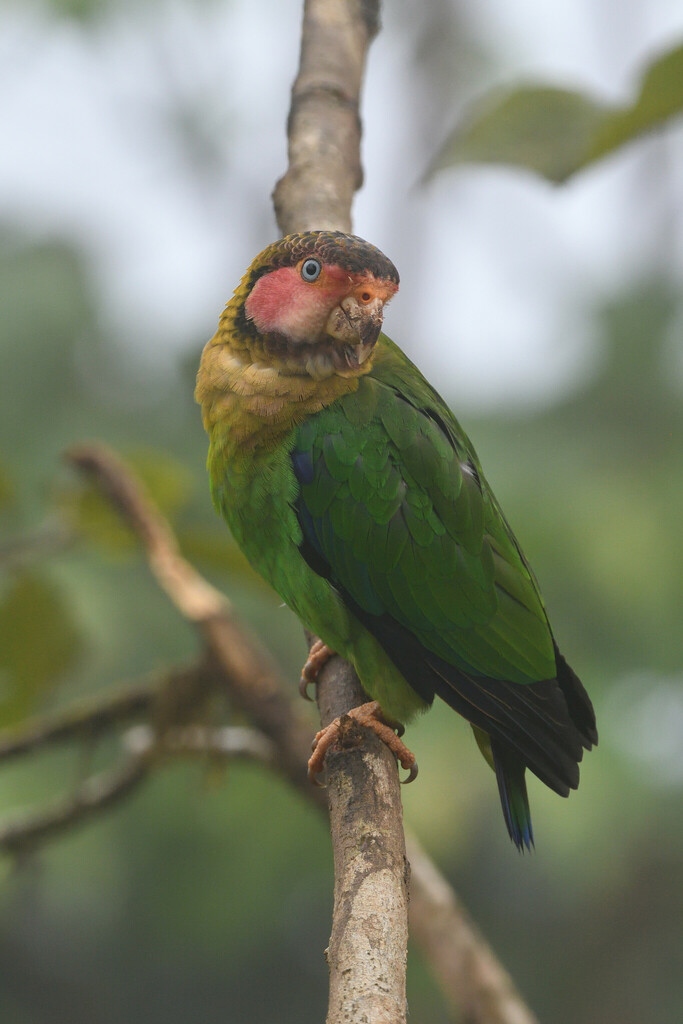
The rose-faced parrot is 21.5 to 23 cm (8.5 to 9.1 in) long. Adults have a reddish brown crown and are pinkish rose from their lores across most of their face. Their nape and breast are dull olive-yellow. Most of the rest of their body is green, with orange and yellow on the bend of the wing, mostly black flight feathers, and blue on the tips of the tail feathers. Their bill is pale creamy whitish. Immature birds are much like adults but with limited rose on the face.
Range & habitat
The rose-faced parrot is found from the central part of Colombia's Chocó Department south through western Ecuador into El Oro Province. It inhabits humid to wet forest, mature secondary forest, plantations, and more open areas with scattered trees. Specimens living in forest tend to stay in the canopy. In elevation it mostly occurs below 1,200 m (3,900 ft) but locally is found as high as 2,100 m (6,900 ft).
Wikipedia: “Distribution and habitat”
What it does
Almost nothing is known about the rose-faced parrot's feeding behavior or diet, but it has been recorded eating small fruit and cultivated bananas.
Wikipedia: “Feeding”
Listen
Looking for field recordings…
Where it lives
Recorded sightings
—
geo-referenced records in GBIF, from museums, herbaria and field observers.
Drag the globe to turn it. Dots are where records exist, not a range map; darker means more records.
In the stacks
Searching the stacks…
Every page naming Pyrilia pulchra in the Biodiversity Heritage Library →
This page is assembled live from iNaturalist, GBIF, Wikipedia, the Source Library and the Internet Archive. It is not yet part of the hand-edited codex. iNaturalist taxon 73324.