On eBird ↗
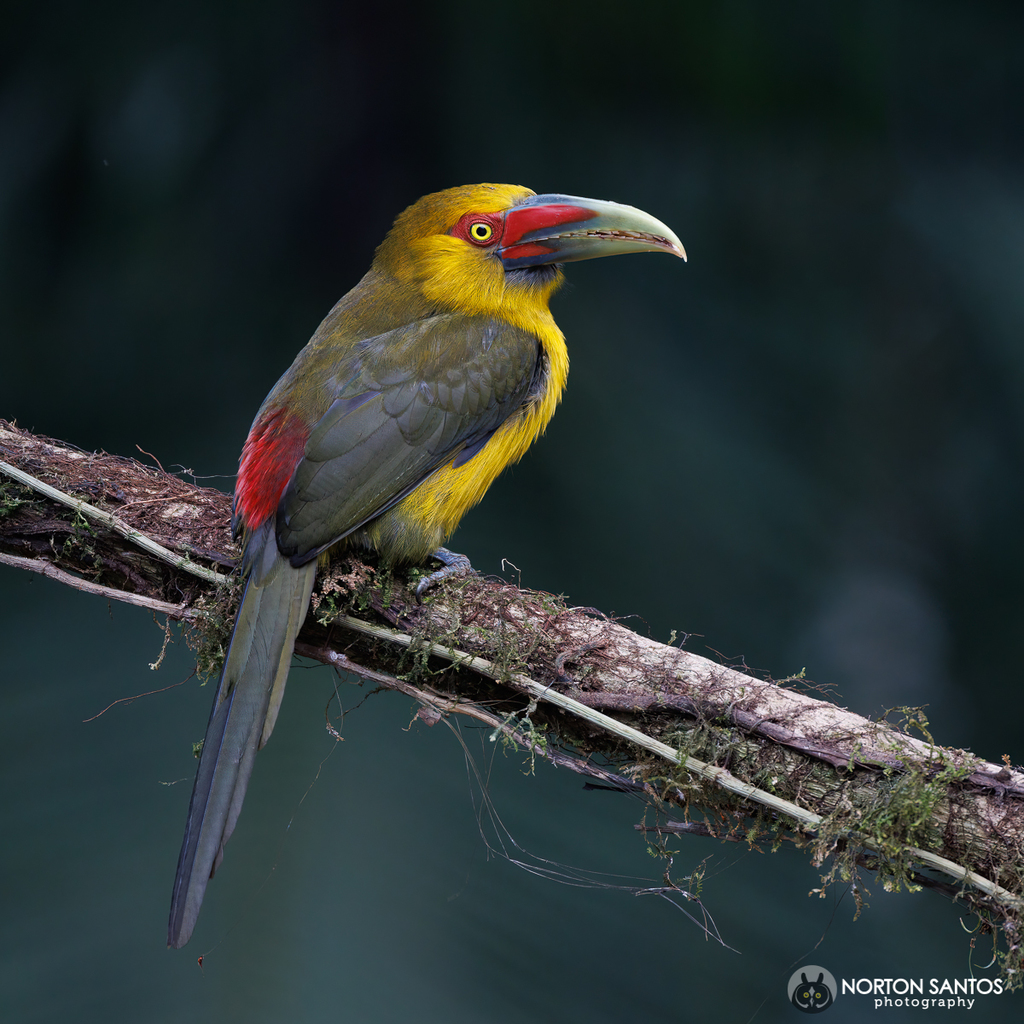
Saffron Toucanet
Live sightings near you, the range map, bar charts of when it is seen, and Macaulay Library photos and recordings.
Saffron Toucanet
Pteroglossus bailloni
The saffron toucanet (Pteroglossus bailloni) is a species of bird in the family Ramphastidae found in the Atlantic Forest in far north-eastern Argentina, south-eastern Brazil, and eastern Paraguay.
From the article Saffron toucanet on Wikipedia (CC BY-SA), quoted section by section
Description
It is a relatively long-tailed toucan with a total length of 35–40 cm (14–15.5 in). As suggested by its common name, it is, uniquely among toucans, overall saffron yellow. The back and tail are darker, more olive in color. The rump, ocular skin and patches on the basal half of the otherwise greenish-horn bill are red. The iris is pale yellowish. This species is dimorphic, meaning that males and females have distinguished looks from each other. The adult male has a golden head and breast, olive mantle (the wings, shoulder feathers and back) and red rump. They have a modestly sized bill, with green, grey blue, and yellowish-grey color all along it. Adult females are similar to the male but have more olive and less gold coloration; they also have a shorter bill. A young toucanet is mostly olive and grey colored, with brown eyes and a blotchy bill.
Range & habitat
The saffron is found in the Atlantic Forest. The viridis group, a superspecies group that includes the saffron, was separated from the other Pteroglossus group around 3 million years ago. The topologies observed in the study showed the saffron toucanet as a member of the Pteroglossus viridis group instead of a sister lineage to all other Pteroglossus. The saffron is separated from the other species in the viridis group by the Brazilian savanna biome. It is thought that this species is part of an ancient stock that became isolated in the current Atlantic Forest from marine transgression and were not able to adapt and invade the Brazilian savanna. It depends on forested habitats to survive. One study investigated whether species endemic to the Atlantic forest and with small geographic ranges were more vulnerable to forest fragmentation. This species was found to be "endemic and high sensitivity" to the fragmentation, meaning that since they are native to the land, they are more likely to be affected by the split. It was found that species at the edges of their ranges were sensitive to fragmentation as well. This may be due to fewer nearby populations for species to move to once their local populations were lost.
Wikipedia: “Distribution and habitat”
What it does
The saffron is a large-gape frugivore. Due to their nature, they are especially crucial for plants with larger seeds to disperse themselves to further areas. They are one of the few birds that are capable of carrying larger seeds to new locations. One study suggests that there is a strong association between species' contribution to network modularity and species' number of interactions. Species with many links tend to establish interactions both within and among environments and to exhibit a greater contribution to nestedness. On average, species that contribute more to network organization, like the saffron, are at a higher risk of extinction. Without a connection between certain species of plant, there may be ecological and evolutionary consequences such as co-extinction.
Breeding. The saffron toucanet has been observed making nests beginning in October. The highest numbers of active nests were recorded in November. Their nests had a cavity depth of 20.0 – 68.0 cm, an entrance diameter of 4.3 – 7.4 cm, and a cavity height of 7.0 – 24.0 meters. Due to their small size, they do not need large cavities for their nests and they do not need to compete with other species for suitable spots. They prefer making their nests in living trees such as the Garapa (Apuleia leiocarpa) and the Aspidosperma australe. The diameter at breast height (DBH) was between 44 – 132 cm. …
Wikipedia: “Behavior and ecology”
Listen
Looking for field recordings…
Where it lives
Recorded sightings
—
geo-referenced records in GBIF, from museums, herbaria and field observers.
Drag the globe to turn it. Dots are where records exist, not a range map; darker means more records.
In the stacks
Searching the stacks…
Every page naming Pteroglossus bailloni in the Biodiversity Heritage Library →
This page is assembled live from iNaturalist, GBIF, Wikipedia, the Source Library and the Internet Archive. It is not yet part of the hand-edited codex. iNaturalist taxon 73304.