On eBird ↗
Blue-winged Macaw
Live sightings near you, the range map, bar charts of when it is seen, and Macaulay Library photos and recordings.
Blue-winged Macaw
Primolius maracana
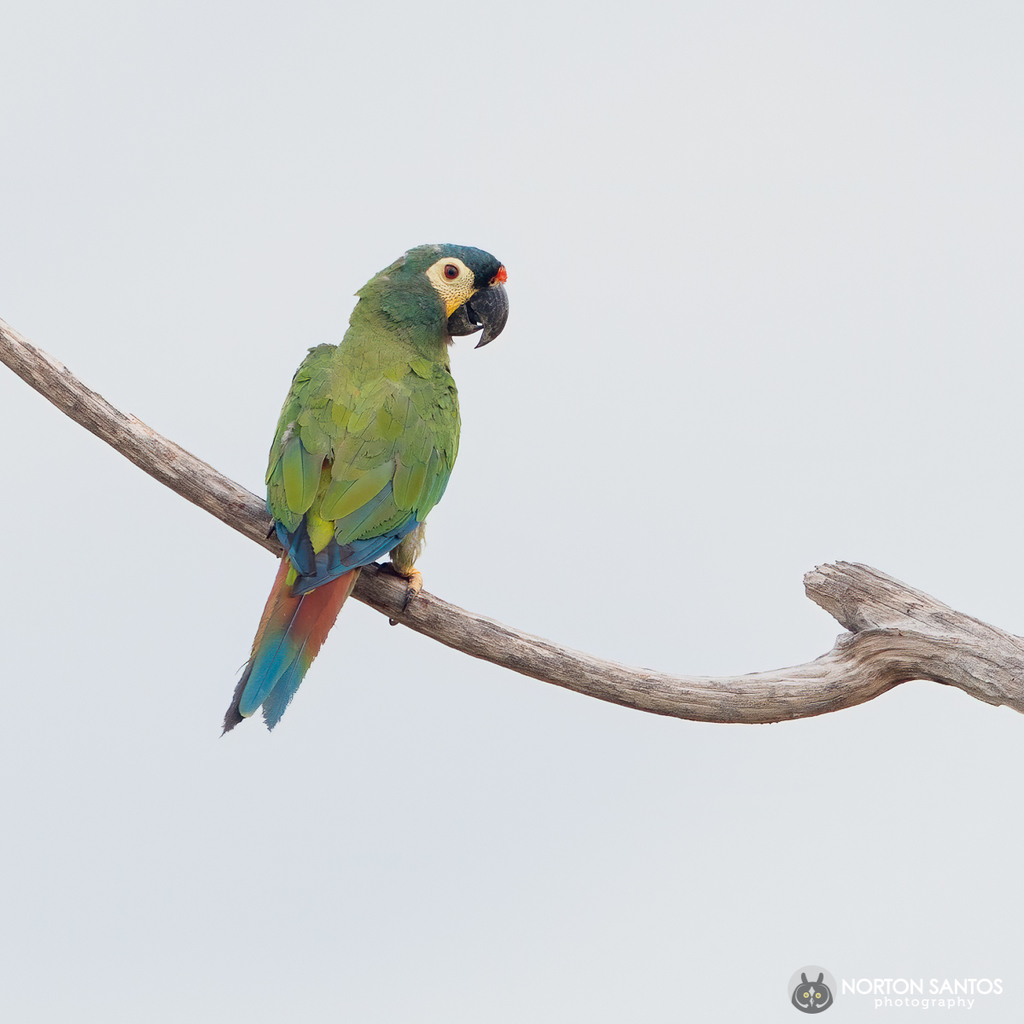
The blue-winged macaw (Primolius maracana), in aviculture more commonly known as Illiger's macaw, is a species of small macaw (sometimes called a mini-macaw) found in central and eastern South America. The second name is in honor of the German ornithologist Johann Karl Wilhelm Illiger. It was previously placed in the genera Ara or Propyrrhura. Blue-winged macaws have been known to reach an age of 50–60 years.
From the article Blue-winged macaw on Wikipedia (CC BY-SA), quoted section by section
Description
It has a total length of approximately 36–43 cm (14–17 in). It has a moderately sized black bill, a long tail and a mainly green plumage. The upperside of the remiges and primary coverts are blue, as indicated by its common name. The underside of the wings is yellowish, the tail-tip, crown and cheeks are bluish, and the tail-base and small belly-patch are red. The iris is amber. It and the red-bellied macaw are the only macaws where the bare facial-skin is yellowish, but this often fades to white in captivity. Unlike the red-bellied macaw, the blue-winged has a red lower abdomen and a red lower back. In the wild, its flight pattern is said to be a distinctive 'jerky, rearing motion.'
Range & habitat
The blue-winged macaw occurs in eastern and southern Brazil (with a remnant population north-east), eastern Paraguay and, at least formerly, in far north-eastern Argentina and east of Bolivia. It occurs in evergreen and deciduous forests, with a preference for gallery forest. They mainly feed on seeds of Cnidoscolus phyllacanthus, Jatropha, Guazuma ulmifolia, and the non-native Melia azedarach. However, the birds also feed on fruits and nuts.
Wikipedia: “Habitat and food”
In human culture
The blue-winged macaw is sometimes kept by humans as an aviary bird or companion parrot. An intensely social bird and a strong flier, this macaw does best when housed with other birds (whether other blue-winged macaws or member of a different parrot species) and given plenty of space in which to fly. It is also an avid chewer and may damage its keeper's property unless provided with wooden destructible objects to occupy its time. Captive breeding of this species is encouraged, due to conservation concerns. If kept as a pet, the blue-winged macaw can bond strongly with humans and some individuals may even begin to mirror their owner's emotional state.
Wikipedia: “Aviculture”
Listen
Looking for field recordings…
Where it lives
Recorded sightings
—
geo-referenced records in GBIF, from museums, herbaria and field observers.
Drag the globe to turn it. Dots are where records exist, not a range map; darker means more records.
In the stacks
Searching the stacks…
Every page naming Primolius maracana in the Biodiversity Heritage Library →
This page is assembled live from iNaturalist, GBIF, Wikipedia, the Source Library and the Internet Archive. It is not yet part of the hand-edited codex. iNaturalist taxon 73274.