On eBird ↗
Vegetarian Finch
Live sightings near you, the range map, bar charts of when it is seen, and Macaulay Library photos and recordings.
Vegetarian Finch
Platyspiza crassirostris
The vegetarian finch (Platyspiza crassirostris) is a species of bird in the Darwin's finch group of the tanager family Thraupidae. It is monotypic within the genus Platyspiza. It is endemic to the Galápagos Islands. Its natural habitats are subtropical or tropical dry forests and subtropical or tropical moist montane forests.
From the article Vegetarian finch on Wikipedia (CC BY-SA), quoted section by section
Description
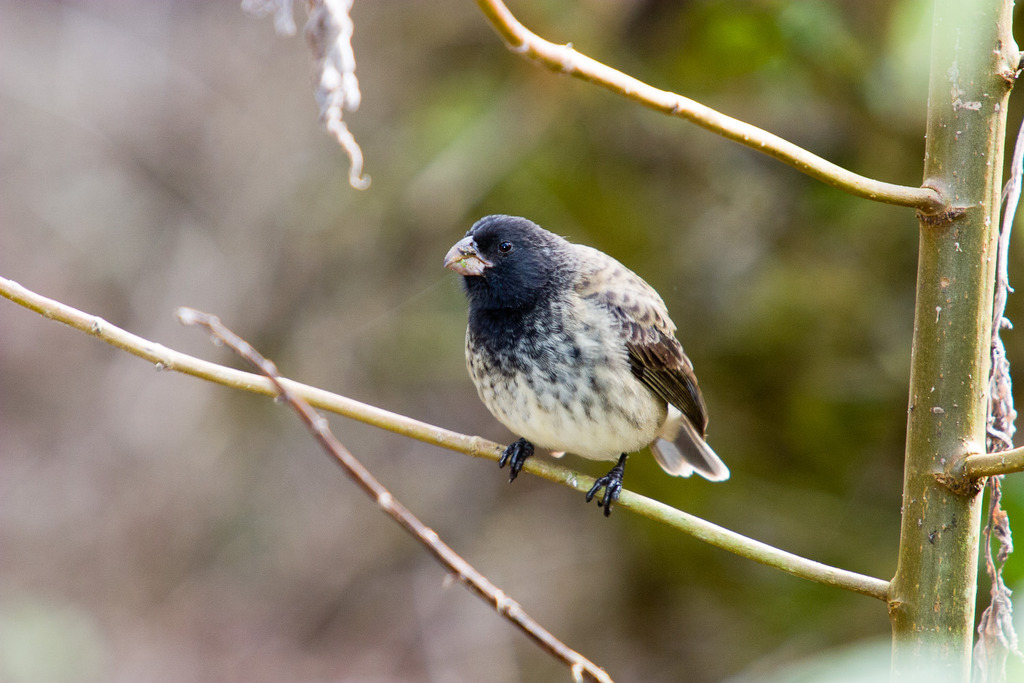
The vegetarian finch is one of the largest Galápagos finches, measuring 16 cm (6.3 in) in length and ranging from 29 to 40 g (1.0 to 1.4 oz) in mass. Its upright stance is described as "parrot-like". Its beak is broad and stout, with a strongly curved culmen. Males have upper parts which are olive-colored, with underparts that are whitish, with smudgy streaking on the lower breast and flanks; some birds show rufous on the underparts. Their lower flanks and undertail coverts are buffy, with a black hood, throat, breast and upper flanks. Their iris is dark, and the bill is black in the breeding season and horn-colored during the rest of the year. Females are principally brown above and off-white below, with a buffy rump and flanks streaked with brown on the face, crown, upperparts, throat, breast and flanks, and show two indistinct buffy wingbars on the brown wings. Their beak is two-toned; the upper mandible ranges in color from dusky brown to black, while the lower mandible is dull orange or dull pink. The immature male is intermediate in appearance between the adult male and the adult female; it appears blackish on the face and throat, but is more streaked below than the adult male.
Voice. The song of the vegetarian finch is nasal and drawn out, with each note lasting about two seconds. Transcribed as ph'wheeeuuuuu-íííúúú, it is accented towards the end. …
Range & habitat
Endemic to the Galápagos, the vegetarian finch is found on seven islands: San Cristóbal, Santa Cruz, Isabela, Marchena, Santiago, Pinta and Fernandina. It is found from 0 to 500 m (0 to 1,640 ft) above sea level. Although it is most common in montane evergreen forest, particularly the transition zone, its range also extends up into the humid zone and down into the arid zone. Although the vegetarian finch was previously found on Pinzón, Santa Fé, and Floreana, the species is now extirpated from these islands. On Floreana, the species was rarely observed in the second half of the 20th century, with the last reported sightings of single individuals in the agricultural zone in 2004 and at Cerro Pajas in 2008.
Wikipedia: “Range and habitat”
What it does
The vegetarian finch is largely a plant-eater. It feeds primarily on buds, leaves, flowers and fruit, and will strip the bark off twigs to get to the cambium and phloem which lies underneath. Although it forages mainly in trees, it will descend to the ground to search for fallen fruits and young plant shoots. It also occasionally eats caterpillars. It feeds primarily at mid-levels, in what has been described as a "rather leisurely" manner. Because its principal food items are soft, the vegetarian finch has a beak morphology unlike those of Darwin's finches which specialize on hard seeds. Described as "parrot-like", the beak is small and stout, with a steep profile and a strong curve in the upper mandible. Its primary function is food manipulation at the tip, rather than seed crushing at the base. The vegetarian finch has a disproportionately large gizzard for its size, as well as a long intestine and a disproportionately small heart. These allow it to process the "relatively indigestible" leaves and buds that make up a large proportion of its diet.
Wikipedia: “Feeding”
In human culture
The genus name Platyspiza comes from the Greek platus, meaning "broad" and spiza, meaning "finch". The specific name crassirostris comes from the Latin crassus, meaning "heavy" or "thick" and rostris, meaning "-billed" (rostrum = bill). The "vegetarian" of its common name refers to its primary diet.
Wikipedia: “Etymology”
Listen
Looking for field recordings…
Where it lives
Recorded sightings
—
geo-referenced records in GBIF, from museums, herbaria and field observers.
Drag the globe to turn it. Dots are where records exist, not a range map; darker means more records.
In the stacks
Searching the stacks…
Every page naming Platyspiza crassirostris in the Biodiversity Heritage Library →
This page is assembled live from iNaturalist, GBIF, Wikipedia, the Source Library and the Internet Archive. It is not yet part of the hand-edited codex. iNaturalist taxon 73255.