On eBird ↗
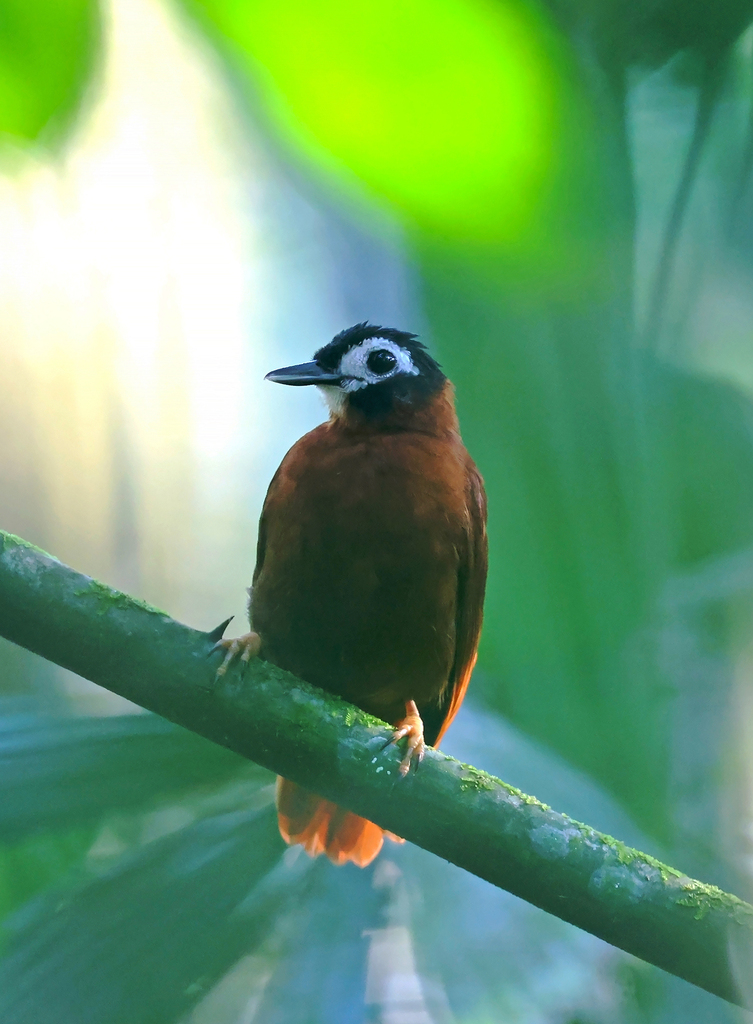
White-masked Antbird
Live sightings near you, the range map, bar charts of when it is seen, and Macaulay Library photos and recordings.
White-masked Antbird
Pithys castaneus
The white-masked antbird (Pithys castaneus) is a Near Threatened species of bird in subfamily Thamnophilinae of family Thamnophilidae, the "typical antbirds". It is endemic to Peru.
From the article White-masked antbird on Wikipedia (CC BY-SA), quoted section by section
Description
The white-masked antbird is about 14 cm (5.5 in) long. The sexes are alike. Adults are mostly bright rufous chestnut. Their crown, nape, lower ear coverts, and the sides of their throat are black. Their lores, a wide area around their eye, their chin, and their throat are white. Juveniles are a duller rufous chestnut, with less white on the face and with sooty brown replacing the adult's black on the head. Adults have a brown or dark brown iris and brownish orange or ochre orange legs and feet. Juveniles' iris is dark gray and their legs and feet gray-tinged dirty yellow. All ages have a blackish slate bill with silvery white cutting edges.
Range & habitat
The white-masked antbird is found in northern Peru in a small area from northeastern Amazonas Department into western Loreto. It inhabits a type of stunted forest called varillal that grows on white sand soil. Its floor typically has a thick layer of humus and dead leaves, and the trees reach a height of about 30 m (100 ft). All of the known sites are below an elevation of 300 m (1,000 ft).
Wikipedia: “Distribution and habitat”
What it does
The white-masked antbird is an obligate ant follower that feeds on arthropods that flee foraging army ant swarms. It typically forages near the front of the ant swarm, sallying or dropping to the ground from a low perch. Up to four have been observed at a swarm.
Wikipedia: “Feeding”
Listen
Looking for field recordings…
Where it lives
Recorded sightings
—
geo-referenced records in GBIF, from museums, herbaria and field observers.
Drag the globe to turn it. Dots are where records exist, not a range map; darker means more records.
In the stacks
Searching the stacks…
Every page naming Pithys castaneus in the Biodiversity Heritage Library →
This page is assembled live from iNaturalist, GBIF, Wikipedia, the Source Library and the Internet Archive. It is not yet part of the hand-edited codex. iNaturalist taxon 73251.