On eBird ↗
James's Flamingo
Live sightings near you, the range map, bar charts of when it is seen, and Macaulay Library photos and recordings.
James's Flamingo
Phoenicoparrus jamesi
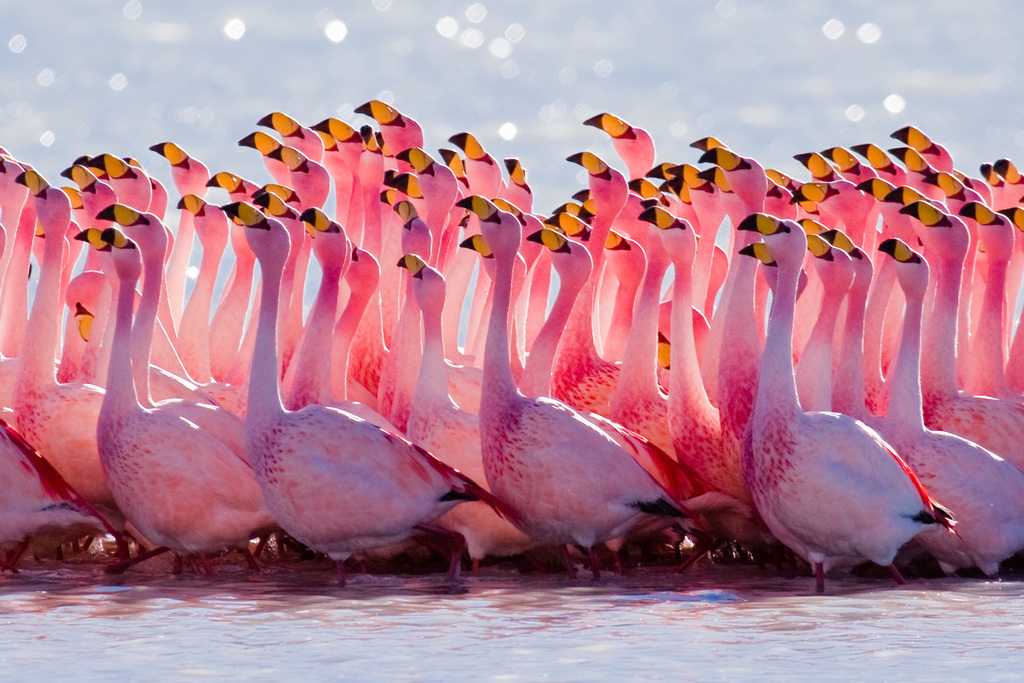
James's flamingo (Phoenicoparrus jamesi), also known as the puna flamingo, is a species of flamingo that lives at high altitudes in the Andean plateaus of Peru, Chile, Bolivia, and northwest Argentina.
It is named for Harry Berkeley James, a British naturalist who studied the bird. James's flamingo is closely related to the Andean flamingo, and the two species are the only members of the genus Phoenicoparrus. The Chilean flamingo, Andean flamingo, and James's flamingo are all sympatric, and all live in colonies (including shared nesting areas). James's flamingo had been thought to be extinct until a population was discovered in a remote area in 1956.
From the article James's flamingo on Wikipedia (CC BY-SA), quoted section by section
Description
The James's flamingo is smaller than the Andean flamingo, and is about the same size as the Old World species, the lesser flamingo. A specimen of the bird was first collected by Charles Rahmer, who was on a collecting expedition sponsored by Harry Berkeley James, (1846–1892, a manager of a Chilean saltpetre mine born in Walsall, England) after whom the bird was named. It typically measures about 90–92 cm (2.95–3.02 ft) long and weighs about 2 kg (4.4 lb). James's flamingos have a very long neck made up of 19 long cervical vertebrae, allowing for a large range of movement and rotation of the head. They are also distinctive for their long, thin legs. The knee is not externally visible: it is located at the top of the leg. The joint at the middle of the leg, which may be mistaken for the knee joint, is actually the ankle joint. Its plumage is very pale pink, with bright carmine streaks around the neck and on the back. When it is perched, a small amount of black can be seen in its wings; these are the "flight feathers". They have bright red skin around their eyes, which in adults are yellow. …
What it does
Both James's and Andean flamingos feed their chicks through an esophageal secretion that is regurgitated from the crop of the bird. The difference between the two species lies in the composition of the prolactin secretion produced by each bird. Both male and female parents are able to feed the chick. Adult flamingos are the most developed filter feeders of the birds. Of the species, James's flamingo has the finest filter-feeding apparatus. The flamingo feeds on diatoms and other microscopic algae. The shape of the bill is deeply keeled. To feed, the flamingos' long legs allow them to walk into the water and swoop their necks down into an S-shape to allow the beak to enter the water. The S-shape is effective because it allows the head to be placed upright and the bottom of the bill to be placed as shallow or as deep as it pleases. Only lowering the distal end of the bill into the water allows nostrils to remain above water. The water filled with small organisms floods the bill and filtration process begins. The lakes, from which the flamingo typically feeds, are Andean lakes which are mostly fresh water, but if salt water is encountered, the flamingos have salt glands in their nostrils where excess salt is secreted.
The filtering process starts with the tongue, which is very soft and fleshy with channel-like features that direct the food and water to the filtering apparatus. …
Wikipedia: “Feeding”
Listen
Looking for field recordings…
Where it lives
Recorded sightings
—
geo-referenced records in GBIF, from museums, herbaria and field observers.
Drag the globe to turn it. Dots are where records exist, not a range map; darker means more records.
In the stacks
Searching the stacks…
Every page naming Phoenicoparrus jamesi in the Biodiversity Heritage Library →
This page is assembled live from iNaturalist, GBIF, Wikipedia, the Source Library and the Internet Archive. It is not yet part of the hand-edited codex. iNaturalist taxon 73221.