- Animals
- ›Chordates
- ›Vertebrates
- ›Birds
- ›Hawks, Eagles, Kites, and Allies
- ›Hawks, Eagles, and Kites
- ›Typical Eagles and Hawk-Eagles
- ›Nisaetus
On eBird ↗
Mountain Hawk-Eagle
Live sightings near you, the range map, bar charts of when it is seen, and Macaulay Library photos and recordings.
Mountain Hawk-Eagle
Nisaetus nipalensis
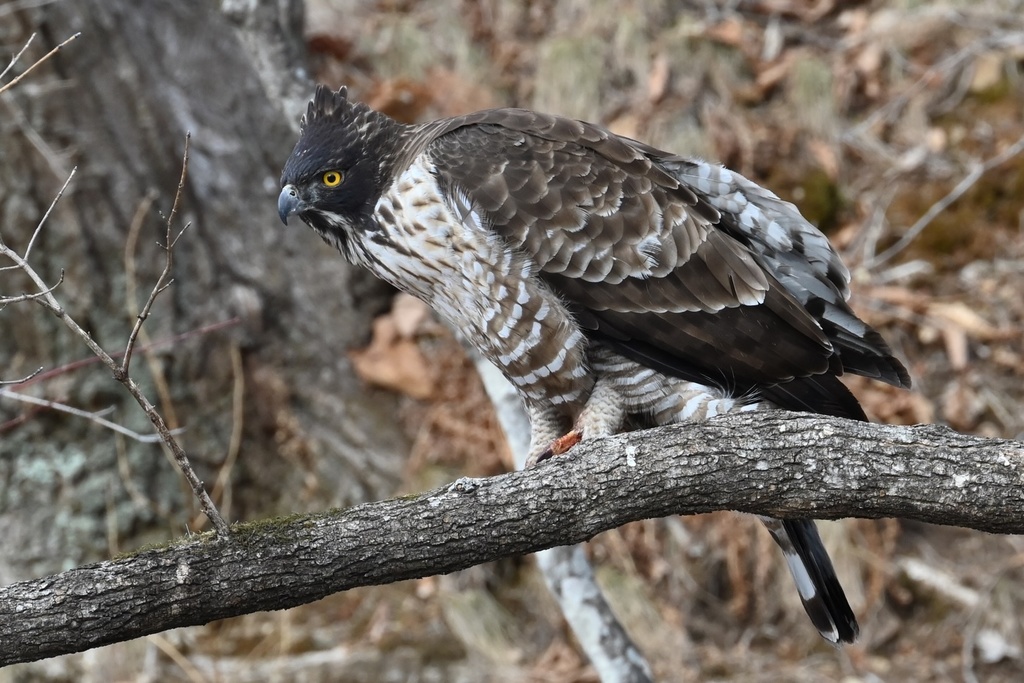
The mountain hawk-eagle (Nisaetus nipalensis) or Hodgson's hawk-eagle, is a large bird of prey native to Asia. The latter name is in reference to the naturalist, Brian Houghton Hodgson, who described the species after collecting one himself in the Himalayas. A less widely recognized common English name is the feather-toed eagle. Like all eagles, it is in the family Accipitridae. Its feathered tarsus marks this species as a member of the subfamily Aquilinae. It is a confirmed breeding species in the northern part of the Indian subcontinent, from India, Nepal (hence the epithet nipalensis) through Bangladesh to Thailand, Taiwan, Vietnam and Japan, although its distribution could be wider still as breeding species. Like other Asian hawk-eagles, this species was earlier treated under the genera of Spizaetus but genetic studies have shown this group to be paraphyletic, resulting in the Old World members being placed in Nisaetus (Hodgson, 1836) and separated from the New World species. As is typical of hawk-eagles, the mountain hawk-eagle is a forest dwelling opportunistic predator who readily varies its prey selection between birds, mammals and reptiles along with other vertebrates. Although classified currently as a least-concern species due its persistence over a rather wide distribution, this species is often quite rare and scarce and seems to be decreasing, especially in response to large-scale habitat degradation and deforestation.
From the article Mountain hawk-eagle on Wikipedia (CC BY-SA), quoted section by section
Range & habitat
Both the northern and southern limits of this widely found raptor are surprisingly poorly known to this day, with historic records suggesting that the species may take up residence hundreds of kilometers north of its accepted range and year-around reports of this species from areas formerly considered only to be visited by wintering migrant or vagrant hawk-eagles. The mountain hawk-eagle is distributed through the Himalayas, extending from northeastern Pakistan through north India in at least the states of central Jammu and Kashmir, Himachal Pradesh and Uttarakhand, continuing into Nepal, Bhutan to northern Assam thence southward into the north and east Burmese highlands, west and peninsular Thailand, also the northern parts of Laos and probably Vietnam. Their range continues eastward into southeastern China where they may be found in Yunnan, Guangxi and Guangdong Province northward in the east to the lower reaches of the Yangtze in Anhui and Zhejiang. Their range also extends to Hainan, an offshore island of China. Mountain hawk-eagles are additionally found in the island nations of Taiwan and Japan, with the highest concentration known on northern islands such Hokkaido but they may be found on nearly all the islands of Japan. …
Wikipedia: “Distribution and habitat”
What it does
Mountain hawk-eagles are well adapted to living in forests. As is the case for all Nisaetus species, their physical form and flight style is typical of forest-dwelling raptors in general and is often found to be roughly comparable to the features of true hawks or Accipiters in particular larger species such as the occasionally sympatric Eurasian Goshawk (Accipiter Gentilis). Like most other forest raptors, mountain hawk-eagles (and Nisaetus species in general) have a long tail, short broad wings and relatively long but powerful legs, all of which impart greater maneuverability and quicker strike times in denser wooded hunting grounds than other raptorial body plans. The common name hawk-eagle is apparently in reference to their similar adaptations to true hawks. Contrary to the suggestion that, based on their physiology, especially their longer wings and tarsus but shorter talon and bill length, when physically compared to the Legge's hawk-eagle implies that the mountain hawk-eagle is morphologically adapted to hunting birds more so than mammals, dietary studies indicate that the mountain hawk-eagle is not necessarily a specialized bird predator but rather a generalist and opportunist like many predators. …
Wikipedia: “Behaviour and ecology”
In human culture
The eagle's feathers are coveted among indigenous Paiwan and Rukai peoples of Taiwan; the Rukai especially regard it as sacred being a reincarnation of the sharp-nosed viper who guided their ancestors.
Listen
Looking for field recordings…
Where it lives
Recorded sightings
—
geo-referenced records in GBIF, from museums, herbaria and field observers.
Drag the globe to turn it. Dots are where records exist, not a range map; darker means more records.
In the stacks
Searching the stacks…
Every page naming Nisaetus nipalensis in the Biodiversity Heritage Library →
This page is assembled live from iNaturalist, GBIF, Wikipedia, the Source Library and the Internet Archive. It is not yet part of the hand-edited codex. iNaturalist taxon 73104.