On eBird ↗
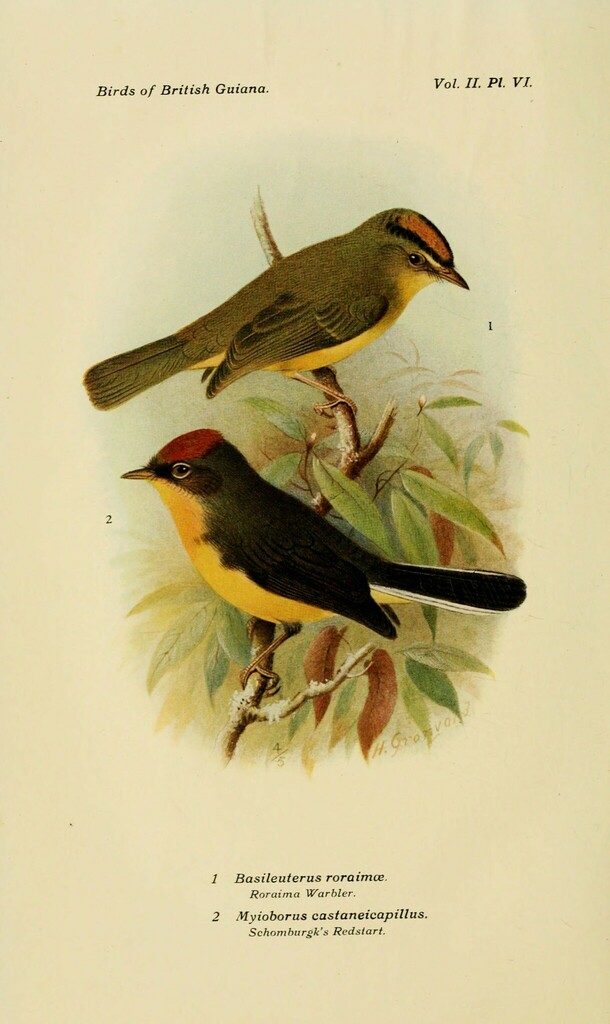
Tepui Redstart
Live sightings near you, the range map, bar charts of when it is seen, and Macaulay Library photos and recordings.
Tepui Redstart
Myioborus castaneocapilla
The tepui whitestart (Myioborus castaneocapilla), or, less accurately, the tepui redstart, is a species of bird in the Parulidae family. It is found in humid highland forest, woodland and scrub in the Tepuis in southern Venezuela, western Guyana and northern Brazil. It is sometimes included as a subspecies of the brown-capped whitestart.
From the article Tepui whitestart on Wikipedia (CC BY-SA), quoted section by section
Description
The tepui whitestart is about 13 cm (5.1 in) long and weighs 7.5 to 12 g (0.26 to 0.42 oz). The sexes have the same plumage. Adults of the nominate subspecies M. c. castaneocapilla have a mostly gray head with a rufous crown, a pale gray stripe above the lores, and thin white crescents above and below the eye. Their upperparts are gray with an olive tinge. Their wings are gray. Their tail is black with much white on the outer two pairs of feathers and a large white spot at the tip of the next pair inward. Their throat and most underparts are yellow and their undertail coverts white. Subspecies M. c. duidae is brighter overall than the other two subspecies. It has a whiter, more visible loral stripe, larger eye crescents, and purer gray upperparts than the nominate with rich orange-yellow underparts. M. c. maguirei has more conspicuous eye crescents and paler yellow underparts than the nominate. All subspecies have a dark iris, a blackish bill, and dusky gray to blackish legs and feet.
Range & habitat
The tepui whitestart has a disjunct distribution in the tepui region where Venezuela, Guyana, and Brazil meet. The nominate subspecies is the most widespread. It is found from Auyán-tepui and Sierra de Lema in Venezuela's eastern Bolívar state east and south into western Guyana and extreme northern Brazil's Roraima state. Subspecies M. c. duidae is found on several Venezuelan tepuis in southern Bolívar and northern and central Amazonas state. M. c. maguirei is found only on Cerro de la Neblina, which is mostly in Venezuelan Amazonas and extends slightly into Brazil's Amazonas state. The species inhabits the edges and clearings of primary and secondary montane forest. In elevation it ranges between 1,200 and 2,200 m (3,900 and 7,200 ft).
Wikipedia: “Distribution and habitat”
What it does
The tepui whitestart feeds on insects and is assumed to also feed on other arthropods. Pairs forage mostly by gleaning from the forest's understory to its middle levels and often join mixed-species feeding flocks.
Wikipedia: “Feeding”
Listen
Looking for field recordings…
Where it lives
Recorded sightings
—
geo-referenced records in GBIF, from museums, herbaria and field observers.
Drag the globe to turn it. Dots are where records exist, not a range map; darker means more records.
In the stacks
Searching the stacks…
Every page naming Myioborus castaneocapilla in the Biodiversity Heritage Library →
This page is assembled live from iNaturalist, GBIF, Wikipedia, the Source Library and the Internet Archive. It is not yet part of the hand-edited codex. iNaturalist taxon 73073.