On eBird ↗
Española Mockingbird
Live sightings near you, the range map, bar charts of when it is seen, and Macaulay Library photos and recordings.
Española Mockingbird
Mimus macdonaldi
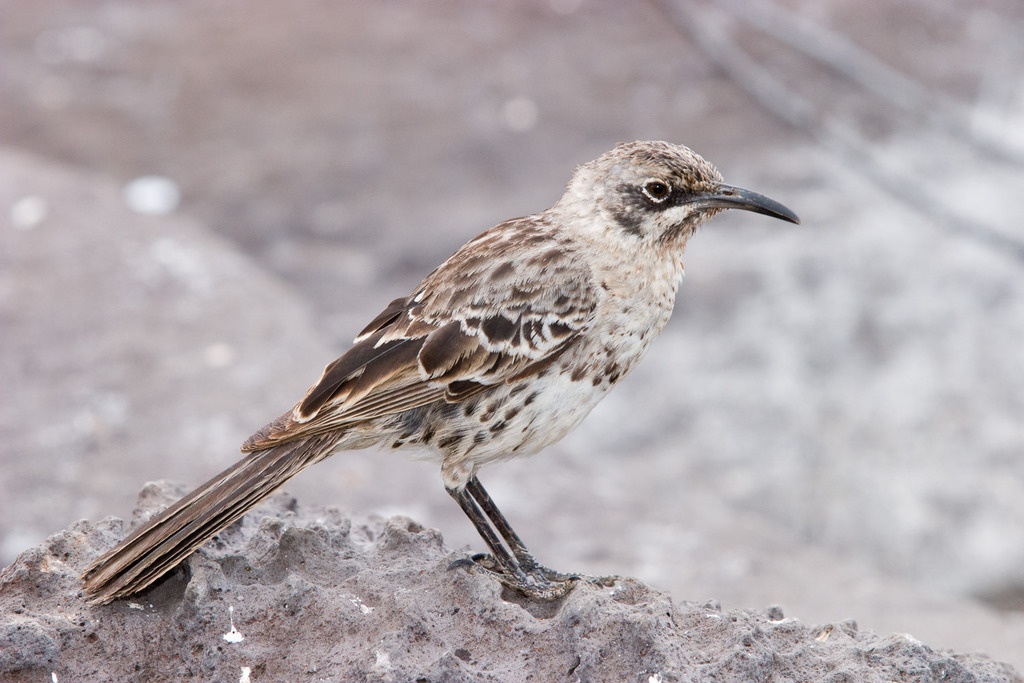
The Española mockingbird (Mimus macdonaldi), also known as the Hood mockingbird, is a species of bird in the family Mimidae. It is endemic to Española Island in the Galápagos Islands, Ecuador, and it is one of four closely related mockingbird species endemic to the Galápagos archipelago. It is found in dry forests and is omnivorous, though it primarily is a carnivore or scavenger. The species has a highly territorial social structure and has no fear of humans. It is the only species of Galápagos mockingbird that Charles Darwin did not see or collect on the voyage of HMS Beagle.
From the article Española mockingbird on Wikipedia (CC BY-SA), quoted section by section
Description
Similar to the other species of Galápagos mockingbirds, this species has a mottled gray and brown plumage with a white underbelly. A long tail and legs give the bird its distinctive appearance. The species has a long, thin beak, useful for tapping into the eggs of seabirds. The species has the largest bill of any of the Galápagos mockingbirds. The species, along with the other Galápagos mockingbirds, is most closely related to the Bahama mockingbird (Mimus gundlachii), despite the closer geographical proximity of Ecuador's long-tailed mockingbird (Mimus longicaudatus).
Range & habitat
Its natural habitats are subtropical or tropical dry forests and subtropical or tropical dry shrubland. Found only on Española Island, the bird can be found throughout the dry scrub of the island.
Wikipedia: “Habitat”
What it does
The species has an omnivorous diet, but is mainly a predator or scavenger. The species will eat the eggs of seabirds nesting on the island, as well as eat from dead animals and kills made by other predators, such as the Galápagos hawk. Sometimes, just like a vampire finch, they will feed on blood of wounded seabirds.
Wikipedia: “Diet”
Listen
Looking for field recordings…
Where it lives
Recorded sightings
—
geo-referenced records in GBIF, from museums, herbaria and field observers.
Drag the globe to turn it. Dots are where records exist, not a range map; darker means more records.
In the stacks
Searching the stacks…
Every page naming Mimus macdonaldi in the Biodiversity Heritage Library →
This page is assembled live from iNaturalist, GBIF, Wikipedia, the Source Library and the Internet Archive. It is not yet part of the hand-edited codex. iNaturalist taxon 73049.