On eBird ↗
Variable Oriole
Live sightings near you, the range map, bar charts of when it is seen, and Macaulay Library photos and recordings.
Variable Oriole
Icterus pyrrhopterus
The variable oriole (Icterus pyrrhopterus) is a species of bird in the family Icteridae, the oropendolas, New World orioles, and New World blackbirds. It is found in Argentina, Bolivia, Brazil, Paraguay, and Uruguay and as a vagrant to Chile.
From the article Variable oriole on Wikipedia (CC BY-SA), quoted section by section
Description
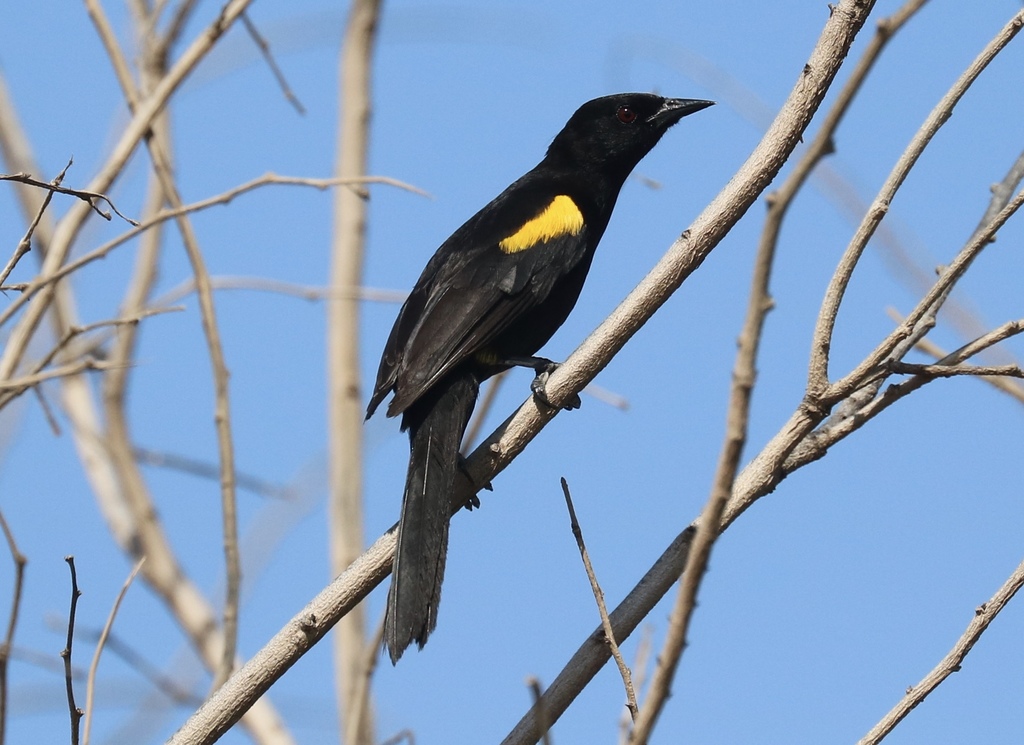
The variable oriole is about 20 cm (7.9 in) long. Males weigh an average of about 33 g (1.2 oz) and females an average of 30 g (1.1 oz). The sexes have the same plumage. Adults of the nominate subspecies I. p. pyrrhopterus are almost entirely black. They have dark chestnut lesser and median wing coverts that show as an epaulet on the closed wing and a pale gray underwing. Subspecies I. p. periporphyrus has a larger and paler chestnut epaulet than the nominate. I. p. valenciobuenoi is similar to the nominate but has a variable tawny to yellow epaulet. I. p. tibialis has a yellow epaulet and yellow thigh feathers. All subspecies have a reddish tawny to dark red-brown iris, a slender, straight, blackish bill, and leaden gray to blackish legs and feet. Juveniles are more dusky than pure black and have paler epaulets than adults.
Range & habitat
Subspecies I. p. tibialis is the most northerly of the four. It is found in eastern Brazil from Maranhão and Ceará south to Rio de Janeiro state. Subspecies I. p. valenciobuenoi is found in southeastern Brazil from Goiás and Minas Gerais south to Santa Catarina. I. p. periporphyrus is found from Beni and Cochabamba departments in east-central Bolivia east into west-central Brazil's Mato Grosso. The nominate I. p. pyrrhopterus is found from southeastern Bolivia east through Paraguay into southern Brazil's Mato Grosso do Sul and Rio Grande do Sul, south through Uruguay, and south in Argentina roughly to a line from San Juan Province to northern Buenos Aires Province. The South American Classification Committee also has documented records of the species in Chile. The variable oriole inhabits a wide variety of landscapes, most of which are somewhat open. They include clearings and edges of forest, gallery forest, palm savanna, Gran Chaco and humid Chaco woodlands, caatinga woodlands, parks, and gardens. In Brazil it ranges from sea level to 900 m (3,000 ft). It reaches 2,500 m (8,200 ft) in Bolivia though is rare at that elevation.
Wikipedia: “Distribution and habitat”
What it does
The variable oriole feeds on insects, other arthropods, fruit, nectar, and flowers. It almost always forages in trees and often hangs upside-down to reach food. During the breeding season it forages mainly in pairs and family groups; in the non-breeding season it may feed in flocks of up to 30 individuals. In the latter season it also often joins mixed-species feeding flocks.
Wikipedia: “Feeding”
Listen
Looking for field recordings…
Where it lives
Recorded sightings
—
geo-referenced records in GBIF, from museums, herbaria and field observers.
Drag the globe to turn it. Dots are where records exist, not a range map; darker means more records.
In the stacks
Searching the stacks…
Every page naming Icterus pyrrhopterus in the Biodiversity Heritage Library →
This page is assembled live from iNaturalist, GBIF, Wikipedia, the Source Library and the Internet Archive. It is not yet part of the hand-edited codex. iNaturalist taxon 72954.