On eBird ↗
Spix's Warbling-Antbird
Live sightings near you, the range map, bar charts of when it is seen, and Macaulay Library photos and recordings.
Spix's Warbling-Antbird
Hypocnemis striata
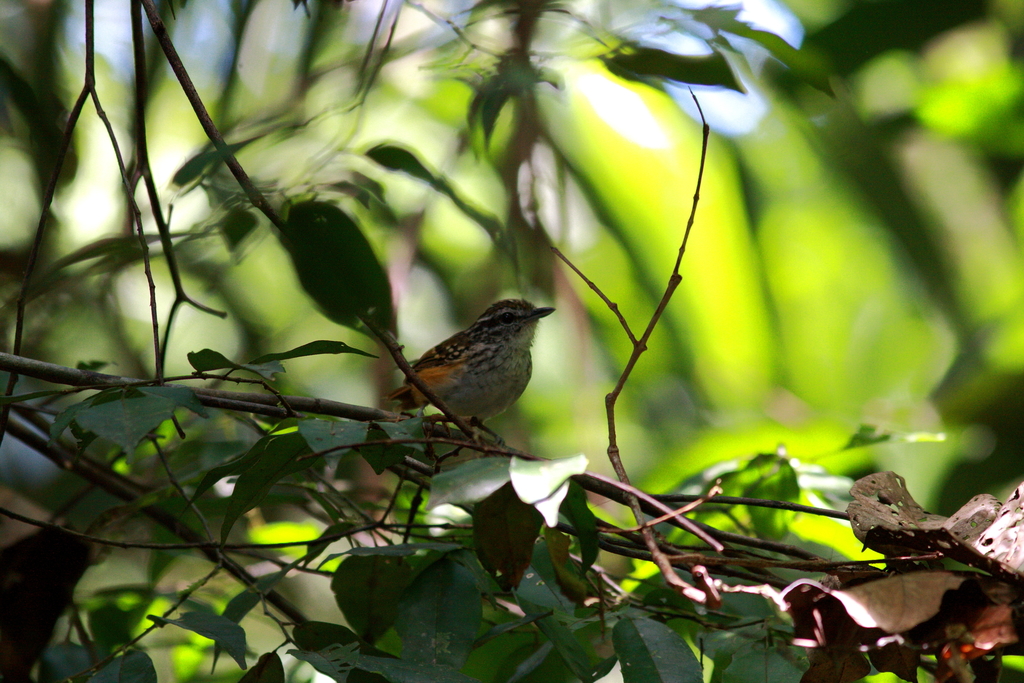
Spix's warbling antbird (Hypocnemis striata) is a species of bird in the family Thamnophilidae. Until recently, it was considered a subspecies of Hypocnemis cantator, but based on vocal differences and to a lesser degree differences in plumage, it has been recommended treating them as separate species. As presently defined, Spix's warbling antbird includes two subspecies, H. s. implicata and H. s. affinis. The westernmost population is likely to represent an undescribed subspecies. Spix's warbling antbird is...
From the article Spix's warbling antbird on Wikipedia (CC BY-SA), quoted section by section
Description
Spix's warbling antbird is 11 to 12 cm (4.3 to 4.7 in) long and weighs 10 to 14 g (0.35 to 0.49 oz). Adult males of the nominate subspecies have a black crown with a white central streak and a white supercilium on an otherwise black and white speckled face. Their upperparts are olive-gray with a white patch between the scapulars; their nape and back have black and white streaks. Their rump is rufous. Their flight feathers are rufescent brown with yellowish olive-brown edges and their wing coverts black with white tips. Their tail is rufescent brown with pale buff tips to the feathers. Their throat is very pale gray. Their breast and sides are spotted with black and white, their belly's center is white, and their flanks and undertail coverts are rufous. Females have the same pattern but different colors than males. Their crown is streaked with pale buff, the interscapular patch is small or absent, their nape and back are streaked buff, black, and white, and their wing coverts are olive-brown with pale buff tips. Subspecies H. s. implicata is similar to the nominate but less deeply rufescent and with more muted black and white streaking. Males of H. s. affinis are more heavily marked than those of implicata but females are less heavily marked.
Range & habitat
Spix's warbling antbird is a resident of Amazonian Brazil south of the Amazon River. Subspecies H. s. implicata is the westernmost; it is found between the rios Madeira and Tapajós and its tributary Teles Pires. The nominate is found from the Tapajos/Teles Pires east to the Rio Xingu and south into north-central Mato Grosso state. H. s. affinis is found from the Xingu east to the Rio Tocantins and south into eastern Mato Grosso. The species inhabits the edges of terra firme and várzea evergreen forest, the transition zone between them, and adjacent mature secondary woodland. It favors the understorey to mid-storey of the forest edges and within the forest along watercourses and at gaps caused by fallen trees. In elevation it ranges up to about 800 m (2,600 ft).
Wikipedia: “Distribution and habitat”
What it does
The diet and foraging behavior of Spix's warbling antbird are not known in detail, but it feeds primarily on insects and spiders. Its diet and behavior are assumed to be very similar to those of its previous "parent" H. cantator, which see here.
Wikipedia: “Feeding”
Listen
Looking for field recordings…
Where it lives
Recorded sightings
—
geo-referenced records in GBIF, from museums, herbaria and field observers.
Drag the globe to turn it. Dots are where records exist, not a range map; darker means more records.
In the stacks
Searching the stacks…
Every page naming Hypocnemis striata in the Biodiversity Heritage Library →
This page is assembled live from iNaturalist, GBIF, Wikipedia, the Source Library and the Internet Archive. It is not yet part of the hand-edited codex. iNaturalist taxon 72940.