On eBird ↗
Golden Parakeet
Live sightings near you, the range map, bar charts of when it is seen, and Macaulay Library photos and recordings.
Golden Parakeet
Guaruba guarouba
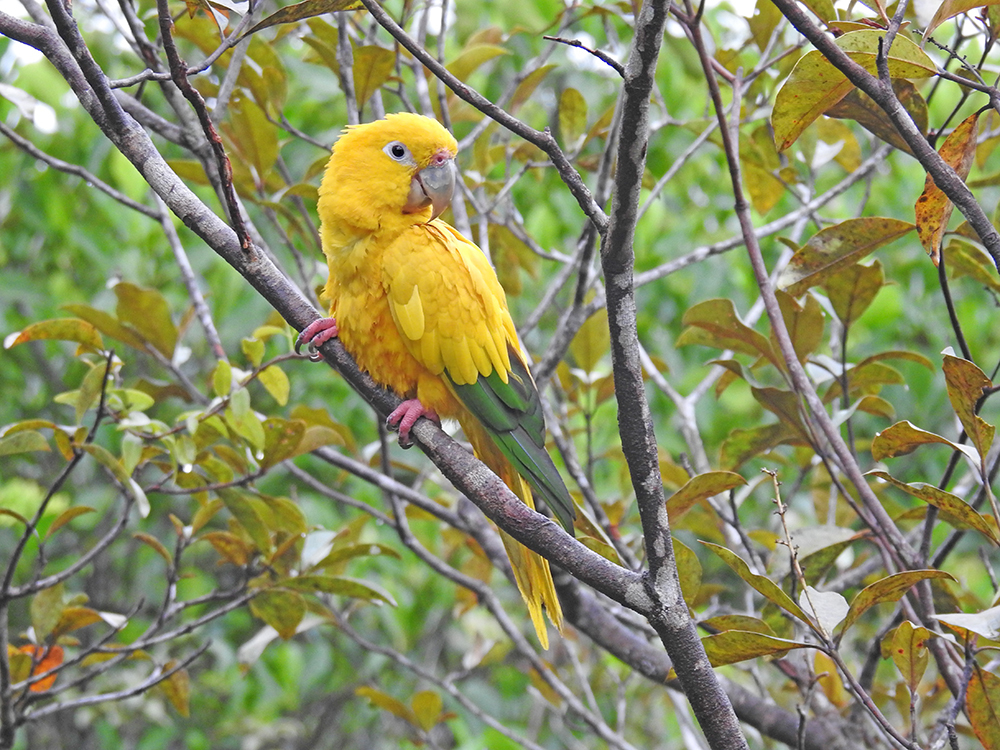
The golden parakeet, golden conure, or Queen of Bavaria conure (Guaruba guarouba) is a medium-sized golden-yellow Neotropical parrot native to the Amazon Basin of interior northern Brazil. It is the only species placed in the genus Guaruba.
Its plumage is mostly bright yellow, hence its common name, but it also possesses green remiges. It lives in the drier, upland rainforests in Amazonian Brazil, and is threatened by deforestation and flooding, and also by the now-illegal trapping of wild individuals for the pet trade. It is listed on CITES appendix I.
From the article Golden parakeet on Wikipedia (CC BY-SA), quoted section by section
Description
The golden parakeet is 34–36 cm (13–14 in) long and mainly yellow with green in the outer wings and with an all-yellow tail. It has a large horn-colored (gray) beak, pale-pink bare eye rings, brown irises, and pink legs. Males and females have identical external appearance. Juveniles are duller and have less yellow and more green plumage than the adults. The juvenile's head and neck are mostly green, the back is green and yellow, the upper side of tail is mostly green, the breast is greenish, the eye rings are pale-gray, and the legs are brown.
Range & habitat
Its range is estimated to be limited to about 174,000 km2. between the Tocantins, lower Xingu, and Tapajós Rivers in the Amazon Basin south of the Amazon River in the state of Pará, northern Brazil. Additional records occur from adjacent northern Maranhão. The birds in a 1986 study used two different habitats during the year; during the nonbreeding season, which coincided with the dry season, they occupied the tall forest. During the breeding season, they left the tall forest and entered open areas on the edge of the forest such as fields used in agriculture.
Wikipedia: “Distribution and habitat”
What it does
Golden parakeets are a social species, living, feeding, sleeping, and even breeding together. In the wild, they have a varied diet, feeding on fruits such as mango, muruci and açai, flowers, buds, seeds (including Croton matouensis, and crop plants, particularly maize.
Breeding. The golden parakeet's breeding system is almost unique amongst parrots, as pairs are aided by a number of helpers which aid in the raising of the young. This behavior is less common with parakeets in captivity, which often abandon their young after three weeks. After the golden parakeet reaches sexual maturity at the age of three years, the breeding season starts in November and runs through February. They nest in a high tree, in deeper than average nesting cavities, and lay an average of four 37.1 by 29.9 mm (1.46 by 1.18 in) white eggs, which they aggressively guard. The incubation period is about 30 days, in which the male and female take turns incubating. In the first few years of sexual maturity, golden parakeets tend to lay infertile clutches until the age of six to eight. In captivity, golden parakeets resume breeding when their chicks are taken from them. At birth, golden parakeets are covered in white down that eventually turns darker within a week. By the end of the third week, wing feathers start to develop. Juveniles are playful, but may turn abusive against their peers. …
Wikipedia: “Behavior and ecology”
Listen
Looking for field recordings…
Where it lives
Recorded sightings
—
geo-referenced records in GBIF, from museums, herbaria and field observers.
Drag the globe to turn it. Dots are where records exist, not a range map; darker means more records.
In the stacks
Searching the stacks…
Every page naming Guaruba guarouba in the Biodiversity Heritage Library →
This page is assembled live from iNaturalist, GBIF, Wikipedia, the Source Library and the Internet Archive. It is not yet part of the hand-edited codex. iNaturalist taxon 72901.