On eBird ↗
Sincora Antwren
Live sightings near you, the range map, bar charts of when it is seen, and Macaulay Library photos and recordings.
Sincorá Antwren
Formicivora grantsaui
The Sincorá antwren (Formicivora grantsaui) is a small passerine bird of the genus Formicivora in the family Thamnophilidae, the typical antbirds. It is endemic to a small area of eastern Brazil. The bird was not described as a new species until 2007 (coincidentally, another species was also described from the same region in 2007, the Diamantina tapaculo). The binomial name commemorates the German-born naturalist Rolf Grantsau who collected a specimen in 1965 that was recently identified...
From the article Sincorá antwren on Wikipedia (CC BY-SA), quoted section by section
Description
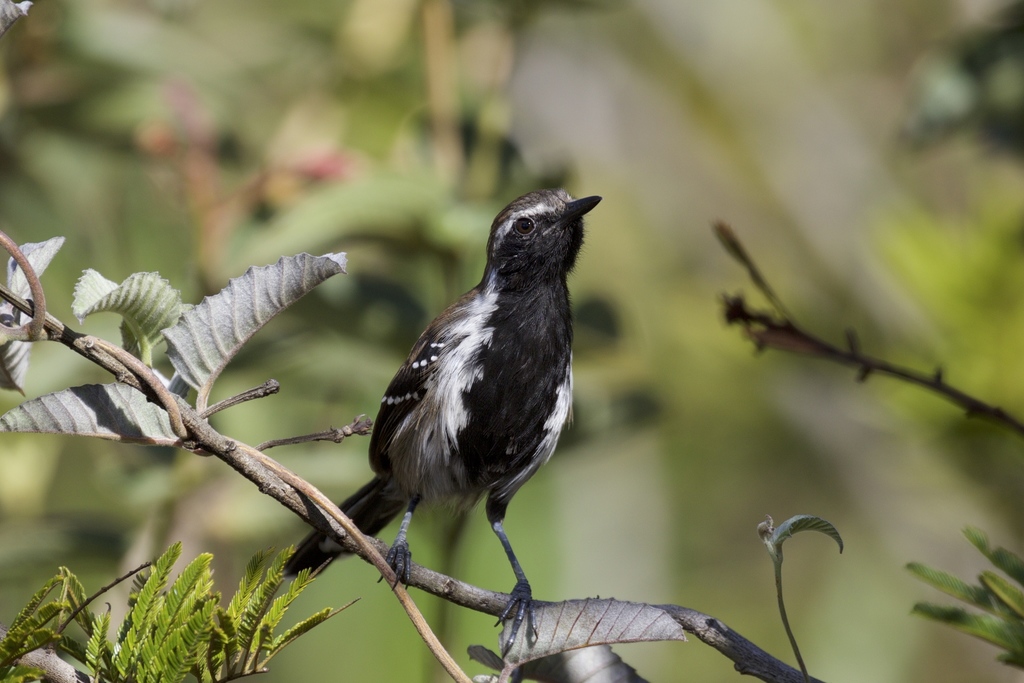
The Sincora antwren is 12 to 13 cm (4.7 to 5.1 in) long and weighs 8.5 to 11.5 g (0.30 to 0.41 oz). Adult males have a white supercilium that extends down the neck and along the sides of the breast and belly. Their crown and upperparts are generally deep brown; the color is grayer on the forehead and brighter on the mantle and scapulars. Their wing coverts are black with white spots on the ends and their flight feathers are dark brownish gray with thin brown outer edges. Their tail feathers are gray and black with narrow white tips on the central ones and wide white tips on the rest. Their face, throat, and underparts are black with deep brown flanks and gray and white underwing coverts. Adult females have a paler brown crown and back than males. They have a thin black band through the eye and their face, throat, and breast are whitish with wide black streaks. Both sexes have a dark brown iris, bare grayish black skin around the eye, dark plumbeous gray legs, and dark plumbeous gray feet with yellow soles. Males have a black bill; females have a black bill with a bluish gray base.
Range & habitat
The Sincora antwren is found in the Serra do Sincorá, part of the Espinhaço Mountains located at the eastern edge of the Chapada Diamantina region of Brazil's Bahia state. It inhabits campo rupestre, a biome characterized by scrub and grasses on poor soil among rocky outcrops, which in the Chapada Diamantina are sandstone. In elevation it ranges between 850 and 1,100 m (2,800 and 3,600 ft).
Wikipedia: “Distribution and habitat”
What it does
The Sincora antwren's diet and foraging behavior are not known but are assumed to be similar to those of others of its genus. They feed on arthropods, usually in pairs or family groups.
Wikipedia: “Feeding”
Listen
Looking for field recordings…
Where it lives
Recorded sightings
—
geo-referenced records in GBIF, from museums, herbaria and field observers.
Drag the globe to turn it. Dots are where records exist, not a range map; darker means more records.
In the stacks
Searching the stacks…
Every page naming Formicivora grantsaui in the Biodiversity Heritage Library →
This page is assembled live from iNaturalist, GBIF, Wikipedia, the Source Library and the Internet Archive. It is not yet part of the hand-edited codex. iNaturalist taxon 72863.