On eBird ↗
White-breasted Tapaculo
Live sightings near you, the range map, bar charts of when it is seen, and Macaulay Library photos and recordings.
White-breasted Tapaculo
Eleoscytalopus indigoticus
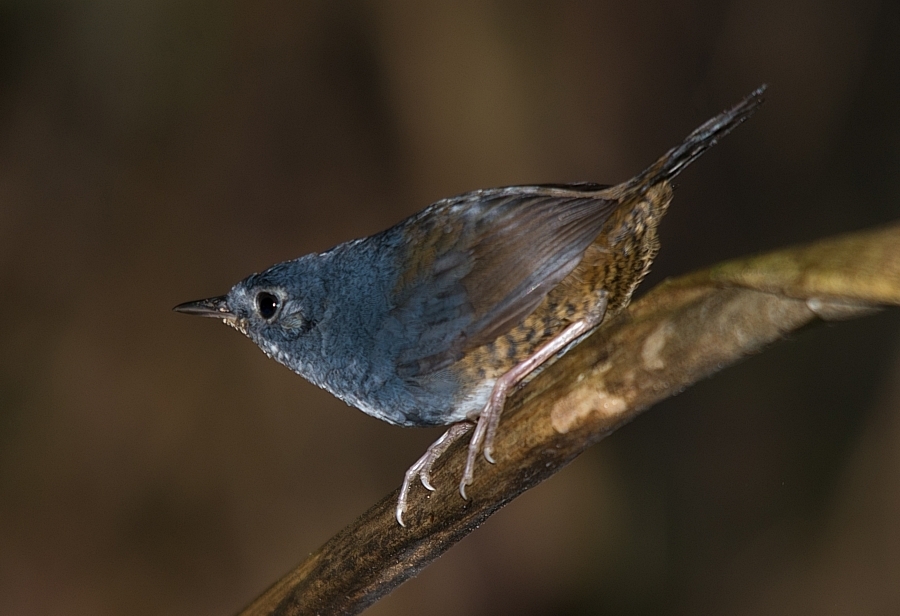
The white-breasted tapaculo (Eleoscytalopus indigoticus) is a species of bird in the Rhinocryptidae family. It is endemic to Atlantic forest in south-eastern Brazil. It is threatened by habitat loss. Together with the closely related Bahia tapaculo, it was formerly placed in the genus Scytalopus, but these two species are now known to be closer to the bristlefronts (genus Merulaxis).
From the article White-breasted tapaculo on Wikipedia (CC BY-SA), quoted section by section
Description
The white-breasted tapaculo is 11 cm (4.3 in) long. Males weigh 13 to 18 g (0.46 to 0.63 oz) and females 12.2 to 16 g (0.43 to 0.56 oz). The male's upper parts are blue-gray and its rump reddish brown. The throat, chest, and belly are white and the flanks and vent area are chestnut with dark barring. Males in a small part of its range have more extensive dark underparts. Females and immatures are similar to the males but have browner upper parts.
Range & habitat
The white-breasted tapaculo is found in Brazilian states from eastern Bahia south to northeastern Rio Grande do Sul, including western Paraná and eastern Santa Catarina. It inhabits the undergrowth of open forest, forest edges, and dense secondary forest. In elevation it ranges up to 1,500 m (4,900 ft).
Wikipedia: “Distribution and habitat”
What it does
The white-breasted tapaculo feeds on insects captured on or very near the ground.
Wikipedia: “Feeding”
Listen
Looking for field recordings…
Where it lives
Recorded sightings
—
geo-referenced records in GBIF, from museums, herbaria and field observers.
Drag the globe to turn it. Dots are where records exist, not a range map; darker means more records.
In the stacks
Searching the stacks…
Every page naming Eleoscytalopus indigoticus in the Biodiversity Heritage Library →
This page is assembled live from iNaturalist, GBIF, Wikipedia, the Source Library and the Internet Archive. It is not yet part of the hand-edited codex. iNaturalist taxon 72823.