On eBird ↗
Black-necked Swan
Live sightings near you, the range map, bar charts of when it is seen, and Macaulay Library photos and recordings.
Black-necked Swan
Cygnus melancoryphus
The black-necked swan (Cygnus melancoryphus) is a species of South American waterfowl in the tribe Cygnini of the subfamily Anserinae. It is found in Argentina, Brazil, Chile, Uruguay, and the Falkland Islands. The black-necked swan is the smallest true swan on average, weighing between 3.5–8.7 kg (7.7–19.2 lb) as adults, but it is still the largest species of waterfowl native to South America.
From the article Black-necked swan on Wikipedia (CC BY-SA), quoted section by section
Description
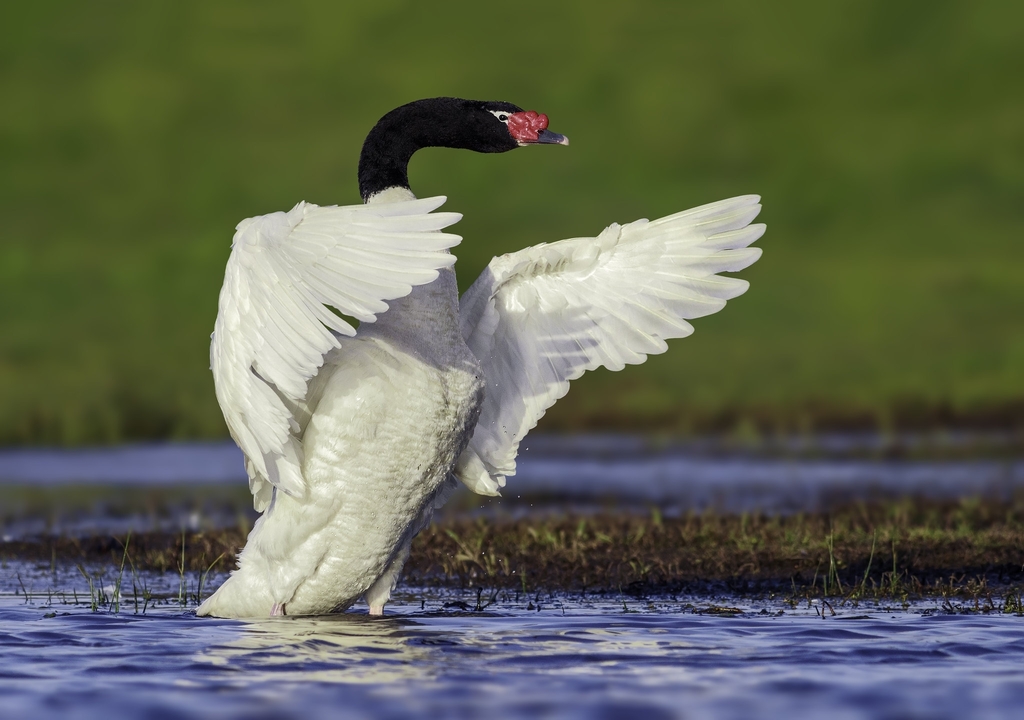
The black-necked swan is the only member of its genus that breeds in the neotropics and is the largest waterfowl native to South America. Adults can range 102 to 126 cm (40 to 50 in) in length. In wingspan, male black-necked swans averaged 160 cm (5.2 ft) in one study. In a separate study, The wingspan of males in two populations was found to range 158–178 cm (5.18–5.84 ft). Out of black-necked swans from the Carlos Anwandter Nature Sanctuary, excluding those in poor body condition, adult males were found to weigh 4.8 to 8 kg (11 to 18 lb) and females 4.1 to 7 kg (9.0 to 15.4 lb). Overall, adults weigh between 3.5–8.7 kg (7.7–19.2 lb). The black-necked swan is the lightest true swan on average. In appearance, the sexes are alike. Adults' body plumage is white and the neck and head black; the latter usually has a white stripe behind the eye. They have a prominent red knob at the base of their bill. Juveniles are grayish rather than white and lack the knob until their third or fourth year.
Range & habitat
The black-necked swan is found in the southern tier of South America. It nests from Tierra del Fuego north to central Chile, Uruguay, and Rio Grande do Sul in extreme southern Brazil. It withdraws from the southern half of Argentina in winter and is then found as far north as Brazil's São Paulo state. It is a year-round resident of the Falkland Islands. Vagrants have been found on Juan Fernández Island, the South Orkney Islands, the South Shetland Islands, and the Antarctic Peninsula. The black-necked swan inhabits freshwater marshes and swamps, shallow lakes, brackish lagoons, and sheltered coastal sites. On the mainland of South America, it is often found near human habitation but shuns built-up areas in the Falklands. It is generally found at low elevations but non-breeding flocks can be found as high as 900 to 1,250 metres (3,000 to 4,100 ft) in the Andes of southern Argentina. The wetlands created in Chile by the 1960 Valdivia earthquake, such as Carlos Anwandter Nature Sanctuary on the Cruces River, have become important population centers for the black-necked swan. The population in this sanctuary has fluctuated widely over the years, reaching a low of 214 in January 2008 and a peak of 22,419 in May 2020 before plumbing to 2,782 in May 2022.
Wikipedia: “Distribution and habitat”
What it does
The black-necked swan's diet is almost entirely vegetarian. It feeds on aquatic plants like Chara, Potamogeton, Typha; algae such as Aphantotece and Rhyzoclonium; and presumably small numbers of aquatic invertebrates. In parts of Chile its principal food is Egeria densa. It forages mostly by immersing its head and neck and by surface feeding, but also upends to reach deeper. In times of drought it has been observed grazing in meadows and pastures.
Wikipedia: “Feeding”
Listen
Looking for field recordings…
Where it lives
Recorded sightings
—
geo-referenced records in GBIF, from museums, herbaria and field observers.
Drag the globe to turn it. Dots are where records exist, not a range map; darker means more records.
In the stacks
Searching the stacks…
Every page naming Cygnus melancoryphus in the Biodiversity Heritage Library →
This page is assembled live from iNaturalist, GBIF, Wikipedia, the Source Library and the Internet Archive. It is not yet part of the hand-edited codex. iNaturalist taxon 72789.