 NL·0241
Herbarium of the Nature Library
- Name
- Aegithalos caudatus
- Family
- Aegithalidae
- Native to
- Europe, Turkey, the Caucasus and northern Iran across Siberia and Central Asia to Japan and Korea
- Habitat
- Woodland, Temperate forest, Scrub, Gardens and parks
On eBird ↗
Long-tailed Tit
Live sightings near you, the range map, bar charts of when it is seen, and Macaulay Library photos and recordings.
Long-tailed tit
Aegithalos caudatus
Also calledUzun kuyruklu baştankara (Turkish) · Schwanzmeise (German) · Mésange à longue queue (French) · Mito (Spanish) · Staartmees (Dutch)
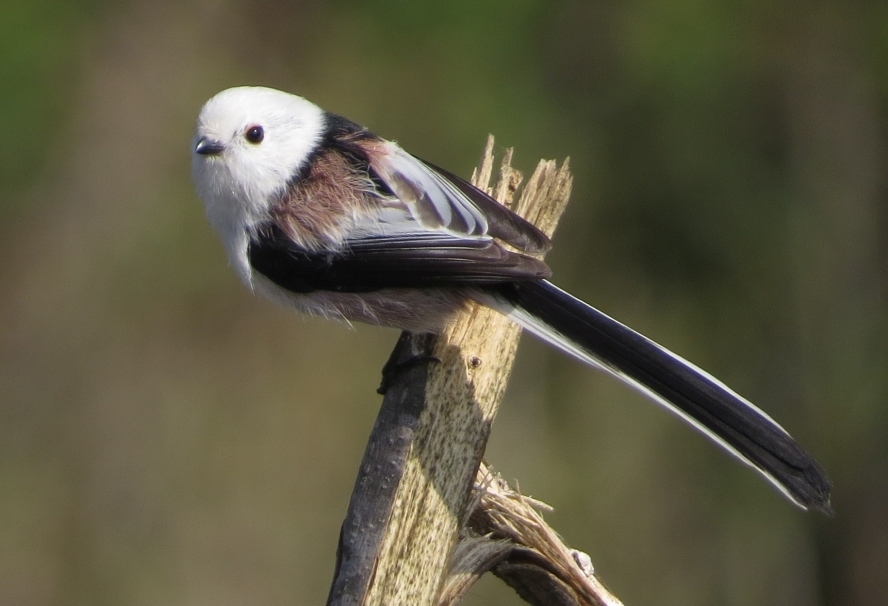
A tiny ball of fluff with a tail longer than its body, travelling through woodland in chattering family flocks. Its domed nest of moss, lichen and spider silk is one of the finest bird constructions in Europe.
The long-tailed tit or long-tailed bushtit is a common bird species belonging to the bushtit family found throughout Eurasia. An insectivore, it inhabits deciduous and mixed woodlands as well as scrub, heathland, farmland, parks and gardens. The plumage of this small long-tailed bird is predominantly black and white with varying amounts of pink and grey. Northern subspecies are paler and have completely white heads, lacking the large dark eyebrows of southern populations. It is a social bird that forms compact family flocks of six to seventeen individuals outside of the breeding season, when these flocks break up. It has a strong preference for nesting in scrub areas and often builds its nest in thorny bushes less than 3 metres above the ground. Wikipedia
What it can do
- iBuilds a stretchy, domed nest bound with spider silk and lined with up to about 2,000 feathers
- iiBirds whose own nest fails often help feed the chicks of relatives
- iiiHuddles in tight rows at night to survive cold
- ivRecognises relatives by their calls
In the field
Field marks
- aTiny round body with a very long black tail edged in white
- bPinkish shoulders and flanks
- cWhite crown with broad black stripes in western birds; pure white head in northern caudatus
- dShort, stubby bill
- Voice
- A thin, high 'tsee-tsee-tsee', a dry rolling 'tsirrup' and a short 'tup' contact call.
- Not to be confused with
- Bearded reedling is tawny and lives in reedbeds. Pied wagtail is larger, walks on the ground and wags its tail.
- Where to see it
- Woodland edges, hedgerows and garden feeders throughout Europe; white-headed birds in Scandinavia and Russia.
- When
- Resident
Listen
Looking for field recordings…
Life & habits
- Diet
- Small insects, spiders and their eggs; occasionally seeds
- Habitat
- Deciduous woodland, scrub, hedges and gardens
- Size
- 13–15 cm including a 7–9 cm tail; 7–9 g
- Lifespan
- Typically 2–3 years
Family flocks of 10–20 birds roam through trees in winter, one following another across gaps.
Where it lives
Recorded sightings
—
geo-referenced records in GBIF, from museums, herbaria and field observers.
Native range
Europe, Turkey, the Caucasus and northern Iran across Siberia and Central Asia to Japan and Korea
Drag the globe to turn it. Dots are where records exist, not a range map; darker means more records.
In the old herbals & bestiaries
Woodcuts and engravings matched from the Source Library’s scanned books by name. Plates marked “relative” show a close kin rather than this exact species. Click a plate to read the page it came from, with translation.

In the stacks
Searching the stacks…
Every page naming Aegithalos caudatus in the Biodiversity Heritage Library →
Marginalia
Its bottle-shaped nest gave it old English names such as 'bottle tit' and 'feather poke', and the white-headed Hokkaido race, 'shima-enaga', has become a popular mascot in Japan.
Curiosity
A nest can take two to three weeks to build and expands as the chicks grow, thanks to its stretchy silk and moss construction.
Kinship





Fact-checked: 1 correction made to this sheet. Photographs: iNaturalist contributors under the licences shown. Records: GBIF.org. Historical plates: Source Library (CC BY-SA 4.0; originals public domain). Summary text: Nature Library editors and Wikipedia (CC BY-SA). Medicinal and edibility notes are historical and educational, not advice. iNaturalist taxon 7278.