On eBird ↗
Chestnut-bellied Cuckoo
Live sightings near you, the range map, bar charts of when it is seen, and Macaulay Library photos and recordings.
Chestnut-bellied Cuckoo
Coccyzus pluvialis
The chestnut-bellied cuckoo (Coccyzus pluvialis) is a species of cuckoo in the Cuculidae family. The monotypic genus Hyetornis was dissolved by the American Ornithologists' Union, but this is not universally accepted. It is endemic to Jamaica. Its natural habitats are subtropical or tropical moist lowland forests and heavily degraded former forest.
From the article Chestnut-bellied cuckoo on Wikipedia (CC BY-SA), quoted section by section
Description
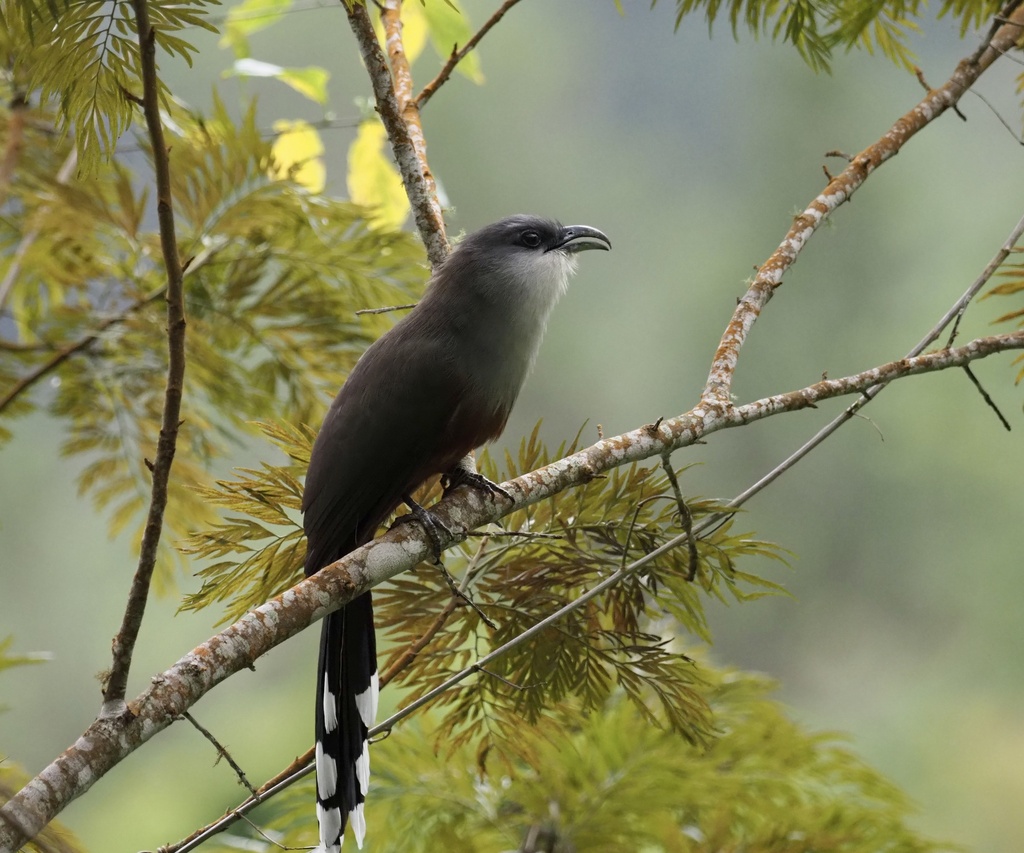
The chestnut-bellied cuckoo is 48 to 56 cm (19 to 22 in) long, about half of which is the tail, and weighs 130 to 189 g (4.6 to 6.7 oz). The species' blackish bill is stout and decurved. Males and females have the same plumage. Adults have dull brown upperparts, a light gray face and breast with a paler throat, and a dark rufous belly. Their tail is black with large white tips and a purple gloss. Juveniles have a dark brown tail with white tips but no gloss.
Range & habitat
The chestnut-bellied cuckoo is found throughout most of Jamaica. It inhabits mature evergreen forest, secondary forest, thickets and brushy areas, and semi-open woodlands. In elevation it ranges from sea level to above 1,500 m (4,900 ft).
Wikipedia: “Distribution and habitat”
What it does
The chestnut-bellied cuckoo has a varied diet that includes adult insects, caterpillars, lizards, nestling birds, and eggs. It forages mostly from the forest mid-story to the canopy, running along branches and gliding from tree to tree. It usually forages alone.
Wikipedia: “Feeding”
Listen
Looking for field recordings…
Where it lives
Recorded sightings
—
geo-referenced records in GBIF, from museums, herbaria and field observers.
Drag the globe to turn it. Dots are where records exist, not a range map; darker means more records.
In the stacks
Searching the stacks…
Every page naming Coccyzus pluvialis in the Biodiversity Heritage Library →
This page is assembled live from iNaturalist, GBIF, Wikipedia, the Source Library and the Internet Archive. It is not yet part of the hand-edited codex. iNaturalist taxon 72744.