- Animals
- ›Chordates
- ›Vertebrates
- ›Birds
- ›Hawks, Eagles, Kites, and Allies
- ›Hawks, Eagles, and Kites
- ›Snake-Eagles, Serpent-Eagles, and allies
- ›Circaetus
On eBird ↗
Beaudouin's Snake-Eagle
Live sightings near you, the range map, bar charts of when it is seen, and Macaulay Library photos and recordings.
Beaudouin's Snake-Eagle
Circaetus beaudouini
Beaudouin's snake eagle (Circaetus beaudouini) is a species of snake eagle in the family Accipitridae found in the Sahel region of west Africa. It forms a superspecies with the Palearctic short-toed snake eagle Circaetus gallicus and the black-chested snake eagle Circaetus pectoralis. This bird seems to be declining in numbers and the International Union for Conservation of Nature has rated it as a "vulnerable species".
From the article Beaudouin's snake eagle on Wikipedia (CC BY-SA), quoted section by section
Description
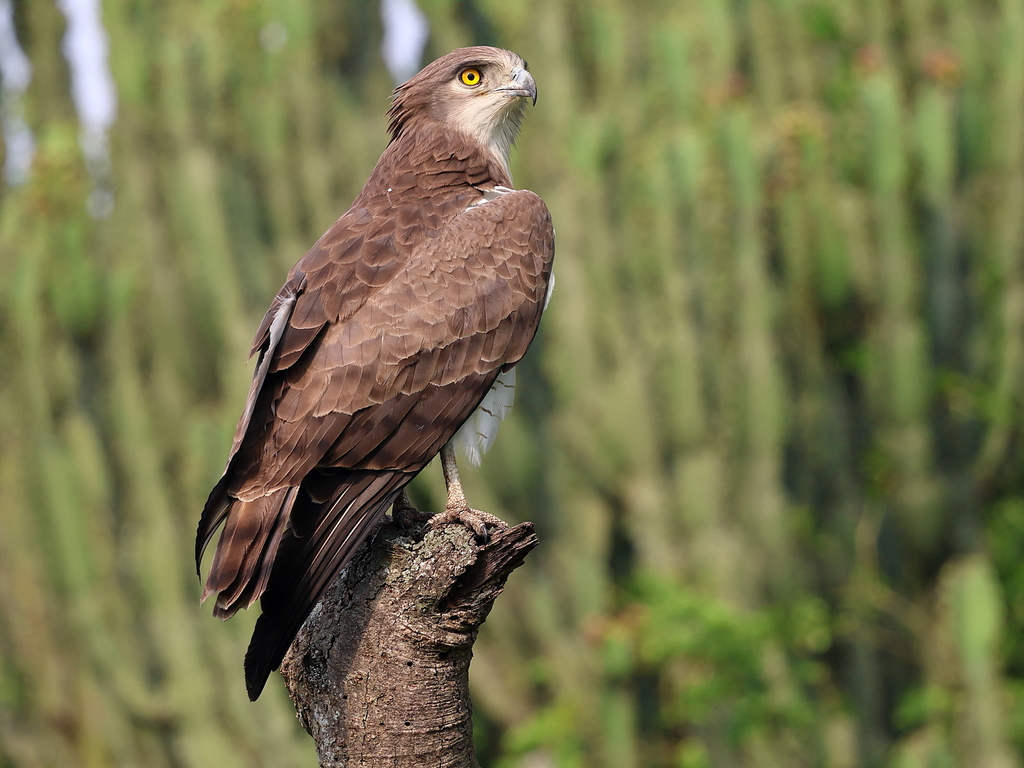
The bird has a wingspan of 170 cm (67 in). A large snake eagle with grey-brown upperparts, including the head and chest, contrasting with white underparts barred with brown and white vent. It has a black bill and large, bright yellow eyes with long pale grey, unfeathered legs. Juveniles are all dark.
Range & habitat
In a narrow band from Guinea-Bissau, Senegal and Gambia through southern Mali and Burkina Faso, Niger, northern Nigeria and Cameroon, southern Chad, Central African Republic and South Sudan. It has been recorded in Uganda but its status is uncertain in Kenya. There may be some nomadic movements, it appears to move southwards during the dry season and northwards during the rains.
Wikipedia: “Distribution”
What it does
Normally seen on a prominent perch such as a telegraph pole or dead tree, as it is a sit-and-wait hunter, rather than in flight but generally behaviour is poorly known. The diet mainly consists of snakes and other small vertebrates. It breeds in November to March in West Africa in a small stick nest at up to 25 m (82 ft) in the top of a tree. The clutch is usually a single egg. Incubation period is probably around 45 days with a fledging period which may be a further 70 days.
Wikipedia: “Behaviour”
Listen
Looking for field recordings…
Where it lives
Recorded sightings
—
geo-referenced records in GBIF, from museums, herbaria and field observers.
Drag the globe to turn it. Dots are where records exist, not a range map; darker means more records.
In the stacks
Searching the stacks…
Every page naming Circaetus beaudouini in the Biodiversity Heritage Library →
This page is assembled live from iNaturalist, GBIF, Wikipedia, the Source Library and the Internet Archive. It is not yet part of the hand-edited codex. iNaturalist taxon 72725.