On eBird ↗
Rufous-banded Owl
Live sightings near you, the range map, bar charts of when it is seen, and Macaulay Library photos and recordings.
Rufous-banded Owl
Strix albitarsis
The rufous-banded owl (Strix albitarsis) is a species of owl in the family Strigidae. It is found in Bolivia, Colombia, Ecuador, Peru, and Venezuela.
From the article Rufous-banded owl on Wikipedia (CC BY-SA), quoted section by section
Description
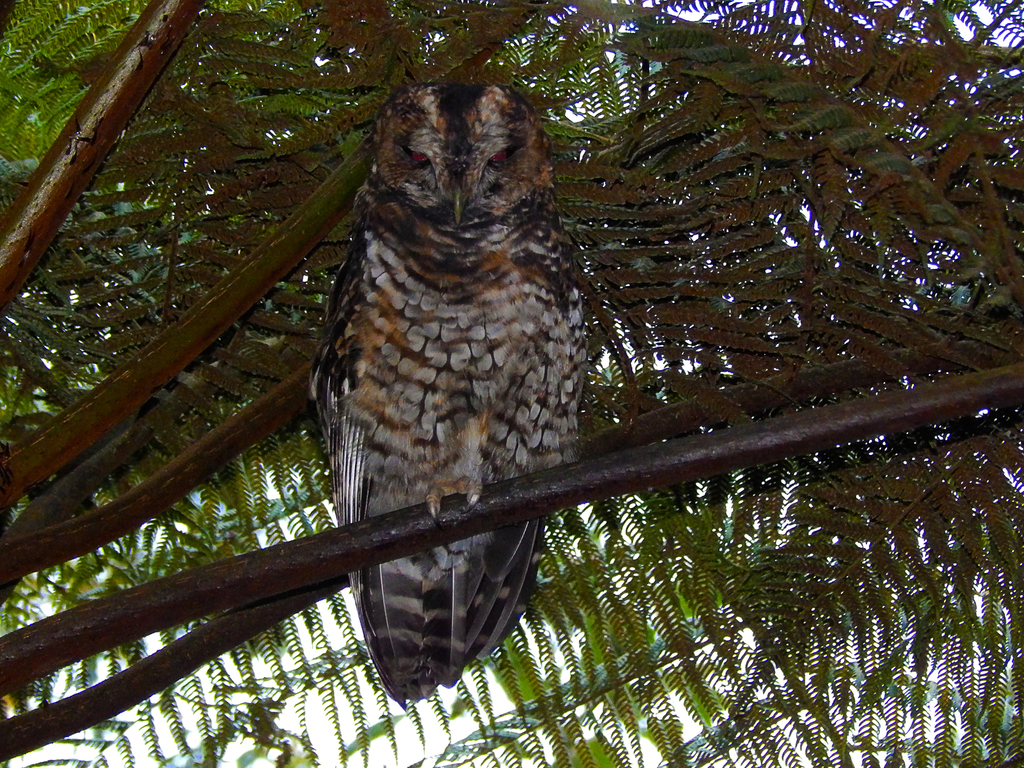
The rufous-banded owl is 30 to 35 cm (12 to 14 in) long; two specimens weighed 265 and 350 g (9.3 and 12.3 oz). It has a round head and no ear tufts. Adults have a rufous facial disk that is blacker around the orange eyes, white "brows", and white lores. The rest of the head and the upperparts are blackish brown with buffy rufous bars and spots. The tail is also blackish brown, with lighter bars. The chest is dark brown with whitish and tawny bars and spots. The rest of the underparts are silvery white and rufous brown in an ocellated ([1]) pattern. The juvenile is buffy with a blackish mask.
Range & habitat
The rufous-banded owl is found in the Andes from northern Venezuela south to western and southern Bolivia. The IOC places the nominate subspecies in Venezuela, Colombia, and Ecuador; S. a. opaca in Peru, and S. a. tertia in Bolivia. The species inhabits humid evergreen montane forest and cloudforest that have a dense understory, epiphytes, and mosses. In Venezuela it has also been recorded in more open areas adjoining dense forest. In elevation it ranges from about 1,700 to 3,700 m (5,600 to 12,100 ft).
Wikipedia: “Distribution and habitat”
What it does
The rufous-banded owl is nocturnal and becomes active soon after dark. It forages in the forest canopy and has been reported to forage from perches at the edge of forest. Its diet has not been studied but is probably insects and small mammals.
Wikipedia: “Feeding”
Listen
Looking for field recordings…
Where it lives
Recorded sightings
—
geo-referenced records in GBIF, from museums, herbaria and field observers.
Drag the globe to turn it. Dots are where records exist, not a range map; darker means more records.
In the stacks
Searching the stacks…
Every page naming Strix albitarsis in the Biodiversity Heritage Library →
This page is assembled live from iNaturalist, GBIF, Wikipedia, the Source Library and the Internet Archive. It is not yet part of the hand-edited codex. iNaturalist taxon 72673.