On eBird ↗
Bushtit
Live sightings near you, the range map, bar charts of when it is seen, and Macaulay Library photos and recordings.
Bushtit
Psaltriparus minimus
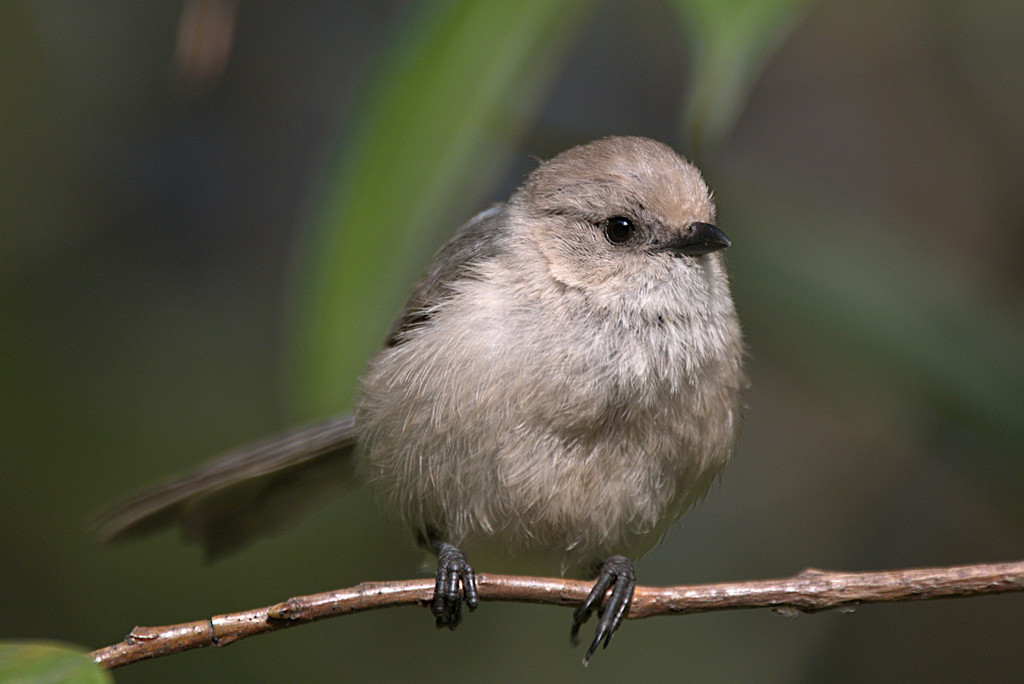
The American bushtit, or simply bushtit (Psaltriparus minimus), is a social songbird belonging to the monotypic genus Psaltriparus. It is one of the smallest passerines in North America and it is the only species in the family Aegithalidae found in the Americas; the other eleven species occur in Eurasia.
The American bushtit's distinguishing characteristics are its tiny size, its plump and large head, and its long tail. Its range stretches from Vancouver in Canada, south through the Western United States, via the Great Basin, the lowlands and foothills of California, the highlands of Mexico, to Guatemala. Bushtits usually inhabit mixed open woodlands, which contains oaks and a scrubby chaparral understory. They can also be found residing in gardens and parks. Their food source is small insects, primarily, and spiders in mixed-species feeding flocks.
From the article American bushtit on Wikipedia (CC BY-SA), quoted section by section
Description
With a length of 100–110 mm (3.9–4.3 in) and a weight of 4.5–6 g (0.16–0.21 oz), the American bushtit is one of the smallest passerines in North America. It is mostly gray-brown, with a large head, short neck, long tail, and small, stubby beak. American bushtits have different characteristics based on their sex and habitats. The male has dark brown to black eyes while the adult female has yellow eyes. Additionally, bushtits resident near the coast tend to have a brown "cap" or "crown", while those further inland have a brown "mask" on their face, and those in Mexico and Central America have a black cheek. This feature does not occur in the northern part of the American bushtits' range and in the United States is confined to near the Mexican border, mainly in Texas. None of the bushtits in that location with the black ear patch are adult females; the majority of them are juvenile males with one or two dark lines on their faces rather than a whole patch. Only from the northeastern Mexican highlands and farther south does the black-eared variant become more prevalent; all males have a full black ear patch, and even mature females have a black arc covering their eyes and typically a black line across them.
What it does
Bushtits usually inhabit mixed open woodlands, which contains oaks and a scrubby chaparral understory. It can also be found residing in gardens and parks. It lives under the highland parts of Mexico and the western United States to Vancouver, via the Great Basin, the lowlands and foothills of California, southern Mexico, and Guatemala. The American bushtit has an active and social demeanor. This species forms flocks of 10 to 40 individuals of various species, including chickadees and warblers, to forage for tiny insects and spiders. Group members frequently communicate with one another through brief calls.
Nesting. Both the males and females work together to construct the hanging nest, which can take up to a month to complete. The nest features a hole near the top that goes down into the nest bowl, and it hangs up to a foot below its anchor point. Using spider webs and plant material, the adults create an elastic sac. Occasionally, they sit inside the nest while it's still being built, which stretches it downward. They cover the outside with fragments of adjacent plants, including the tree the nest is made in, and add insulating materials like feathers, fur, and downy plant debris. All the adults connected to the nest, including the breeding pair and helpers, sleep there when it's in use. Typically, the couple uses the same nest for their second brood of the year. …
Wikipedia: “Behavior”
In human culture
The name "bushtit" has its earliest known origins in the Latin word Parus, which stands for titmouse. The tit in titmouse comes from the Old Icelandic word titr, meaning something small.
Wikipedia: “Etymology”
Listen
Looking for field recordings…
Where it lives
Recorded sightings
—
geo-referenced records in GBIF, from museums, herbaria and field observers.
Drag the globe to turn it. Dots are where records exist, not a range map; darker means more records.
In the stacks
Searching the stacks…
Every page naming Psaltriparus minimus in the Biodiversity Heritage Library →
This page is assembled live from iNaturalist, GBIF, Wikipedia, the Source Library and the Internet Archive. It is not yet part of the hand-edited codex. iNaturalist taxon 7266.