On eBird ↗
Spotted Puffbird
Live sightings near you, the range map, bar charts of when it is seen, and Macaulay Library photos and recordings.
Spotted Puffbird
Bucco tamatia
The spotted puffbird (Bucco tamatia) is a species of puffbird in the family Bucconidae. It is found in Bolivia, Brazil, Colombia, Ecuador, French Guiana, Guyana, Peru, Suriname, and Venezuela. Its natural habitats are subtropical and tropical swamps and heavily degraded former forest.
From the article Spotted puffbird on Wikipedia (CC BY-SA), quoted section by section
Description
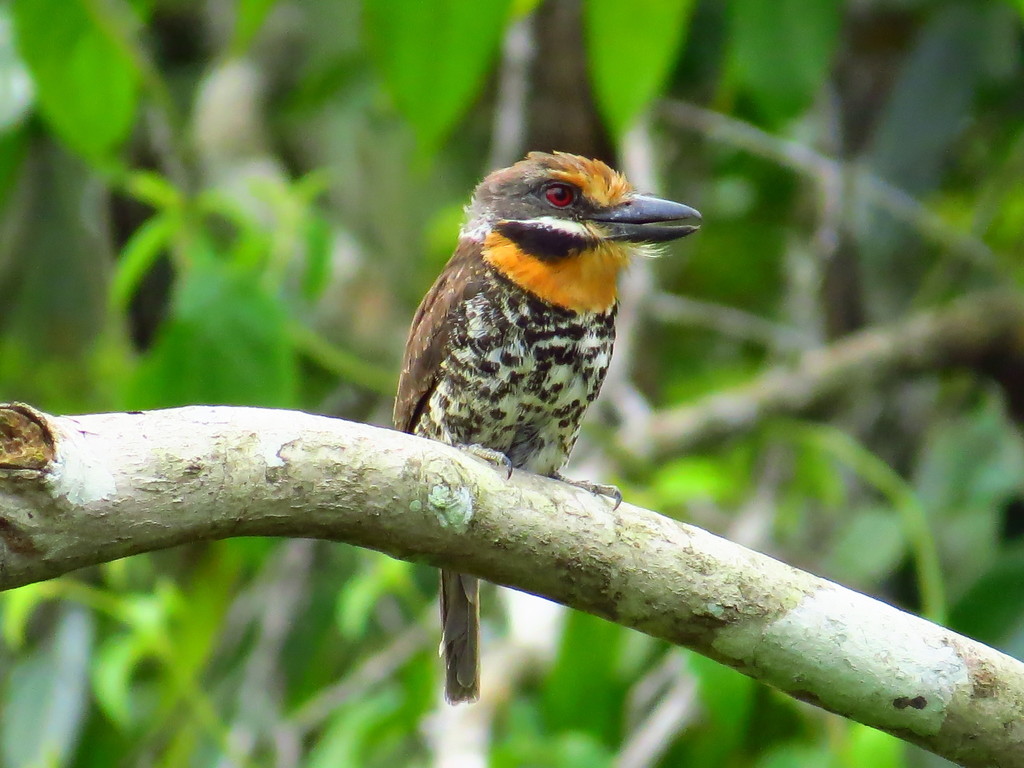
The spotted puffbird is about 18 cm (7.1 in) long and weighs 33 to 42 g (1.2 to 1.5 oz). The nominate subspecies has a pale rufous forehead that becomes rufous spots on a dark brown background on the crown. Below that is a blackish band through the eye, below that a white stripe, and below that a black patch. The white stripe continues around the nape. The upperparts and wings are dark brown with some buffy scallops and the tail is dark brown with some buffy edges to the feathers. The chin is white, the throat rufous, the breast and flanks whitish with black spots and scales, and the belly and vent white with small black spots. The bill is black, the eye bright red, and the feet dark gray or greenish. B. t. pulmentum's throat is much paler than the nominate's, the forehead brighter, and the spotting heavier. B. t. hypnaleus is larger than the nominate but with a smaller bill, and the spotting on its underside is heavier especially on the breast. The spotted puffbird's song is "a series of 10–20 soft, whistled 'chyoi' or 'puwéep' notes (c. 2 per second), weak and hesitant at first, then a few at lower pitch and slower, ending with c. 4 inflected 'pchooii, pchooii, pchooii, peejowee' whistles". It is usually sung at dawn and sometimes sung as a duet. It also makes "faint wheezy whistles" in a dispute.
Range & habitat
The nominate subspecies of spotted puffbird is found from eastern Colombia east through Venezuela and the Guianas into Brazil and south in Brazil to the left (north) bank of the Amazon River. B. t. pulmentum is found from southeastern Colombia south through eastern Ecuador, northeastern Peru, and western Brazil into northeastern Bolivia. B. t. hypnaleus is found in Amazonian Brazil east of the Tapajós River. The species inhabits a variety of somewhat open landscapes such as várzea and igapó forests, mature secondary forest, savanna woodland, and gallery forest. It seldom occurs in the interior of dense forest. In elevation it generally ranges from sea level to 1,400 m (4,600 ft) but in Venezuela it usually occurs below 700 m (2,300 ft).
Wikipedia: “Distribution and habitat”
What it does
The spotted puffbird usually forages from a low perch, sallying out to pluck prey from foliage or bark. It sometimes follows army ant swarms. Its diet includes many types of insects, other invertebrates such as spiders and scorpions, small lizards, and mistletoe berries.
Wikipedia: “Feeding”
Listen
Looking for field recordings…
Where it lives
Recorded sightings
—
geo-referenced records in GBIF, from museums, herbaria and field observers.
Drag the globe to turn it. Dots are where records exist, not a range map; darker means more records.
In the stacks
Searching the stacks…
Every page naming Bucco tamatia in the Biodiversity Heritage Library →
This page is assembled live from iNaturalist, GBIF, Wikipedia, the Source Library and the Internet Archive. It is not yet part of the hand-edited codex. iNaturalist taxon 72576.