- Animals
- ›Chordates
- ›Vertebrates
- ›Birds
- ›Perching Birds
- ›Ovenbirds and Woodcreepers
- ›Typical Ovenbirds
- ›Asthenes
On eBird ↗
Puna Thistletail
Live sightings near you, the range map, bar charts of when it is seen, and Macaulay Library photos and recordings.
Puna Thistletail
Asthenes helleri
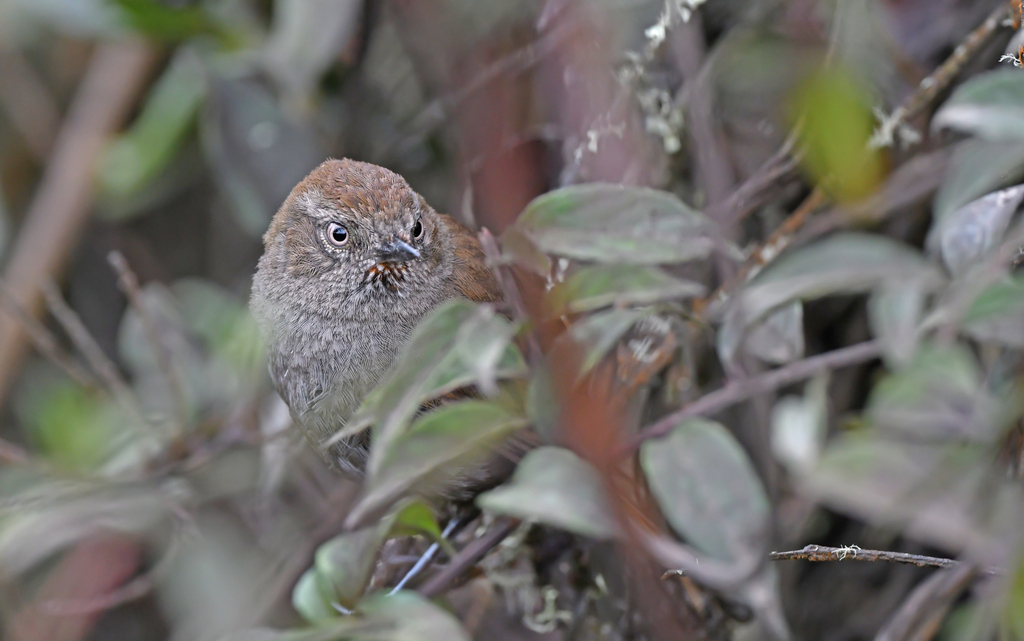
The puna thistletail (Asthenes helleri) is a species of bird in the Furnariinae subfamily of the ovenbird family Furnariidae. It is found in Peru and far-western Bolivia.
From the article Puna thistletail on Wikipedia (CC BY-SA), quoted section by section
Description
The puna thistletail is 17 to 18.5 cm (6.7 to 7.3 in) long and weighs 13 to 17 g (0.46 to 0.60 oz). The sexes have the same plumage. Adults have a brownish gray face with a grayish supercilium. Their crown is dark rufescent-brown with a grayer forehead. Their back, rump, and wings are dark rufescent brown. Their tail is a brighter rufescent brown; it is long and deeply forked with few barbs at the feather ends. Their chin is white, in some areas with a small rufous center. Their throat has a blackish patch with pale gray flecks. Their underparts are mostly gray with a brownish tinge on the flanks and undertail coverts. Their iris is brownish gray, gray, or pale tan, their maxilla black to gray, their mandible gray to whitish with a dark tip, and their legs and feet gray to bluish gray.
Range & habitat
The puna thistletail is found from Peru's Department of Cuzco southeast into Bolivia's La Paz Department. It inhabits elfin forest at the tree line ecotone, usually areas with a dense understory of Chusquea bamboo. In elevation it ranges between 2,700 and 3,700 m (8,900 and 12,100 ft).
Wikipedia: “Distribution and habitat”
What it does
The puna thistletail is thought to feed mostly on arthropods. It forages singly or in pairs, usually in the understory though sometimes higher. It takes its prey by gleaning from foliage, small branches, and moss.
Wikipedia: “Feeding”
Listen
Looking for field recordings…
Where it lives
Recorded sightings
—
geo-referenced records in GBIF, from museums, herbaria and field observers.
Drag the globe to turn it. Dots are where records exist, not a range map; darker means more records.
In the stacks
Searching the stacks…
Every page naming Asthenes helleri in the Biodiversity Heritage Library →
This page is assembled live from iNaturalist, GBIF, Wikipedia, the Source Library and the Internet Archive. It is not yet part of the hand-edited codex. iNaturalist taxon 72541.